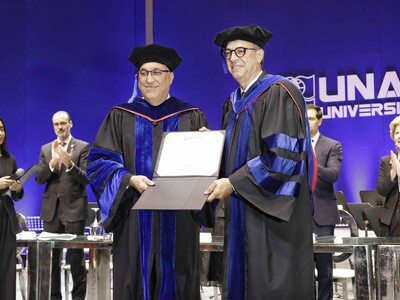
Writer, poet, essayist, and philosopher José Mármol has received the degree of Doctor Honoris Causa from Universidad APEC during a formal ceremony at the Eduardo Brito National Theatre in Santo Domingo.
The honorary doctorate is the highest distinction awarded by the university. It was granted to Mármol in recognition of a career spanning more than four decades in literature, philosophical thought, education, and the promotion of Dominican culture.
The recognition comes as Mármol is also set to be celebrated as the dedicated figure of the 28th Santo Domingo International Book Fair 2026.
Academic ceremony at the National Theatre
The solemn event took place in the Carlos Piantini Hall of the Eduardo Brito National Theatre. The gathering brought together academic authorities, education representatives, writers, intellectuals, and prominent figures from the cultural and business sectors of the Dominican Republic.
Among those in attendance were First Lady of the Republic Raquel Arbaje, Minister of Culture Roberto Ángel Salcedo, Council of Past Presidents president Norma Rivera de Vargas, and organizational president Carlos Alberto Ortega.
Highlighting the honoree's contributions to the development of Dominican letters and humanistic education, Unapec Rector Erik Pérez Vega said that granting the honorary doctorate to Mármol, whom he described as one of the most prominent figures in contemporary Dominican literature, represented a great honor for Universidad APEC.
During the proceedings, Alejandro Moscoso Segarra, dean of the Faculty of Law and Humanities at Unapec, read the official biographical sketch outlining Mármol's career and achievements.
Background on Unapec and the Eduardo Brito Theatre
Universidad APEC, known as Unapec, is a private higher education institution headquartered in Santo Domingo. Founded in 1965, the university focuses on business management, technology, and humanities, playing a central role in academic life across the Dominican Republic.
The Eduardo Brito National Theatre serves as a major cultural venue in the capital city. Located in Santo Domingo's Plaza de la Cultura, its main auditorium, the Carlos Piantini Hall, regularly hosts national honors, cultural performances, and academic convocations.
Address on education, ethics, and technology
In his acceptance speech, Mármol focused on the essential role of education, the necessity of defending critical thinking, and the ethical dilemmas posed by rapid technological advancement.
Mármol stated that education must form free citizens equipped with reasoning skills, moral conscience, and human values. He noted that this foundational ideal maintains full relevance in the 21st century.
Addressing current challenges, the writer observed that despite increases in educational investment, significant problems persist regarding student learning quality and skills. He emphasized that strengthening technical, pedagogical, and humanistic training for teachers is essential to resolving these shortcomings.
Preserving humanity in the era of artificial intelligence
Mármol also warned against the uncritical adoption of technology and artificial intelligence. He argued that technological tools should serve human creativity and transformation rather than replacing fundamental human faculties such as thinking, creating, developing language, and preserving memory.
Advocating for a balanced perspective, Mármol cautioned against both total rejection of technology and its unrestricted adoption. He linked these technological challenges to the urgent need to maintain a humanistic outlook amid rapid digitization, warning of the dangers of technology divorced from ethical principles and human dignity.
Concluding his remarks, the laureate reflected on his relationship with writing and poetry, describing literary creation as a vital necessity and a means to safeguard memory, identity, and the human condition. Mármol expressed that he writes in order to think, feel, and leave a mark of his existence, concluding with a call for human responsibility to build and transform the world rather than destroy it.