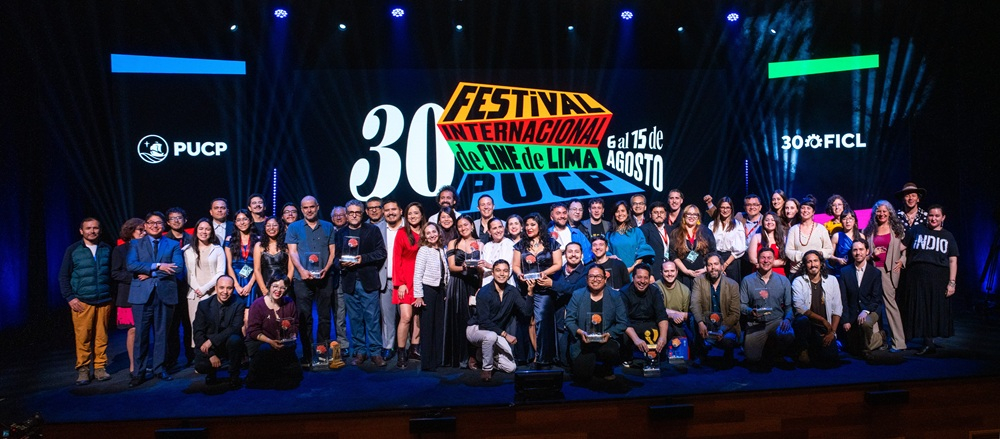
The Mexican film Seis meses en el edificio rosa con azul, directed by Bruno Santamaria Razo, won the top fiction prize at the 30th Lima Film Festival.
The feature, which premiered at the Cannes Film Festival, also received the Spondylus award for best film with an LGTBIQ+ theme.

Set in Mexico during the early 1990s, the story follows an eleven-year-old boy named Bruno who feels attracted to his best friend while his family copes with his father's HIV diagnosis. Upon accepting the festival's main Spondylus trophy, Santamaria Razo said that in community they built something they wanted to share that excited, pained, and brought them together. He echoed remarks made by actresses Rocio Guzman and Darana Alvarez, who shared the best actress award for their work in Chicas tristes.
The Lima Film Festival, held annually in the Peruvian capital, is one of South America's major showcases for Latin American cinema. Its main awards are symbolized by the Spondylus trophy, named after a sea shell historically prized in pre-Columbian Andean culture. This year's milestone 30th edition focused on productions depicting vulnerable social settings, political dictatorships, public policies, and gender violence.
Major Fiction Awards and Speeches
The Argentine production La noche esta marchandose ya, directed by Ramiro Sonzini and Ezequiel Salinas, earned multiple honors on Saturday. The film won best first work, the international critics jury award for best film, the International Labour Organization award for best film in the Latin American fiction competition, and the APC Signis Peru award from the Association of Communicators.
The movie centers on a former film club projectionist who takes a job as a security guard after losing his employment, yet continues watching cinema. Sonzini expressed hope that independent film spaces would grow and connect with people to prevent isolation, while Salinas emphasized the importance of public cinema. Salinas added that cinema is not a luxury, but a fundamental right to tell the story of communities and cities like Cordoba.
The Chilean, Argentine, and Italian coproduction Hangar Rojo won several main awards in the fiction category. Juan Pablo Sallato received the jury award for best direction, while Nicolas Zarate was named best actor. Diego Pequeno took best cinematography, an honor awarded by the Peruvian Association of Cinematographic Authors of Photography and the Latin American Federation of Cinematographic Photography Authors. The film also won the APRECI prize, with Sallato highlighting the necessity of remembering the actions of past dictatorships.
The special jury award went to La hija condor, directed by Alvaro Olmos Torrico as a joint effort between Bolivia, Peru, and Uruguay, with Nicolas Wong Diaz receiving a jury honorable mention for cinematography. Olmos Torrico stated on stage that filmmakers would resist external pressure, noting that Bolivia had completely eliminated its culture ministry and state offices weeks earlier. Meanwhile, Fernanda Tovar won best screenplay for Chicas tristes, a Mexican, French, and Spanish coproduction whose star Darana Alvarez remarked that it is vital for cinema to portray reality.
Peruvian Competition and Regional Cinema
In the Peruvian competition, director Luisa Garcia Alva won best Peruvian film and the Ministry of Culture award for her personal documentary Manuales de supervivencia. Garcia Alva explained that when she was diagnosed with HIV ten years ago, her mother agreed not to tell anyone, but her mother proudly applauded at the premiere and invited friends to screenings. Garcia Alva praised the power of cinema to transform relationships and thanked her crew for guiding her through personal doubts.
Samuel Urbina won best direction in the Peruvian competition for Aquella sombra desvanecia, a feature filmed in Piura. Urbina called for protecting and promoting regional cinema across Peru's diverse territories. The special jury award in the Peruvian category was awarded to Ellas, directed by Eduardo Mendoza de Echave.
The PUCP Community Award for best Peruvian film in competition went to La anatomia de los caballos, directed by Daniel Vidal Toche. Vidal Toche noted that thirty-three thousand spectators attended the festival, demonstrating that audiences view cinema as more than entertainment and as a way to challenge governments across Latin America. In the overall audience vote across fiction, documentary, and Peruvian categories, the prize went to Comparsa, directed by Vickie Curtis and Doug Anderson.
Documentary Winner and Festival Tribute
In the Latin American documentary competition, the jury award for best documentary was presented to Relicto, directed by Colombian filmmaker Guillermo Quintero and coproduced with France.
The 30th edition featured an official tribute to Oscar-nominated Brazilian director Kleber Mendonca Filho, known for Bacurau and The Secret Agent. Honored at the closing ceremony for his career depicting social and political issues, Mendonca Filho described film festivals as schools and dedicated his award to young cinephiles, his children, and his wife, producer Emilie Lesclaux. He observed that cinema remains a powerful tool to break official narratives in a complex global political climate across North America, Latin America, and Europe.