Ukrainian residents in Kyiv are facing round-the-clock attacks from Russian drones as Moscow intensifies its aerial bombardment of the capital city.
The shift to continuous day-and-night strikes marks a change from previous Russian tactics, which primarily targeted the city of three million people during nighttime hours. Air sirens now sound multiple times throughout the day, forcing citizens to constantly adjust their daily routines.
As military developments on the front line grow more difficult for Russian forces, Moscow has escalated its air attacks against Ukraine's capital while Ukrainian military officials seek solutions to counter a new generation of Russian drones.
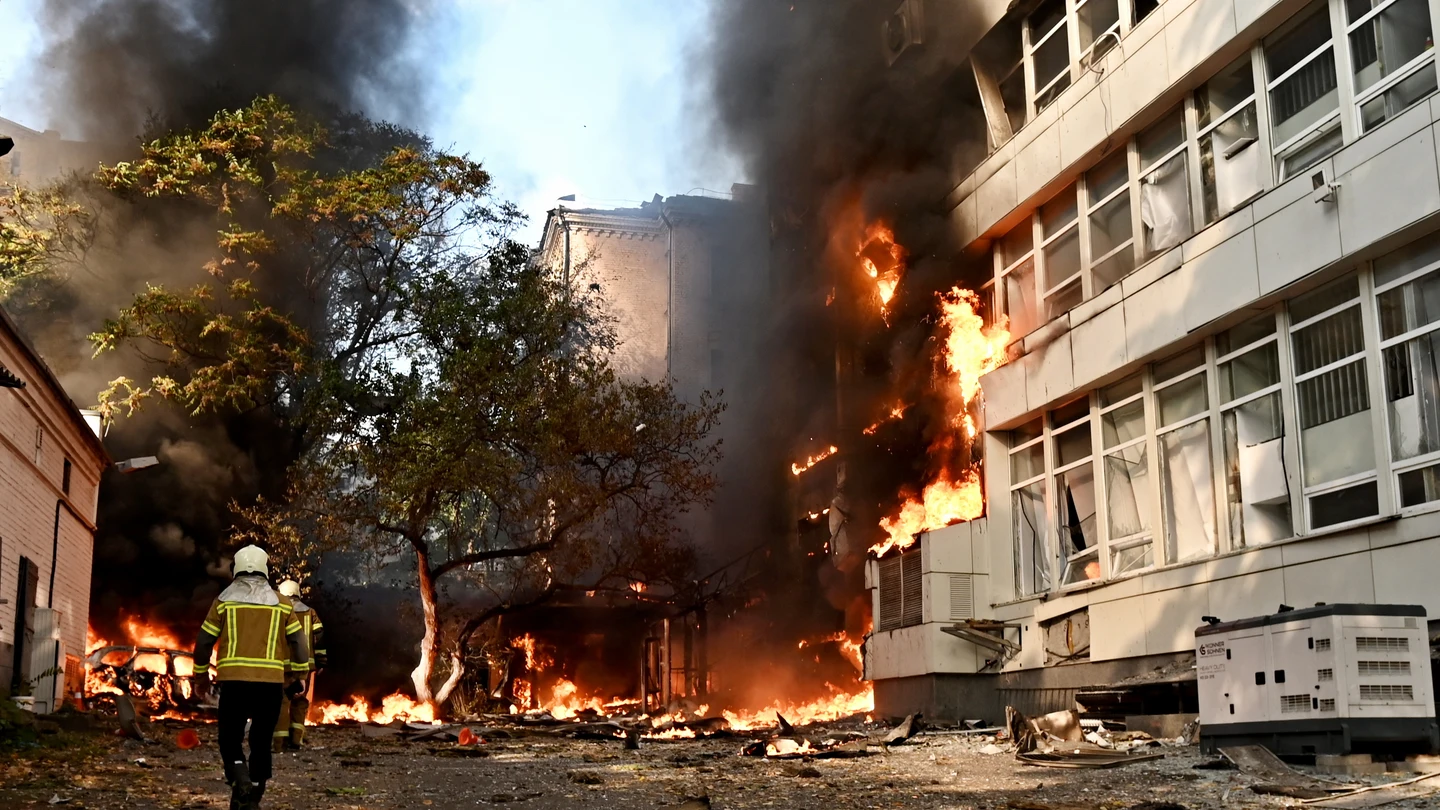
On Tuesday, Kyiv was still recovering from daytime strikes on Monday that hit a hospital and the National Academy of Sciences of Ukraine in broad daylight. The bombardment killed at least two people and injured 26 others, forcing victims to escape from burning buildings through windows.
The National Academy of Sciences, located in Kyiv, serves as the country's main state-sponsored scientific research institution. Monday's strike represented one of the most direct daytime hits on major civilian infrastructure in the center of the capital in recent months.
Strikes Hit Capital Infrastructure
On Tuesday morning, Russian forces launched several ballistic missiles and more than 150 drones across Ukraine. Ballistic missiles are high-speed weapons that follow an arched trajectory and deliver heavy explosive warheads, making them particularly difficult for air defense systems to intercept.
Two missile warheads, each weighing half a ton, landed just meters from large residential apartment buildings during the morning assault. At least one person was injured in the missile strikes.
In Kyiv, the bombardment damaged a railway station depot, business centers, and data centers. Meanwhile, in the southern Odesa region, an important Black Sea maritime hub for international cargo, Russian strikes damaged two foreign commercial vessels.
Despite the frequency of the air sirens, many Kyiv residents attempt to ignore the warnings in order to maintain a sense of normal daily life. However, basic errands have become increasingly complicated as major supermarkets, post offices, and gas stations close during air raid alarms, which can last for half the day or longer.
Daily Life Disrupted by Frequent Air Alarms
Olena Semeniak, a Kyiv copywriter who now works from home, spent a recent night in a basement serving as an air raid shelter. She told La Razón that residents try to continue their daily tasks while monitoring local drone-tracking channels on social media platforms.
Semeniak described buying just two small items as an odyssey after she and her family arrived back home to the sound of nearby explosions. The disruption has led many workers across the capital to shift to remote work when possible.
Other residents reported a growing psychological toll from the relentless bombardment. Ludmila Golovko, a 36-year-old resident of Kyiv, said she had never previously felt so intensely that she could die at any given moment.
Golovko noted that when walking past destroyed buildings or riding on a city bus, she almost visualizes a drone arriving to end her life, adding that the fear has become a constant presence. Despite the anxiety, both Golovko and Semeniak plan to remain in the capital unless conditions become unlivable.
To cope with the ongoing stress, Golovko spends more time gardening to keep herself anchored against the endless flow of bad news. She emphasized that she will continue working and living in the city despite her fear, while volunteering at a local blood donor center and attending a dance studio.
Ukrainian Air Defenses Face New Jet Drones
Ukrainian air defense forces are currently intercepting 57 percent of Russian jet-powered drones, compared to an interception rate of 90 percent for older propeller-driven models. Ukrainian military units are currently testing specialized interceptors designed to counter these faster aerial threats.
Military analysts note that mass production of the new interceptor systems could take several months to establish. In the interim, Russian forces are attempting to maximize physical and structural damage across Ukrainian cities before new defense capabilities can be fully deployed.
The technical shift comes as the Kremlin prepares for a prolonged conflict. Russia is set to increase its military spending by 27 percent to record levels in 2027. Officials in Moscow have shown no indication of opening negotiations for even a limited ceasefire, hoping instead to cause Ukraine's economic collapse and weaken international support from Western partners.
Public Support Remains High Amid Winter Concerns
Despite the intensifying strikes, public determination remains strong across the country. According to a recent survey, 82 percent of Kyiv residents and 77 percent of all Ukrainians believe the nation must continue its military defense even if Russia increases attacks on the energy grid to plunge cities into darkness.
Ukrainians have drawn encouragement from successful frontline operations and overnight strikes inside Russian territory, where oil refineries are targeted on a near-nightly basis. In the Donetsk region of eastern Ukraine, a counteroffensive launched from Lyman has pushed Russian forces out of five additional villages, while Russian troops have failed to achieve rapid advances elsewhere on the front.
Lyman, a strategic railway junction in the Donbas region, was previously liberated by Ukrainian troops in late 2022 and continues to serve as a key staging ground for defensive and offensive maneuvers in eastern Donetsk.
The experience of last winter, which was marked by sub-zero temperatures, severe electrical blackouts, and heating disruptions, has given residents hope that Russia will again fail to crush Ukrainian resolve. Nevertheless, upcoming power cuts and air attacks are expected to cause further casualties and economic hardship.
Attacks targeting major commercial enterprises, including metallurgical plants and large retail distribution chains, will likely leave tens of thousands of workers without employment across the country.
In response, many Kyiv citizens have taken personal precautions by purchasing portable generators, power banks, and storage batteries. The Ukrainian government has assured the public that it has prepared more emergency repair crews and backup equipment than was available prior to last winter.
Decentralized internet networks and resilient fuel supply lines also provide hope that essential services will remain operational throughout the coming months. With Moscow pursuing the total defeat of Ukraine, residents say they see no alternative but to continue resisting and hoping that foreign allies maintain firm support.