

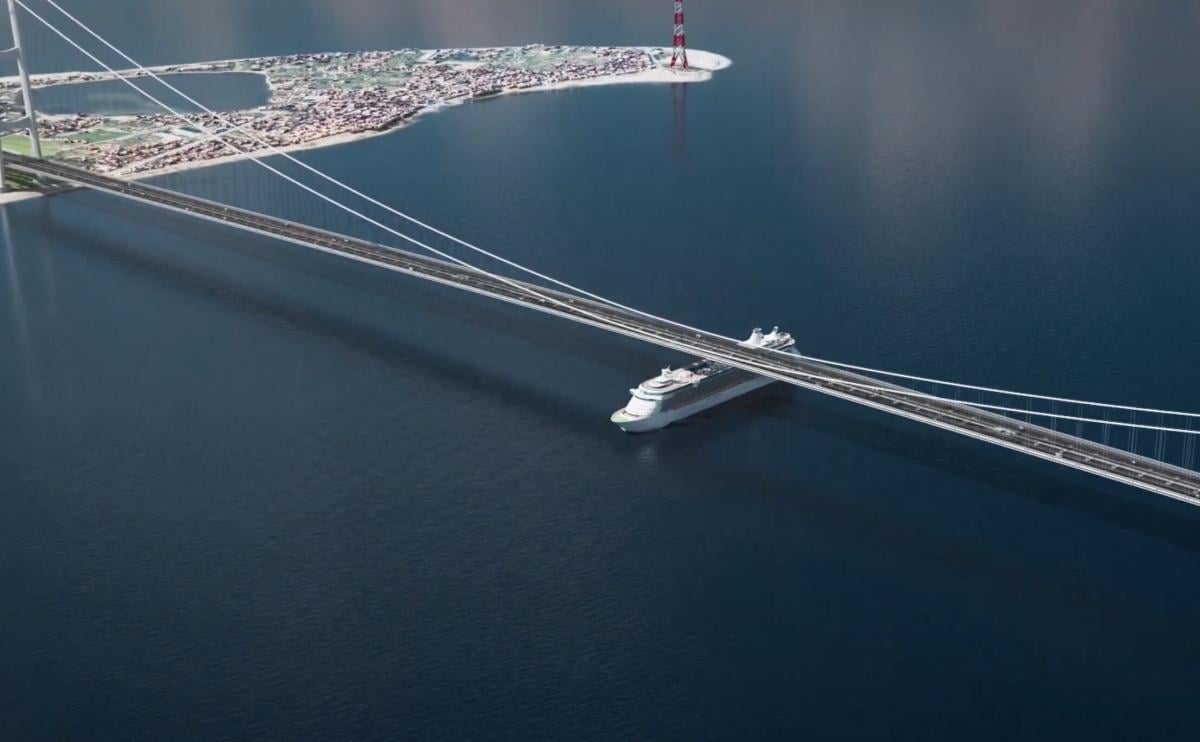
Italy has approved the construction of the world's longest suspension bridge to connect the island of Sicily with the Italian mainland.
The project carries an estimated cost of 11.5 billion pounds, with completion expected between 2032 and 2033, according to a report by Express.
The bridge across the Strait of Messina will span a total length of 3,666 metres. It will feature six lanes for road vehicles alongside two railway tracks, offering a maximum capacity of 6,000 cars per hour and 200 trains per day.
Suspension bridges use heavy steel cables hung between tall towers to hold up the road deck over wide stretches of water. Currently, the longest bridge of any type in the world is the Hong Kong-Zhuhai-Macao bridge, which spans 55 kilometres.
Engineered for extreme conditions
Two massive support towers reaching a height of 399 metres will anchor the structure. That height makes the towers taller than the Empire State Building, the famous skyscraper in New York City.
Engineers had to prioritize seismic safety because the crossing sits directly over the boundary where the African and Eurasian tectonic plates meet. Tectonic plates are massive slabs of the Earth's crust whose movements trigger earthquake activity.
Information on the project website states that the bridge features a wing-like aerodynamic profile designed to withstand wind speeds of up to 216 kilometres per hour. The website also notes that the structure is built to endure earthquakes measuring up to 7.1 on the Richter scale.
Toll costs and regional travel
Drivers using the new bridge will be charged a toll ranging between 4 and 7 euros per car journey.
Project organisers stated that the collected tariffs will cover the construction cost over the course of the concession period. The funds will also pay for ongoing operational expenses as well as routine and emergency maintenance.
The report added that the bridge will establish a seamless connection between Sicily and Calabria, the region at the southern toe of the Italian mainland. Crossing costs under the scheme will be significantly lower than current fares for taking a ferry across the strait.


