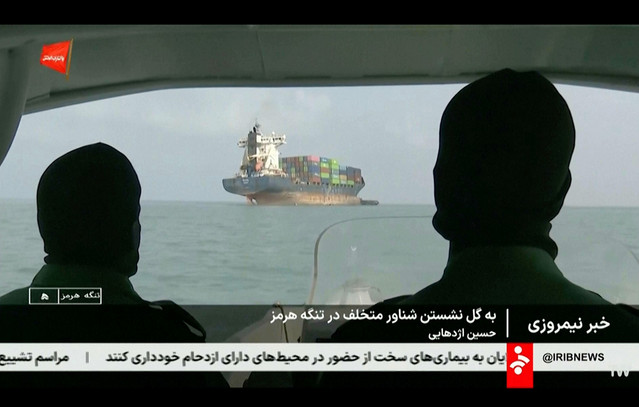
Iran and Oman are close to an agreement to restart shipping through the Strait of Hormuz, according to Iranian and American officials. If implemented, the deal could hand Tehran indirect control over a passage that functioned as an open international waterway before the war.
Officials familiar with the emerging framework say ships heading into the Persian Gulf would pass through a channel near the Iranian coast, while ships leaving the Gulf would use a route closer to Oman.
A service fee instead of a toll
Iranian officials say the agreement will not include tolls but rather a service fee. According to the Iranian side, the fee would cover the environmental impact of shipping, the safety of commercial vessels and tankers, and staffing needs, with revenue split evenly between Iran and Oman.
An American official familiar with the negotiations disputed that account, saying the Iranian description is not accurate. According to this official, any temporary routes through the Strait would not include Iranian permits or approvals, and would not involve tolls.
The political stakes for Trump
For Donald Trump, a deal could resolve the most urgent political problem: restarting shipping and easing pressure on markets. Tehran, however, has signaled that the Strait will remain closed regardless of any agreement until the United States lifts its naval blockade on Iranian ports in the Persian Gulf and both sides return to the 14-point plan described in the Islamabad memorandum of understanding. Officials say Washington could further ease market pressure by granting sanctions exemptions that would let Iran legally sell and deliver oil.
Fear of a precedent for international waterways
The core concern for the West is that if Iran retains a daily control role over passage through the Strait, reopening it could set a dangerous precedent. Iranian officials say they are designing the deal to confirm Tehran's ability to control the passage and preserve strategic leverage it did not use before the war.
Such an outcome would contradict the goal repeatedly stated by US Secretary of State Marco Rubio, who has said the Strait must return to the status of an open international waterway. He has warned that if a precedent is set where a state can control an international waterway, impose payments and threaten ships, the principle of freedom of navigation itself is at risk.
Sixty days to negotiate
Trump has spoken sparingly about the framework, which is tied to a return to negotiations and his decision to cancel a new large-scale attack on Iran over the weekend. The agreement gives Iran and Oman 60 days to negotiate the reopening of the Strait.
During that same period, the US and Iran are expected to resume talks on the future of Iran's enriched uranium stockpile, which totals 11 tons, including roughly half a ton of fuel near weapons-grade purity. The US wants that fuel diluted so it cannot easily be converted for weapons use, and eventually transferred to the United States or another country for disposal or use in nuclear power plants.
Doubts over a nuclear deal
The plan, signed in mid-June by Vice President JD Vance and separately by Trump, had led both men to say a nuclear deal could be reached within 60 days. That deadline expires in two weeks, and officials now acknowledge that any negotiations will likely stretch deep into the fall or later. In private conversations, some officials say they doubt a nuclear deal will happen at all, with some suggesting Trump may simply declare that Iran's stockpiles should remain buried under the rubble left by airstrikes on three nuclear facilities in June 2025.
Reservations at the Pentagon
Despite the political need to reopen the Strait, the Pentagon has reservations about the emerging Iran-Oman deal. Current and former officials briefed on the concerns say some fear the agreement amounts to a concession to Tehran.
They note that on the route from the Gulf to the Strait through Omani waters, enough mines remain that ships will need to coordinate with Iran to move safely. US Central Command guides ships through this route, but they remain under threat from Iranian missiles. Trump has already canceled, twice in two weeks, a plan by Admiral Brad Cooper, head of Central Command, for a brief, intense bombing of Iranian positions behind the attacks and other military targets.
Iran wants to keep its leverage
Mahdi Mohammadi, senior adviser to Iran's chief negotiator, said on state television that Iran and Oman are negotiating a solution for managing the Strait, adding that these talks are separate from the war with the United States.
Iran has accused the US of violating the peace plan when it directed ships toward the southern coast of the Strait, near Oman, saying the agreement's wording was unclear about who controls the passage. Tehran, however, also violated the same plan by opening fire on ships passing through the Gulf without its permission.
Ali Vaez, deputy director of the Middle East program at the International Crisis Group, said Iran is determined to keep the leverage it gained in the Strait, viewing it as the only gain it secured from the war.
Between an unwinnable war and an unwelcome peace
According to Vaez, any solution that leaves Iran in a position of control over the Strait would be extremely difficult for Trump to present politically. At the same time, he said, there is no military solution that could fully strip Iran of its ability to control the passage. Trump's choices, he said, are between a war that cannot be won and a peace that is hard to accept.
The fight over the Strait of Hormuz is no longer just about restarting shipping. It is about who controls one of the world's most important energy corridors, and whether the international order of free navigation can be preserved without ceding strategic advantage to Tehran.