

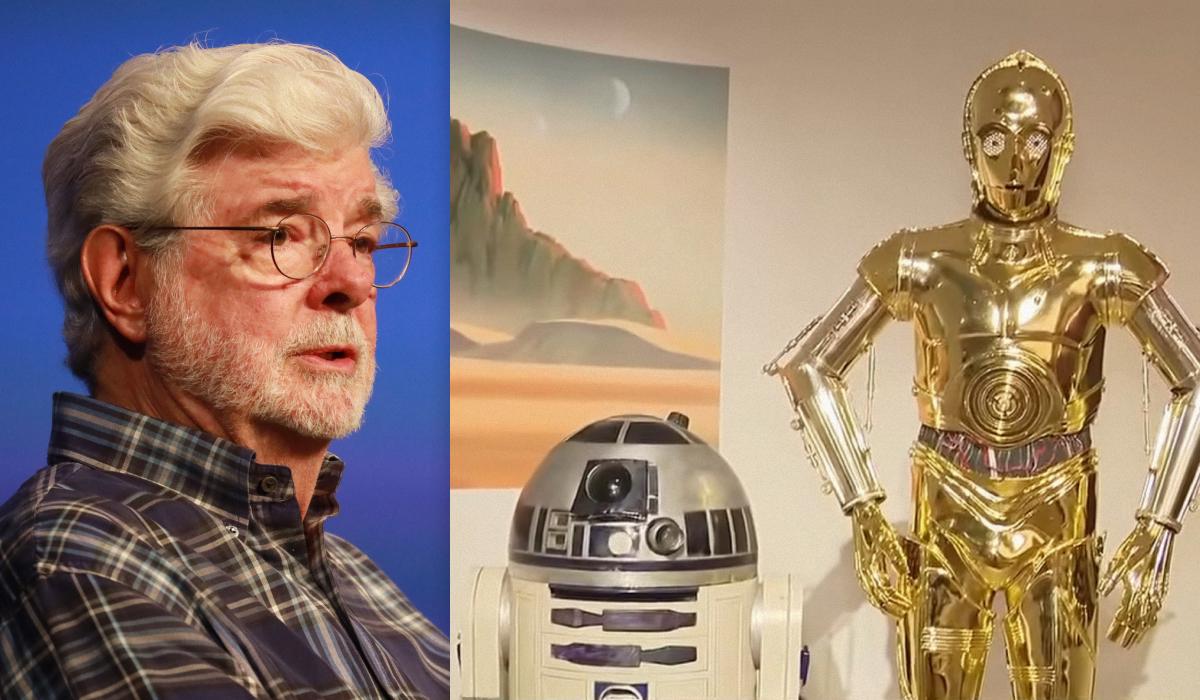
Filmmaker George Lucas will open the Lucas Museum of Narrative Art in Los Angeles on Sept. 22, showcasing a vast collection of commercial illustration, comics and popular culture.
The museum in Exposition Park has been one of the 82-year-old director's main life projects since he sold his company, Lucasfilm, to Disney in 2012. Almost all the exhibits in the 100,000-square-foot exhibition space come from the personal collection of Lucas and his wife, businesswoman Mellody Hobson.
While the museum was created by the man behind "Star Wars," items from the science fiction franchise make up only about seven percent of the exhibition space.
Lucas refers to the institution as a shrine to popular art. The concept is to display works by popular artists, commercial illustrators, comic creators and paperback cover designers on the same level as established classics, elevating artists whose output was traditionally dismissed as mass culture.
Museum chief executive Tracey Bates said the mission was to present familiar works in a curatorial context that allows people to see the genius behind them.
Bates, who joined the project in 2020, told the Associated Press that one of the management team's primary tasks ahead of the opening was to communicate the diversity of the art on display.
'Star Wars' in motion
The famous space saga still features prominently across the campus. Visitors to the public research library will be greeted by a bright yellow Naboo N-1 Starfighter from the 1999 film "Star Wars: Episode I - The Phantom Menace" hanging in the lobby.
The first exhibition, titled "Star Wars in Motion," will include production versions of Luke Skywalker's landspeeder from the original film and speeder bikes from 1983's "Return of the Jedi."
Lucas began collecting original newspaper comics like "Alley Oop" in college when they could be bought for pennies. As he made money from his films, he began buying paintings by commercial artists like Norman Rockwell and Maxfield Parrish, whose work was often considered tasteless by high culture aficionados at the time.
Speaking at a panel discussion at the San Diego Comic-Con last year, Lucas joked that he eventually needed a museum simply to have somewhere to store his entire collection.
American illustrators
Speaking in the Norman Rockwell gallery, Bates said the 20th-century American illustrator embodies the spirit of the museum even more than Luke Skywalker or C-3PO. She described Rockwell as one of the greatest storytellers of our time and said she constantly gets lost in his nuanced, deep paintings.
Rockwell is best known for his weekly covers for The Saturday Evening Post, which depicted Boy Scouts, Thanksgiving dinners and other everyday scenes. While his paintings became extremely popular for their portrayal of small-town America, critics often dismissed his work as too simple and provincial.
Senior curator Ryan Linkof, who began working on the project in 2018, said he previously only knew the generally accepted assessment of Rockwell's work.
Linkof said working at the museum made him fall in love with Rockwell's paintings, and he realised how sophisticated the artist was as an image creator and a cultural figure.
The Rockwell gallery includes "The Problem We All Live With," his 1960 painting of Ruby Bridges, a six-year-old Black student being escorted by federal marshals to a previously all-white school in New Orleans.
The gallery also features a sculpture of Rockwell, created specifically for the museum, which recreates his famous comic portrait of himself working on his own self-portrait.
Sanctuary of light
Another of Lucas's favourites is Maxfield Parrish, a painter and commercial illustrator whose images shaped 20th-century visual culture but whose work was often undervalued as too fantastical and decorative.
Parrish's paintings are known for ethereal, almost angelic imagery, a characteristic shade of blue, and an inner luminescence that appears suited for museum halls. Linkof noted the irony that one of the most lush works in the collection was originally created by the artist for a box of chocolates.
The curator showed journalists the Parrish gallery, which he said had already become a favourite among early visitors and felt like a small sanctuary or chapel dedicated to the artist's work.
Linkof said Parrish was known for beautiful lighting effects and atmospheric landscapes, so the museum wanted to create a space where viewers could feel that atmosphere of calm.
Rather than organising galleries strictly by artist, era or genre, many are arranged around aspects of everyday life, such as sports or civic activism.
Linkof explained that the museum was interested in the stories the works tell and the myths of everyday life, rather than artificial categories defined by artistic disciplines.
High art and fantasy
The museum will also house traditional high art by figures including Frida Kahlo, Diego Rivera and Andy Warhol. The guiding principle is that any work that tells a story has a place in the institution.
The collection features as much science fiction and fantasy art as it does works directly related to Lucas's own output. A separate space is dedicated to Frank Frazetta, known for his sword and sorcery illustrations.
Nearby are large-scale paintings by Paul Raymond Gregory, created under the influence of epic heavy metal and inspired by the works of J.R.R. Tolkien. The paintings are displayed in lush frames decorated with skulls.
Spaceship architecture
The building in Exposition Park was designed by architect Ma Yansong, whose firm was chosen in 2014. The museum features an architectural gallery showing models of alternative designs Ma proposed for San Francisco and Chicago before Lucas chose Los Angeles.
The museum has been under construction for eight years and sits near the University of Southern California, where Lucas studied.
Given the museum's name and futuristic look, Ma acknowledged the structure has been compared to a spaceship, noting the feeling is especially strong near the wide oval windows offering views of Los Angeles.
However, he said his style leans more toward organic forms, making the building look as though it has hovered over the neighbouring Los Angeles Memorial Coliseum and California Science Center.
Ma said the building feels like a cloud or a tree canopy hovering above, appearing almost formless and encouraging visitors to walk around and explore it.
Looking around the interior, the architect said he was looking forward to seeing visitors move through the space, as his team wanted to see people's reactions to the emotional architectural environment they had created.


