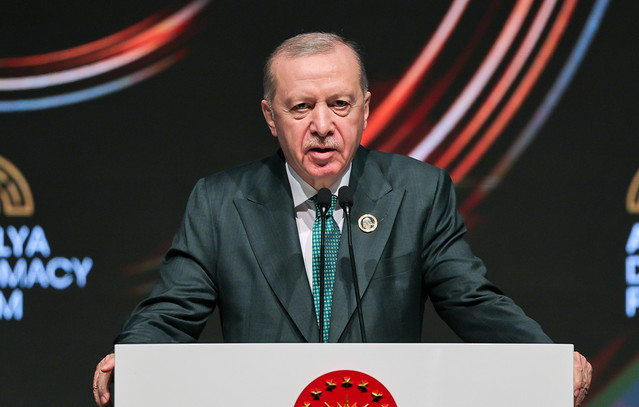
Turkish President Recep Tayyip Erdogan said he expects United States President Donald Trump to honor a commitment to deliver F-35 fighter jets to Turkey.
Erdogan also revealed that Egypt could join a new mutual defense alliance recently established between Turkey, Saudi Arabia, and Pakistan.
Speaking in an interview with news network Al Jazeera scheduled for broadcast on Sunday evening, Erdogan described Cairo joining the pact as possible and noted that the door remained open for other states. Al Jazeera is a state-funded international news broadcaster headquartered in Doha, Qatar.
F-35 Fighter Jet Commitment
During the interview, Erdogan highlighted the issue of American F-35 warplanes, stating that he received a personal promise from Trump and is awaiting its fulfillment.
Turkey was removed from the multinational F-35 procurement program in 2019 after purchasing and taking delivery of S-400 air defense missile systems from Russia. Washington removed Ankara over concerns that operating the Russian system alongside the advanced aircraft could compromise sensitive stealth technology.
The F-35 Lightning II is a single-seat, single-engine stealth multirole fighter jet developed by American defense contractor Lockheed Martin for the United States military and allied nations. The S-400 Triumf is a mobile, long-range surface-to-air missile defense system developed by Russia capable of destroying aircraft, drones, and ballistic missiles.
Erdogan noted that during the NATO summit held in Ankara last month, Trump stated beside him that his administration intended to lift sanctions imposed on Turkey under the Countering America's Adversaries Through Sanctions Act in December 2020. Trump also indicated at the summit that his administration would examine restoring Turkey to the F-35 program.
The North Atlantic Treaty Organization is a political and military alliance of 32 North American and European countries established for collective defense. Turkey joined the alliance in 1952 and maintains the second-largest standing military force among member nations after the United States.
The Countering America's Adversaries Through Sanctions Act is a United States federal law passed in 2017 that imposes economic sanctions on foreign entities engaging in significant transactions with the Russian defense and intelligence sectors.
Any potential jet sale still faces legislative hurdles in Washington. A United States law enacted in 2020 prohibits the Pentagon from transferring F-35 aircraft to Turkey while Ankara retains possession of Russian S-400 hardware, and the deal continues to encounter opposition within the United States Congress, the bicameral legislature of the American federal government.
Expansion of the Mecca Pact
Addressing regional security cooperation, Erdogan detailed the Joint Defense Agreement of Mecca, which mandates mutual assistance if any member state suffers external aggression.
Erdogan stated that the agreement sent an important message to the international community and confirmed that integrating Egypt is among the options under consideration for expanding the coalition.
The accord, known as the Mecca Pact, was signed last Friday in Mecca by Erdogan, Saudi Crown Prince Mohammed bin Salman, and Pakistani Prime Minister Shehbaz Sharif. Mecca, located in western Saudi Arabia, is the holiest city in Islam and the spiritual center of the Islamic world.
Egypt, located in northeastern Africa, possesses one of the largest standing military forces in the Middle East and controls the Suez Canal, a crucial international shipping passage connecting the Mediterranean Sea to the Red Sea.
Strait of Hormuz and Regional Diplomacy
Erdogan addressed maritime security in the Persian Gulf, identifying the reopening of the Strait of Hormuz as a top priority for Ankara. He argued that an ongoing blockade of the waterway served no country's interests.
The Strait of Hormuz is a strategic waterway connecting the Persian Gulf to the Gulf of Oman and the Arabian Sea. Located between Iran and Oman, it is one of the world's most critical maritime choke points, through which approximately 20 percent of global petroleum supplies pass daily.
Erdogan also commended Qatar for its ongoing mediation efforts, stating that the Gulf nation plays a significant diplomatic role in working to end conflicts in the region.
Stance on Syria, Gaza, and Lebanon
Outlining Ankara's foreign policy on regional conflicts, Erdogan announced plans to visit neighboring Syria and stated Turkey would take all possible steps to foster stability there. He added that Syrian Kurds would have a share in peace and stability.
Syria shares a 565-mile northern border with Turkey, and security along the frontier has remained a primary geopolitical concern for Ankara.
On the conflict in Gaza, Erdogan declared that Turkey would not abandon the territory and would continue providing necessary support. He claimed that Hamas was fulfilling its commitments in good faith while Israel continued military operations.
Hamas is the Palestinian political and militant organization that has governed the Gaza Strip since 2007. Gaza is a narrow coastal enclave situated on the eastern shore of the Mediterranean Sea.
Erdogan also voiced strong concern regarding continued Israeli military strikes in Lebanon. He noted that during Trump's recent visit to Turkey, he raised with the American president the need to end the war in Lebanon, pointing to the influence Washington holds in regional diplomatic efforts.