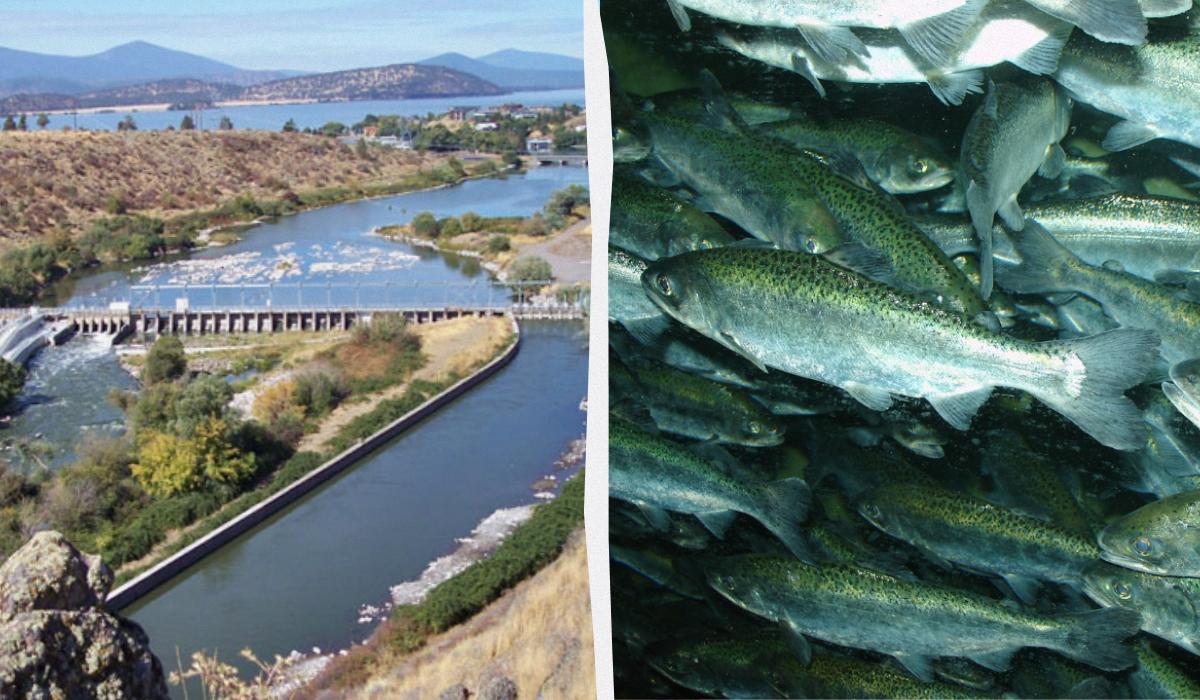
Chinook salmon have returned to the Klamath River in Oregon and California, recolonising 88 percent of their historic upper basin habitat after four hydroelectric dams were removed in 2024.
The removal of the J.C. Boyle, Copco 1, Copco 2, and Iron Gate dams reopened more than 640 kilometres of primary river channel and tributaries to migrating salmon. The dams had completely blocked access to these upstream spawning grounds for over a century.
Chinook salmon, also known as king salmon, are the largest of the Pacific salmon species. As anadromous fish, they hatch in freshwater rivers, migrate to the Pacific Ocean to mature over several years, and ultimately travel back to their native streams to reproduce. The Klamath River stretches for more than 400 kilometres from southern Oregon to the coast of Northern California, historically serving as one of the most productive salmon river systems on the West Coast of the United States.
Hydroelectric dams provide electricity by impounding river water behind large concrete walls, but they frequently construct impassable physical barriers for migratory species. Removing such structures restores natural hydrological flow, allowing sediment, nutrients, and aquatic life to move freely across the watershed once again.
Monitoring Migration with High Resolution Sonar
To monitor the pace of the salmon migration, researchers set up stationary high-resolution sonar equipment near the site of the former Iron Gate dam. Acoustic sonar systems use sound waves to generate visual representations of underwater targets, enabling scientists to detect and count passing fish in dark or muddy river currents where visual counting is impossible.
According to estimates compiled by the research team, 7,742 Chinook salmon passed the former Iron Gate dam site during the 2024 migration season. The first salmon was recorded passing the site on October 2, 2024. In the 2025 season, the annual count expanded to 13,310 fish, with the first migrant detected on September 12.
Ground surveys conducted along the river confirmed that returning Chinook salmon expanded across 345 kilometres of the newly accessible habitat. Individual fish traveled as far as Beatty Gap on the Sprague River, a major upper-basin tributary located at an elevation of about 1,250 metres and more than 580 kilometres inland from the Pacific Ocean.
Historic Range and Basin Topography
The research findings were published in the scientific journal Scientific Reports in a paper titled "Wilding the upper Klamath River basin: Rapid recolonisation by Chinook salmon following the world's largest dam removal", as reported by The Times of India.
Researchers calculated that salmon reoccupied 88 percent of the river length within their documented historic range in the upper basin over the first two migration seasons. However, the authors emphasized that this figure represents the linear proportion of documented historic stream length that fish began using again. It does not mean salmon occupied 88 percent of the entire Klamath River, nor that 88 percent of the historic fish population has returned.
The study authors noted that the natural geography of the upper Klamath basin likely assisted the rapid return of the salmon. The upper watershed features broad valley floors with relatively gentle river gradients, alongside spring-fed streams that deliver consistent supplies of cold water. Cold water is critical for salmon survival, as high water temperatures can cause severe stress or mortality in migrating fish.
Long Term Outlook and Hatchery Contributions
The study provides the first quantitative assessment of salmon recolonisation following the dam demolitions. Nonetheless, the authors stated that continued observation will be necessary to judge whether a self-sustaining wild population can rebuild over time. Chinook salmon typically live between two and four years, meaning scientists must track the ecosystem for several more years to evaluate the success of the first generation spawned in the reopened river channels.
The removal of the four dams could also create suitable conditions for the return of spring-run Chinook salmon. Historically abundant in the upper Klamath basin, spring-run Chinook enter freshwater earlier in the season than fall-run salmon. However, the spring run had not been observed near the former Iron Gate dam site since the 1970s. Researchers noted that only future genetic analysis and ongoing field surveys will determine if spring-run salmon successfully re-establish themselves.
The study also pointed out that a portion of the salmon recorded during the first two seasons originated from fish hatcheries rather than wild spawning. Hatcheries artificially incubate eggs and release juvenile fish into rivers to bolster declining populations. Because hatchery-reared fish accounted for part of the returning count, researchers cautioned that early migration figures cannot be taken as proof of complete wild salmon recovery, reinforcing the need for long-term monitoring.