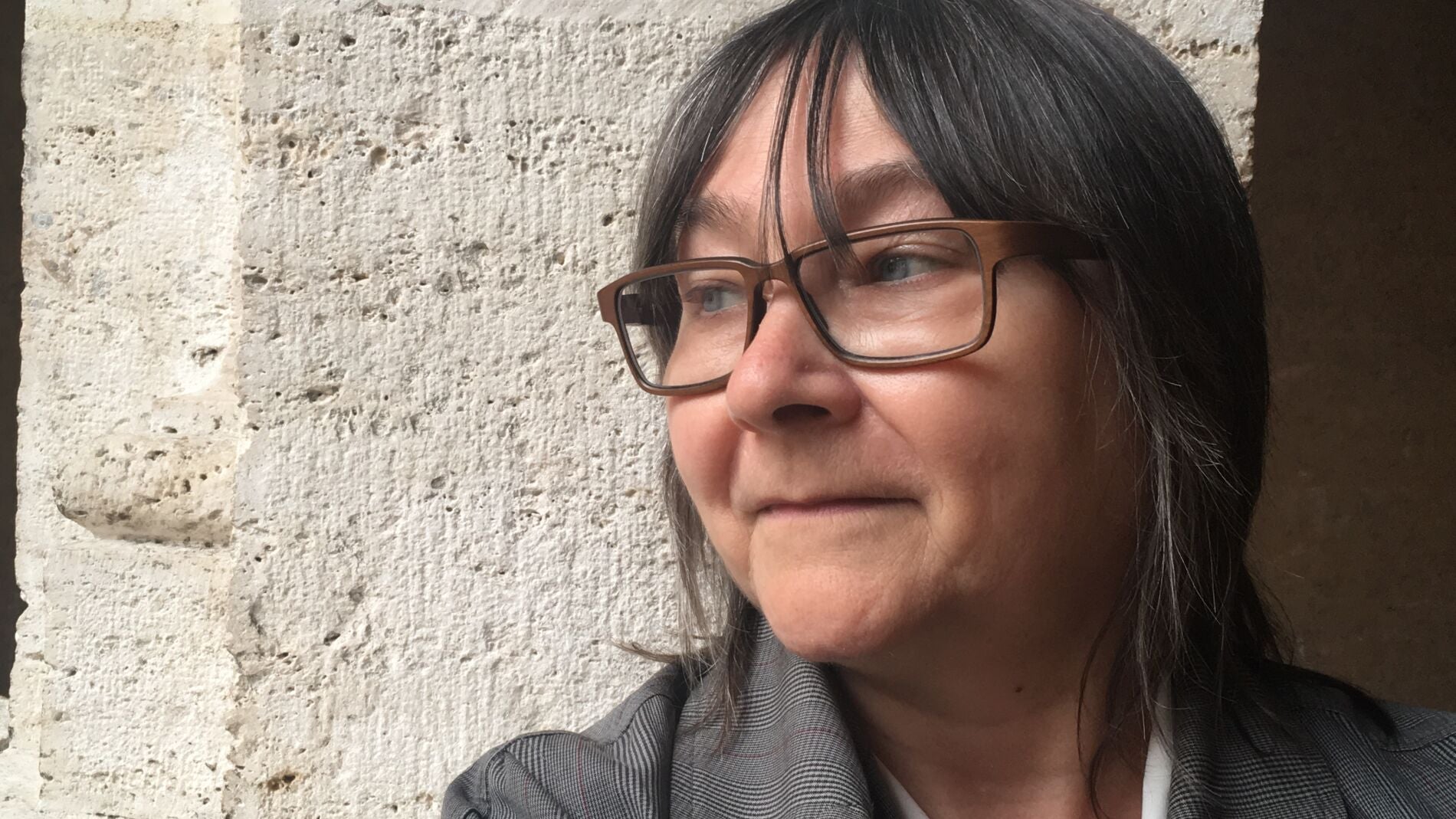
Scottish novelist Ali Smith has published her new book Glifo, a companion novel to her earlier work Gliff that examines the human cost of military conflict, family grief, and the political manipulation of narrative.
Speaking in Madrid on September 22, 2026, the author reflected on how international warfare and state power shape contemporary literature. She warned that governments and industrial interests are attempting to justify a renewed global arms race while restricting citizen protests against violence in the Middle East.
Glifo, published in Spain by Nórdica Editorial, forms what Smith described as a mirror novel to Gliff. The story centers on two sisters dealing with the death of their mother, incorporating symbolic figures such as a deceased soldier, a blind horse, and a ghost to reflect personal tragedy against the backdrop of historical warfare.
Smith explained that both novels developed from a central image of a traveler who, at the end of the Second World War, saw a human body completely crushed onto the asphalt along a road in southern France. That scene prompted her to reflect on how individuals are physically and emotionally crushed by war, history, and industrial development.
The title itself arose from a linguistic discovery. Smith had initially planned a single book titled Glyph before encountering the homonym gliff. Although she initially assumed gliff was a meaningless term, she found it contained a wide array of definitions, leading her to develop the two interconnected projects as literary sisters.
Political Narratives and State Power
Addressing a question raised by a character in her novel about whether explicit politics harms literature, Smith stated that her sole responsibility is to the story itself. However, she noted that all writing is inevitably influenced by the era of its creation because both language and history are organic and porous. She observed that every action carries political weight, adding that choosing to remain politically neutral is itself a political decision.
The novel incorporates direct statements from contemporary government officials asserting that the world order has changed and that old assumptions must disappear. Smith warned that such rhetoric is being deployed by state and corporate actors to legitimize military expansion and land acquisition. She added that there is nothing new about these historical cycles, describing the justification of arms races as an ancient pattern.
When asked about the role of literature in a technological era, Smith stated that the purpose of storytelling remains unchanged. She expressed continued confidence in the power of language to convey truth, describing words as humanity's essential wealth. She noted that common expressions such as giving one's word reflect deep commitments to trust and honor across 8.3 billion individual human lives.
War in Gaza and Free Speech Restrictions
Smith spoke directly about the humanitarian crisis and military actions in Gaza, condemning the civilian deaths and expressing dismay at political responses. Speaking as a citizen rather than a politician, she criticized the government in her home country for moving to criminalize certain public demonstrations held in support of Palestinians.
She warned that reactionary forces across the globe are pressuring society to abandon ethical and human obligations toward others. She emphasized that storytelling is fundamentally rooted in ethics because narrative deals directly with cause and consequence.
To illustrate the clarity of literary voices amid conflict, Smith cited a poem by Gazan poet Nima Hasan, which she had read shortly before speaking. In the poem, Hasan wrote about having a remaining portion of coffee and half a cigarette, wagering on whether she or the cigarette would finish first, and asserting that writing would allow her voice to reach the world.
Art as a Counterweight to Deception
Smith argued that artistic expression serves as a vital counterweight to political deception and false news. She stated that art consistently finds forms for difficult truths and described fiction as the exact opposite of a lie. While political speech and falsehoods carry hidden agendas designed to persuade and acquire power, she stated that a genuine story exists solely for its own sake and never seeks to exclude anyone.
She added that authoritative power has long feared artistic creation. Tyrants throughout history have sought to control or ban art, burn libraries, censor texts, and imprison or execute artists. She described these repressive acts as clear indicators of dictatorship, noting that artists are targeted precisely because art possesses greater enduring power than political tyranny.
Addressing the presence of ghosts in Glifo and her earlier novel Winter, Smith explained that the ground people walk on every day is formed by the memory of those who lived before. She stated that departed generations continue to shape living society, adding that stories provide both distance and deep involvement while connecting humans to their era.
Artificial Intelligence and the Human Condition
On the topic of modern technology, Smith acknowledged positive advancements in medical science but urged careful ethical choices regarding new tools. She offered a sharp critique of artificial intelligence, describing current large language models as machines fed on pages torn from destroyed books to generate text.
Smith asserted that AI relies on an act of destruction against original source materials, which she argued reveals the true nature of the technology industry. Despite these challenges, she expressed lasting faith in the human condition, concluding that art inevitably rises from the ruins of civilizations to express and assimilate human complexity across the centuries.