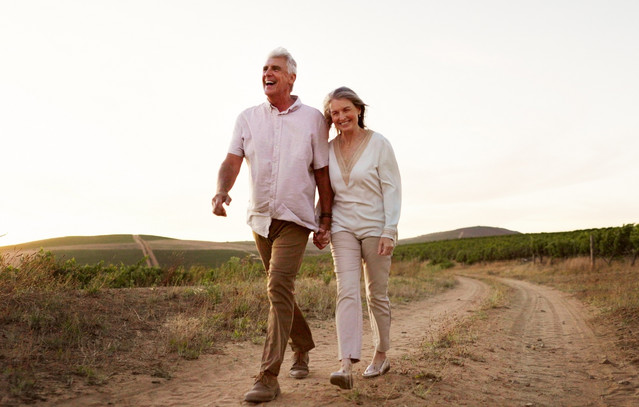
Walking at a brisk pace of 4.8 kilometers per hour could help adults extend their life expectancy by several years, according to a predictive modeling study published in the British Journal of Sports Medicine.
Researchers built a life expectancy model using device-measured physical activity data from Americans over 40 years old, combined with national mortality records.
The study designated 4.8 kilometers per hour, which equals approximately 3 miles per hour or 12.5 minutes per kilometer, as a standard walking equivalent to translate overall daily physical activity into an easily understandable benchmark.
The most active group, representing the top 25 percent of participants, completed total daily movement equivalent to about 160 minutes of walking at 4.8 kilometers per hour.
If all Americans over the age of 40 increased their physical activity to match that top group, the model estimated that average life expectancy across the population could rise by approximately 5.3 years.
The largest theoretical gain appeared among the least active individuals. To reach the activity levels of the most active cohort, the least active group would need movement equivalent to about 111 additional minutes of walking each day at 4.8 kilometers per hour.
In the model, adding those 111 minutes corresponded to nearly 11 additional years of life expectancy. Mathematically, each extra hour of equivalent activity among the least active was linked to roughly 6.3 additional hours of life expectancy.
Understanding the modeling study
The authors emphasized that the research was a predictive life-table analysis based on existing activity and mortality data rather than a clinical trial.
The study did not assign participants to walk on a treadmill for 111 minutes daily or monitor them over time to observe whether they lived 11 years longer.
Instead, the research shows that people who are currently the least active stand to gain the largest health improvements by incorporating regular movement into their daily routine.
The British Journal of Sports Medicine is a peer-reviewed medical journal published by BMJ that focuses on sport and exercise medicine.
Pace and individual fitness
For many adults, a speed of 4.8 kilometers per hour represents a brisk walk where breathing accelerates and the pulse rises while maintaining the ability to talk.
Thomas Buford, a professor and director of the Center for Exercise Medicine at the University of Alabama at Birmingham, described 4.8 kilometers per hour on average as a good target for people.
Buford noted that the speed serves as a general average rather than a strict requirement, explaining that proper pace must depend on individual health and physical fitness.
An older adult resuming exercise after years of inactivity may achieve significant cardiorespiratory benefits at 3.5 to 4 kilometers per hour.
Conversely, a younger and fitter individual might require a speed of 5.5 or 6 kilometers per hour to reach the same relative exercise intensity. Health experts recommend monitoring how hard the body works rather than strictly targeting a smartwatch figure.
Walking speed and chronic disease risks
Walking speed also correlates with long-term metabolic health and reduced chronic disease risk.
A systematic review and meta-analysis in the British Journal of Sports Medicine found that faster walking speeds were associated with a lower risk of developing type 2 diabetes.
The review identified a gradual risk reduction across speeds ranging from 4 to 8 kilometers per hour, with each speed increase of 1 kilometer per hour linked to an approximate 9 percent lower relative risk.
A separate 2025 systematic review and meta-analysis found that higher walking speed was inversely associated with overall mortality and major non-communicable diseases, including cardiovascular disease, cancer, and type 2 diabetes.
Researchers noted that these findings represent statistical associations, as individuals who naturally walk faster may possess higher baseline health and physical fitness.
Official physical activity guidelines
The 160 daily minutes highlighted in the modeling study do not represent a new global health recommendation.
The World Health Organization, the specialized public health agency of the United Nations, recommends that adults get 150 to 300 minutes of moderate-intensity aerobic activity per week, or 75 to 150 minutes of vigorous activity.
The World Health Organization also advises adults to perform muscle-strengthening exercises targeting major muscle groups at least two days each week.
A practical starting goal for many adults is 30 minutes of brisk walking five days per week.
The U.S. Centers for Disease Control and Prevention, the national public health agency of the United States, confirms that the weekly 150-minute aerobic target can be divided into smaller sessions throughout the day.
Long term adherence and global activity rates
Health experts emphasize that the most effective exercise routine is one that individuals can maintain consistently over several years.
Panteleimon Ekkekakis, a professor of exercise psychology, argued that the primary challenge in exercise science is long-term adherence, where walking has no competition.
Walking provides an accessible, low-impact form of exercise that requires no gym membership and easily integrates into daily routines.
Data from the U.S. National Center for Health Statistics showed that only 24.2 percent of American adults met both aerobic and muscle-strengthening guidelines simultaneously in 2020.
Globally, World Health Organization estimates from 2022 indicated that approximately 31 percent of adults, representing 1.8 billion people, failed to meet recommended physical activity levels.
Walking speed as a vital sign in geriatrics
In geriatric medicine, walking speed is recognized as a key indicator of overall physical and functional health.
A landmark scientific paper introduced the term walking speed: the sixth vital sign, demonstrating that measuring pace provides vital insight into an older person's functional status.
A large analysis of older adults published in JAMA, the peer-reviewed medical journal of the American Medical Association, showed that faster walking speed consistently correlated with improved survival rates.
In that analysis, every increase of 0.1 meters per second in walking speed was associated with a lower relative risk of death.
Walking speed reflects broader physiological function, including muscle strength, balance, neurological operation, cardiorespiratory capacity, and general vitality.
Fall risks and clinical assessments
A walking speed below 1 meter per second, which equals roughly 3.6 kilometers per hour or 2.2 miles per hour, is associated with increased frailty and fall risk in older adults.
A study evaluating walking pace against established fall risk factors identified a speed below 1 meter per second as a strong indicator of elevated fall risk among seniors.
Current clinical guidelines for fall prevention use a low walking speed, typically below 0.8 to 1 meter per second, as a threshold to trigger comprehensive medical evaluations.
Geriatricians warn that a sudden drop in an older adult's walking speed should be medically evaluated rather than dismissed as a natural consequence of aging.
Finding an enjoyable personal pace
Fitness experts advise individuals against competing with external benchmarks or forcing an unsustainable pace.
Buford noted that if someone comfortably walks at 3.5 kilometers per hour, there is no reason to force a speed of 4.8 kilometers per hour simply because a study used that number.
Buford explained that individuals who can safely walk faster do not need to cap their speed at 4.8 kilometers per hour, while those who are not ready should gradually build duration and intensity.
For people who dislike walking, moderate-intensity aerobic exercise can be achieved through alternatives such as cycling, swimming, dancing, or water aerobics.
Buford explained that he always encourages people to choose an activity they will enjoy and maintain over time.
Health researchers emphasize that 4.8 kilometers per hour is a practical guide rather than a strict threshold, and the largest health gains occur when transitioning from inactivity to regular movement.