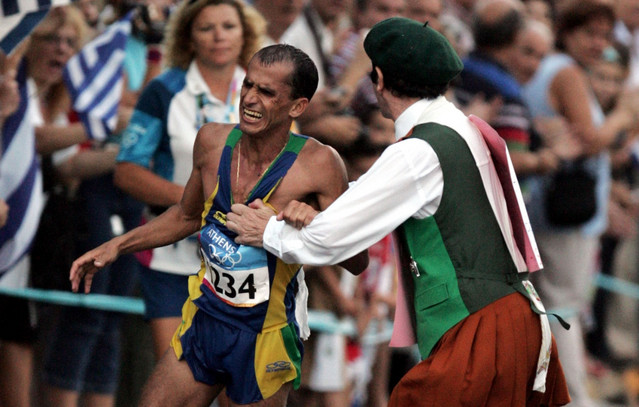
On August 29, 2004, Brazilian runner Vanderlei Cordeiro de Lima was leading the men's marathon during the Athens Olympic Games when a spectator attacked him.
De Lima was running alone at the front near the 36th kilometer mark, heading toward the Panathenaic Stadium in Athens, Greece, when the spectator invaded the course. He had pulled away from his competitors shortly before the 20th kilometer and maintained a lead of roughly 25 to 40 seconds with approximately six kilometers left in the race.
The attacker was identified as Cornelius "Neil" Horan, a former Irish Catholic priest who had invaded the track at the Formula 1 British Grand Prix motor race one year earlier. A Greek spectator named Polyvios Kossivas rushed onto the course to help free the Brazilian athlete and return him to the road.
Race Finish and Olympic Recognition
De Lima resumed running and initially held onto first place, but Italian athlete Stefano Baldini soon passed him. Baldini won the gold medal in a time of 2:10:55, while American runner Meb Keflezighi finished second to take silver. De Lima entered the historic marble Panathenaic Stadium in third place, crossing the line to take bronze in 2:12:11.
The incident immediately sparked debate over whether the disruption cost de Lima the victory. The Brazilian delegation filed an official protest, but the original race results were upheld. A subsequent analysis by World Athletics noted that Baldini was closing the gap rapidly before the tackle occurred and likely would have caught de Lima anyway, making it impossible to determine with certainty if the attack cost him the gold medal.
De Lima was widely praised for completing the race without giving up despite the assault. The International Olympic Committee later awarded him the Pierre de Coubertin medal for his exceptional demonstration of sportsmanship and adherence to Olympic values. The marathon was the final athletic event of the 2004 Summer Olympics, taking place just hours before the closing ceremony in Athens.
Historical Events on August 29
August 29 has been the date of several pivotal moments in world history. In 1824, the Greek naval fleet under Admiral Andreas Miaoulis achieved a major victory against the Turco-Egyptian fleet at the Battle of Gerontas, providing vital defense for the island of Samos during the Greek War of Independence. In 1831, British scientist Michael Faraday discovered electromagnetic induction, establishing the fundamental physical law that powers modern electrical generators and electrical engineering technology.
In 1842, representatives from Great Britain and the Qing dynasty signed the Treaty of Nanking to conclude the First Opium War. Under the terms of the treaty, sovereignty over Hong Kong was ceded to Britain, establishing it as a British crown colony. In 1912, the Hellenic Air Force recorded its first operational casualty when pioneer aviator Alexandros Karamanlakis died after his aircraft crashed into the Gulf of Corinth.
In 1949, forces from the Democratic Army of Greece retreated from their strongholds on Mount Grammos into Albania, bringing an effective end to active combat in the Greek Civil War. The military campaign officially concluded on August 30.
Cultural Milestones and Natural Disasters
In 1966, English rock group The Beatles performed their final commercial concert at Candlestick Park in San Francisco, California. The performance marked the end of the band's touring era, as John Lennon, Paul McCartney, George Harrison, and Ringo Starr retired from live public performances to concentrate exclusively on studio album recordings.
In 2005, Hurricane Katrina struck the Gulf Coast of the United States, causing catastrophic damage in Louisiana and breaching levees in New Orleans. The storm resulted in more than 1,300 deaths and caused an estimated 125 billion dollars in property damage, becoming one of the deadliest and costliest natural disasters in American history.
Notable Births on August 29
August 29 is also the birth date of several influential historical figures. English philosopher and physician John Locke was born in 1632. Considered the founder of British empiricism and a key thinker of the Enlightenment, Locke wrote An Essay Concerning Human Understanding and advanced foundational ideas about individual liberty and natural law that shaped modern democratic governance.
Greek historian Eleni Glykatzi-Ahrweiler was born in 1926. A renowned scholar of Byzantine history, she became the first woman appointed as rector of the University of Paris at the Sorbonne. Greek singer Stelios Kazantzidis was born in 1931. Kazantzidis became an iconic voice in laiko music, celebrated for songs that reflected the struggles, nostalgia, and hardships of working-class Greeks.
American entertainer Michael Jackson was born in 1958. Known worldwide as the King of Pop, Jackson broke global sales records and redefined popular music, dance choreography, and music video production with hit songs such as Thriller, Billie Jean, and Beat It.
Notable Deaths and Global Observances
Notable figures in the arts also passed away on August 29. Greek composer, lyricist, and performer Attik, born Kleon Triantafyllou, died in 1944. A leading figure in urban Athenian music and light song, Attik was celebrated for classic compositions including Zitate na sas po, Ta kanarinia, and Pame mia volta sto fengari, as well as his famous venue known as the Big Apple.
Swedish actress Ingrid Bergman died on her birthday in 1982. The three-time Academy Award winner starred in classic cinema masterpieces such as Casablanca, Anastasia, For Whom the Bell Tolls, and Autumn Sonata.
In the Greek Orthodox calendar, August 29 is celebrated as the name day for Arkadios and Arkadia. Internationally, August 29 is designated by the United Nations as the International Day against Nuclear Tests, encouraging global efforts to end nuclear testing.