

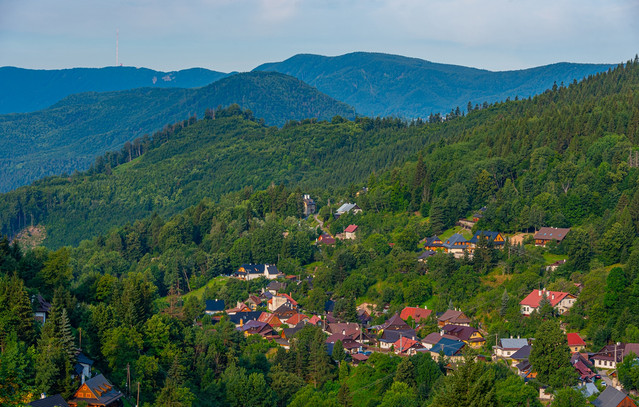
The historic village of Spania Dolina in central Slovakia preserves a copper mining heritage that spans more than 3,000 years. Located 10 to 12 kilometres north of the city of Banska Bystrica, the mountain settlement remains one of Central Europe's most intact historic locations.
Situated at an altitude of approximately 728 metres, the village sits between the foothills of the Low Tatras and Great Fatra mountain ranges. Although its permanent population today does not exceed 200 residents, Spania Dolina retains deep historical roots and a medieval atmosphere.
Slovakia, a landlocked country in Central Europe, is defined by the Carpathian Mountain system, which includes both the Low Tatras and Great Fatra ranges. Nearby Banska Bystrica served for centuries as the regional administrative and commercial centre for mining operations across central Slovakia.
Bronze Age origins and Renaissance mining networks
The identity of Spania Dolina has been defined by copper extraction for more than a millennium. Archaeological discoveries in the area indicate that copper mining began during the Bronze Age, between 2000 BC and 1700 BC. By the Middle Ages, the village had grown into one of the most prominent mining centres in Central Europe.
During subsequent centuries, local production of copper and silver expanded to unprecedented volumes. Major merchant families and investors of the era, including the Thurzo and Fugger families, established powerful business consortia that transformed Spania Dolina into a major European mining hub.
The Fugger family of Augsburg and nobleman Janos Thurzo formed one of Europe's largest merchant enterprises during the Renaissance. Their commercial network controlled copper trading routes that supplied markets across Europe and overseas.
Historic architecture and the 13th-century church
The physical layout of Spania Dolina reflects its industrial heritage. Traditional stone-built miners' houses line the narrow streets, featuring white mud-plaster facades and wooden roofs tiled with slate. The structures remain preserved in their original form, blending into the surrounding mountain landscape.
The village skyline is dominated by the Church of the Transfiguration of Our Lord, which dates back to the 13th century. Considered one of the oldest churches in the region, the building originated as an early Gothic structure before undergoing expansions and modifications in later historical periods.
Visitors reach the church entrance and surrounding square from the main road by climbing a covered wooden staircase comprising approximately 162 steps. The covered walkway is a distinctive architectural feature of the village and serves as a popular route for tourists.
Traditional lace craft and mountain trail networks
Today, Spania Dolina functions as a quiet village that maintains its cultural authenticity. While it is not a large commercial tourism destination, local residents host traditional events and festivals during the summer months to showcase local customs, folk music, and regional handicrafts.
Among the preserved traditions is the art of lace making, which has been passed down through generations. Local craftspeople demonstrate the technique through educational workshops and small presentations designed for visitors interested in regional folk art.
The village also features a network of hiking trails that lead through the surrounding natural scenery and past historic mining monuments. Old underground galleries, copper processing facilities, and preserved mining tools along the paths offer visitors direct insight into the industrial past of Spania Dolina.


