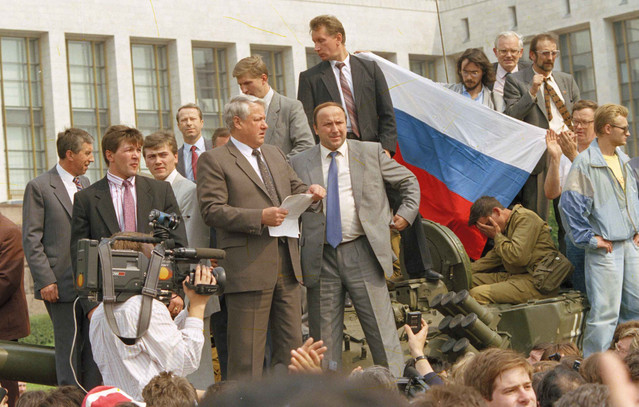
On August 19, 1991, Soviet hardliners launched a coup against President Mikhail Gorbachev in Moscow, placing him under house arrest in Crimea. Soviet citizens awoke on the morning of August 19 to tanks rolling through the streets of the capital, the ballet Swan Lake broadcasting continuously on state television, and an official announcement regarding the leadership.
The official broadcast declared that President Gorbachev was unable to exercise his official duties due to health reasons. In reality, the Soviet leader had been confined to the presidential summer residence in Foros, Crimea, after refusing to sign an emergency decree.
Communications at the villa were completely cut off when Gorbachev declined to yield executive authority or sign a declaration establishing a state of emergency across the Soviet Union.
The Committee of Eight and the takeover attempt
The attempt to seize power was organized by a group of eight senior officials representing the Soviet state, the Communist Party, the military, and the KGB. The leaders included Vice President Gennady Yanayev, KGB Chief Vladimir Kryuchkov, Defense Minister Dmitry Yazov, and Prime Minister Valentin Pavlov.
Calling themselves the State Committee on the State of Emergency, the group suspended political freedoms, imposed strict controls on the press, and ordered hundreds of armored vehicles into Moscow.
The primary goal of the hardliners was to halt the perestroika and glasnost reform policies introduced during the era of Soviet restructuring. They specifically sought to block the signing of a new union treaty scheduled for August 20, which would have granted expanded autonomy to individual Soviet republics and weakened central authority.
Boris Yeltsin mobilizes civilian resistance
Opposition to the coup centered outside the Russian Parliament building, known as the White House, where Boris Yeltsin took a decisive stand. Yeltsin, serving as President of the Russian Republic, climbed atop an armored tank to denounce the coup as illegal and unconstitutional while calling for a nationwide general strike.
Thousands of Muscovites gathered around the Parliament building to build barricades and maintain a continuous vigil through heavy rain, preparing for a potential assault by special forces. Key military units defied orders from the committee or transferred allegiance to Yeltsin, preventing the plotters from establishing operational control.
Over the night of August 20 to August 21, three young protesters were killed during violent clashes with a military convoy near the Parliament. They were the only recorded fatalities during the three days of the crisis.
Collapse of the coup and dissolution of the USSR
By August 21, the coup attempt had effectively collapsed as military forces withdrew from Moscow and committee members were placed under arrest. Gorbachev returned to the capital from Crimea, but he arrived back into a drastically altered political landscape.
Yeltsin emerged from the crisis as the dominant symbol of political resistance, while the Communist Party and central Soviet institutions suffered a permanent loss of authority. In the weeks that followed, individual Soviet republics rapidly accelerated their declarations of independence.
Gorbachev formally resigned as president on December 25, 1991, and the Soviet Union was officially dissolved one day later on December 26. Historical assessments view the August coup as the critical catalyst that fatally weakened central leadership and sealed the nation's end during an existing economic and political crisis.
Historical events recorded on August 19
August 19 marks several other significant historical milestones across international diplomacy, intelligence operations, and space exploration. In 1923, the British government rejected a request from Greek Cypriot representatives seeking Enosis, the political union of Cyprus with Greece, fueling widespread discontent against colonial rule.
In 1953, a covert intelligence operation backed by the United States Central Intelligence Agency and British intelligence overthrew Iranian Prime Minister Mohammad Mossadegh. The coup restored and strengthened the executive authority of Shah Mohammad Reza Pahlavi over Iran.
In 1960, the Soviet space program achieved a major milestone by launching Sputnik 5 carrying two dogs, Belka and Strelka. They became the first living creatures to successfully complete an orbital spaceflight and return safely to Earth.
Notable births on August 19
Several influential global figures in fashion, politics, sports, and entertainment were born on August 19. French fashion designer Gabrielle Bonheur Coco Chanel was born in 1883, rising from humble beginnings to open her first Paris shop in 1909 and establish her iconic haute couture house. She revolutionized women's fashion with the little black dress, Chanel No. 5 perfume, and designs emphasizing comfort and simplicity.
Bill Clinton, the 42nd President of the United States, was born in 1946 in Arkansas. Educated at Georgetown University, Oxford, and Yale Law School, the Democratic politician served two presidential terms from 1993 to 2001, characterized by strong economic growth, low unemployment, Third Way policies, and public scrutiny surrounding the Monica Lewinsky scandal.
Greek sailor Nikos Kaklamanakis was born in Varkiza in 1968, earning the moniker son of the wind while serving as a five-time Olympic flag bearer for Greece. He won the gold medal in Mistral windsurfing at the 1996 Atlanta Olympics, secured silver at the 2004 Athens Games, and lit the Olympic flame during the opening ceremony in Athens.
American-Canadian actor Matthew Perry was born in 1969, gaining international acclaim for his role as Chandler Bing on the television series Friends. Nominated for Emmy and Golden Globe awards, Perry also starred in films such as Fools Rush In and The Whole Nine Yards before his death at age 54 in October 2023 after speaking openly about his struggles with addiction.
Notable deaths and global observances
August 19 also marks the deaths of prominent cultural figures and international commemorations. Spanish poet and playwright Federico García Lorca, a leading figure of the Generation of 1927 known for works like Blood Wedding and Gypsy Ballads, was murdered by Francoist Nationalist forces in 1936 at the start of the Spanish Civil War.
Greek journalist and international relations analyst Nikos Cheiladakis passed away on this date in 2021. Born in Thessaloniki, he studied economics at ASOEE and Turkology in Paris, working for years as a foreign correspondent in Turkey and serving on the Defense Analysis Institute of the Ministry of Defense.
August 19 is officially recognized around the world as World Humanitarian Day, honoring humanitarian workers and advocating for people affected by global crises.