The Monastery of San Juan de la Peña, located in Botaya to the southwest of Jaca, stands as one of the most distinctive medieval complexes in the Aragonese Pyrenees, built directly beneath a massive rock face that serves as its natural roof.
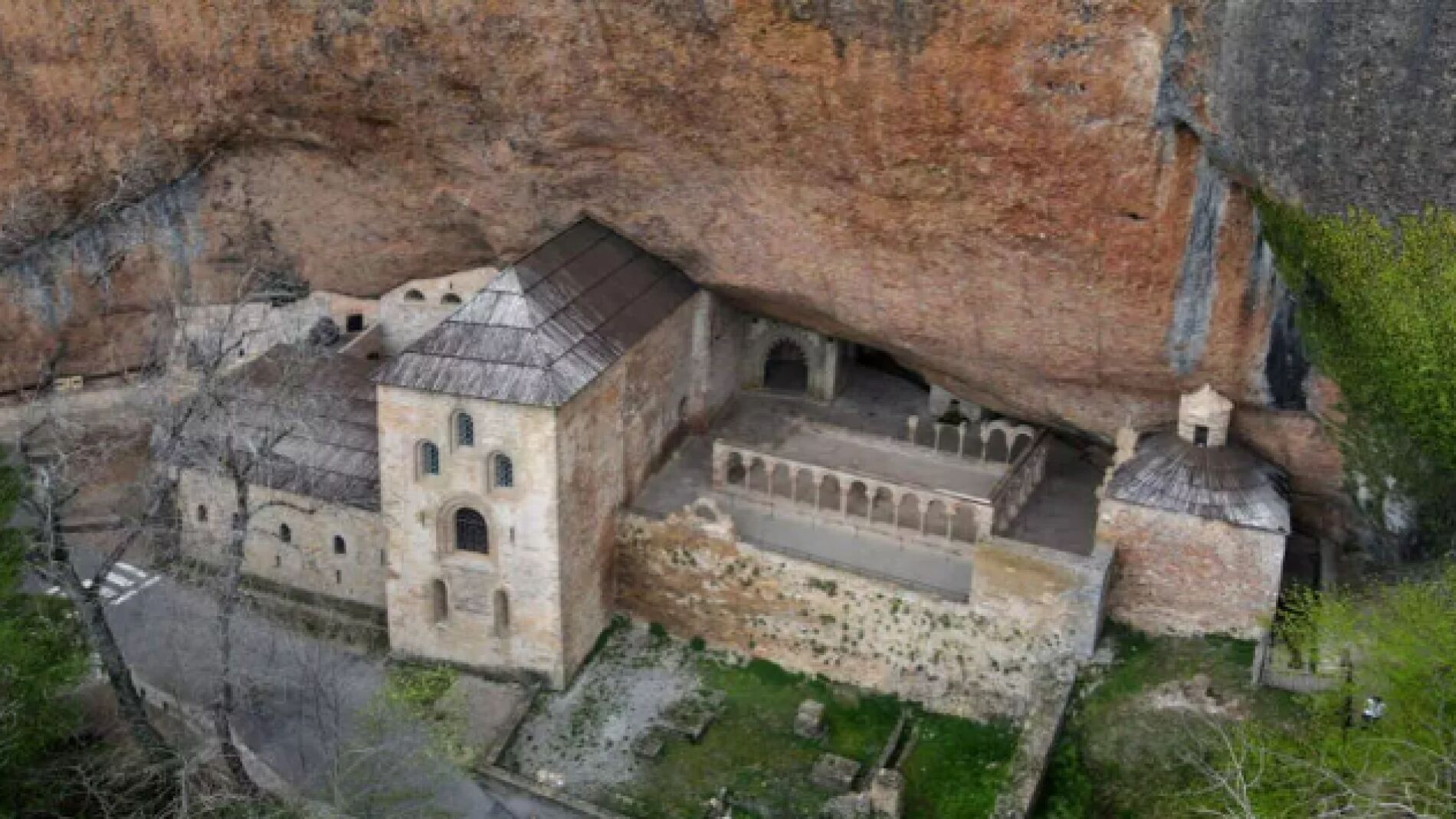
Surrounded by dense forests and protected by rugged mountain terrain, the sanctuary was bound for centuries to kings, nobles, and religious leaders. Between the ninth and eleventh centuries, the enclave gained major political and religious importance during the consolidation of Christian territories that led to the founding of the Kingdom of Aragon.
Because of its pivotal location and early royal ties, historians regard the site as a fundamental landmark for understanding how the kingdom emerged and how its earliest rulers expanded their power across northern Spain.
Huesca, the northernmost province of modern Aragon, formed the defensive heart of the early Aragonese county before it grew into a major medieval realm. The Pyrenean geography offered natural strongholds against external threats, making rock-sheltered sites ideal strategic bases for monastic and royal power.
A Monastery Carved into the Mountain
The site comprises two primary structures: the Monasterio Viejo, or Old Monastery, and the Monasterio Nuevo, or New Monastery. The older complex is the most famous, built straight into the natural shelter of the mountain rock, which provides a dramatic natural canopy over its chambers.
Inside the Old Monastery, visitors can trace several centuries of religious architecture, beginning with an early pre-Romanesque church. Above it lies the upper church, which was consecrated in the eleventh century during the height of the region's early royal expansion.
The complex also houses the Pantheon of Nobles, where twelfth-century wall paintings depicting Saint Cosmas and Saint Damian remain preserved, alongside the later Gothic chapel of San Victorián.
Among the most celebrated architectural features is the Romanesque cloister, which sits partially tucked beneath the rock overhang. Its stone capitals are intricately carved with scenes from the Bible, human figures, animals, and detailed plant motifs.
Romanesque sculpture of the eleventh and twelfth centuries relied heavily on relief carvings along cloister columns to visually communicate biblical narratives and moral lessons to monastic orders and visiting pilgrims.
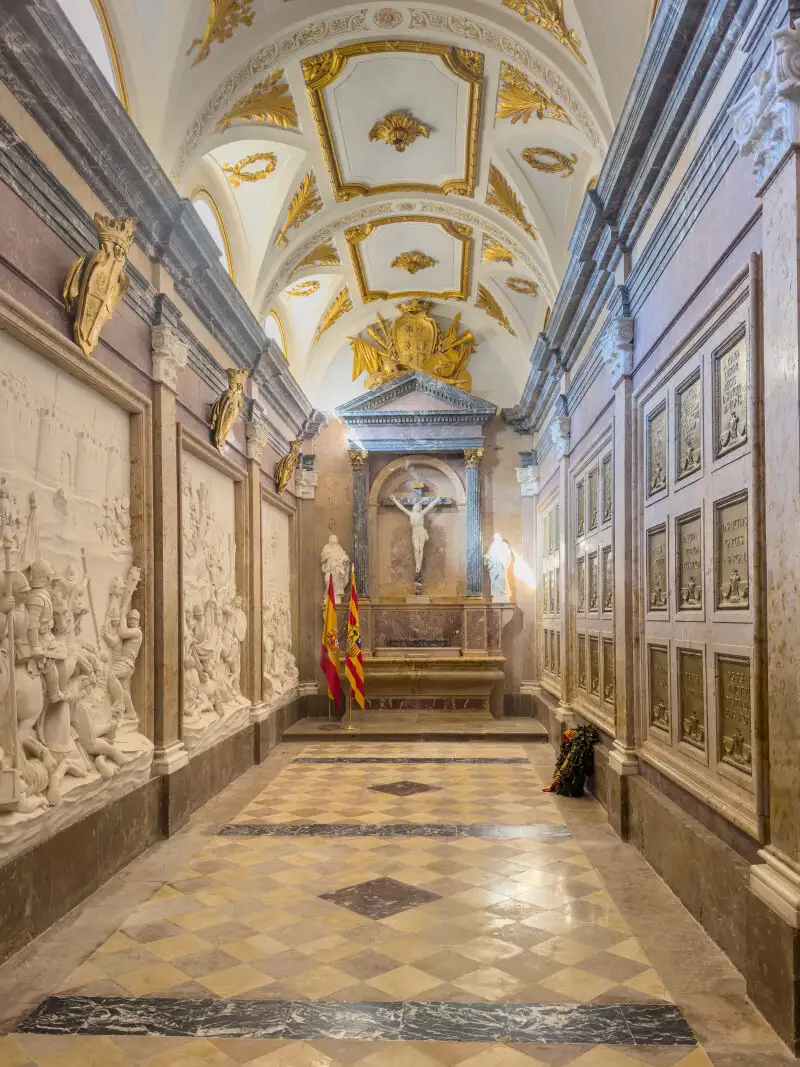
San Juan de la Peña maintained deep ties to the Aragonese monarchy throughout its history, functioning as a primary burial ground for early rulers and nobility. In the eighteenth century, the complex added a neoclassical Royal Pantheon to honor the monarchs entombed at the site.
The 1675 Fire and the New Monastery
The trajectory of the sanctuary changed dramatically in 1675 when a severe fire swept through the Old Monastery, causing catastrophic damage to its facilities.
Following the disaster, religious authorities decided to construct a replacement monastery higher up the mountain in a broader, more open clearing. This site became the New Monastery of San Juan de la Peña, which stands today as a contrasting architectural counterpart to the ancient cave-bound complex.
Both structures are open to visitors, offering a comprehensive look at how the monastic community adapted its living spaces, religious practices, and architectural styles across different eras of Spanish history.
The Cradle of the Kingdom of Aragon
Beyond its architectural uniqueness, San Juan de la Peña served as a dominant spiritual and cultural center during the Middle Ages, with its monastic community wielding considerable regional influence.
The history of the monastery is tied to key historical figures including Sancho III the Great and Ramiro I of Aragon, who is recognized as the first king of Aragon, along with prominent members of the earliest ruling dynasties of the realm.
Ramiro I established the independent Kingdom of Aragon in 1035 after the division of the realm of his father, Sancho III of Navarre. His reign laid the foundations for Aragon to grow into one of the principal powers of the Iberian Peninsula.