

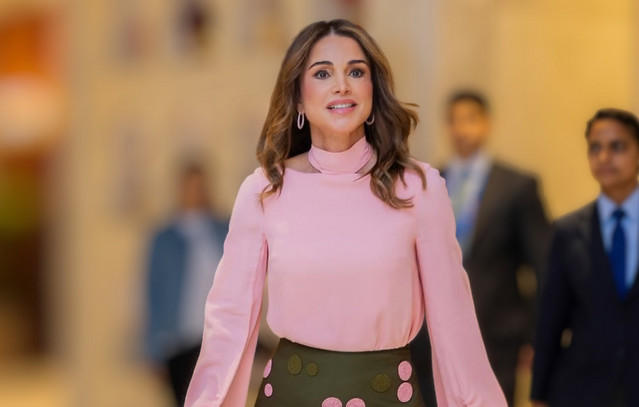
Queen Rania of Jordan became a grandmother of four after her daughter Princess Iman gave birth to twin girls on August 14, 2026, just weeks before the monarch celebrated her 56th birthday.
The newborn twin daughters were named Talia and Rania, with the second baby named in honor of her grandmother. To mark her 56th birthday on August 31, 2026, the Jordanian royal court released an official portrait showing Queen Rania in jeans, a white t-shirt, and an Apple Watch, reflecting a casual style away from formal royal protocol.
The Hashemite Kingdom of Jordan, a Middle Eastern nation bordered by Saudi Arabia, Iraq, Syria, Israel, and the West Bank, has been ruled by the Hashemite dynasty since 1921. Queen Rania has served as queen consort alongside her husband, King Abdullah II, since 1999.
Royal Family Expands With Four Grandchildren
The birth of the twins marks the latest addition to the royal family, following three other milestone arrivals in recent years. Princess Iman and her husband, Jameel Alexander Thermiotis, welcomed their first daughter, Amina, in February 2025.
In August 2024, Crown Prince Hussein and his wife, Princess Rajwa Al Saif, welcomed a daughter also named Princess Iman after her aunt, a choice that drew widespread public interest. Crown Prince Hussein had married Rajwa Al Saif in 2023.
Queen Rania and King Abdullah II are parents to four adult children: Crown Prince Hussein, born in 1994; Princess Iman, born in 1996; Princess Salma, born in 2000; and Prince Hashem, born in 2005. Rania has spoken publicly about motherhood, describing it as both a teaching and a learning process in which parents often learn more from their children than they impart.
Early Life from Kuwait to Corporate Amman
Born Rania Al-Yassin on August 31, 1970, in Kuwait to parents of Palestinian origin, her father, Faisal Al-Yassin, worked as a physician. She spent her early childhood in Kuwait and attended the New English School, growing up in a family with no ties to royalty.
She later moved to Egypt to attend the American University in Cairo, graduating in 1991 with a degree in Business Administration. As a student, she focused on corporate business and did not anticipate a life within a royal palace.
Following the Gulf War, her family relocated to Jordan, where she settled in Amman and launched a career in the corporate sector. She worked in banking at Citibank before joining Apple as a marketing professional.
Meeting Prince Abdullah and Royal Wedding
In January 1993, at age 22, she attended a dinner party hosted by Princess Aisha, the sister of then-Prince Abdullah bin Al Hussein. The meeting led to a rapid courtship, and the couple married at Zahran Palace on June 10, 1993, a date declared a national holiday in Jordan.
For her wedding ceremony, Rania wore a gown designed by British fashion designer Bruce Oldfield, featuring rich gold embroidery inspired by traditional Middle Eastern garments, paired with a head covering instead of a tiara. She wore a separate creation by Oldfield for the evening reception.
Thirty years later, a detail from that wedding dress returned to public view when her daughter, Princess Iman, wore the belt from Rania's wedding gown during her own 2023 wedding appearance.
Unexpected Rise to the Throne
At the time of their marriage, Prince Abdullah was not the designated heir to the throne; King Hussein's brother, Prince Hassan, served as crown prince. In early 1999, King Hussein altered the succession order to name Abdullah as his successor.
King Hussein passed away on February 7, 1999, resulting in Abdullah's accession to the throne. Rania became queen in March 1999 at the age of 28, a transition she later described as a big shock because she had not been raised with expectations of royalty.
After entering the royal family, official archives recorded her driving herself while listening to Lauryn Hill's music and making unannounced visits to social welfare centers outside strict protocol routines.
Child Advocacy and International Initiatives
Rania began her social advocacy prior to becoming queen, founding the Jordan River Foundation in 1995 to protect children, empower families, and provide economic support to local communities. In the late 1990s, she spearheaded campaigns addressing child abuse, a subject rarely discussed in public across Jordan at the time.
Education subsequently became a cornerstone of her public work, focusing on school upgrades, educational technology, and youth opportunities. She backed the Madrasati initiative in Jordan to restore schools and improve learning conditions.
In 2007, UNICEF appointed Queen Rania as its first Eminent Advocate for Children, a role that involved leading international campaigns and protection missions worldwide.
Her childhood experiences in Kuwait inspired her to co-author a children's book titled The Sandwich Swap with Kelly DiPucchio. The story was based on her memory of trading her home-packed hummus and pita for an American classmate's peanut butter and jelly sandwich, which she initially questioned before coming to enjoy. The book became a New York Times bestseller, with proceeds funding the Madrasati educational program.
Partnership with King Abdullah and Global Fashion
In an interview with Elle magazine, Queen Rania discussed her relationship with King Abdullah, stating that they describe themselves as each other's biggest fans and biggest critics, creating a strong working partnership. She explained that they regularly discuss their work and exchange opinions on public initiatives.
She has clarified that her institutional duties remain separate from the king's political authority, concentrating her work on social organizations, educational initiatives, and public welfare causes.
Over the past three decades, Queen Rania has also established a prominent presence in international fashion. Featured frequently in lifestyle publications, her wardrobe blends modern tailored lines with traditional Arab and Jordanian design elements, complementing a public career built around social reform and family life.


