

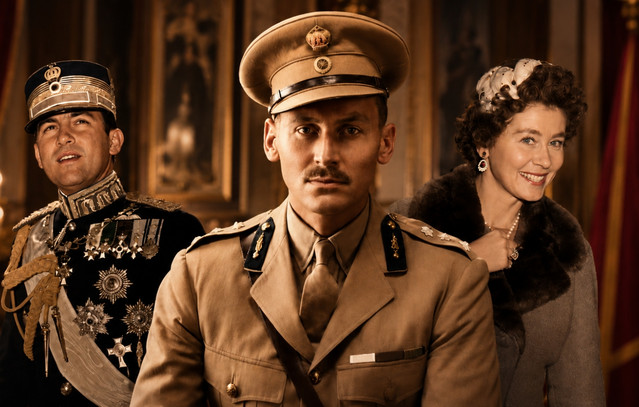
Prince Peter of Greece severed his ties with the Greek royal family and relinquished his rights to the throne after marrying a divorced Russian refugee in India.
His decision to wed Irina Ovchinnikova in 1939 triggered a feud with Queen Frederica and his family that lasted for decades, altering the royal line of succession until the monarchy was abolished.
Prince Peter was born into European royalty as the son of Prince George of Greece and Denmark and Princess Marie Bonaparte, a wealthy French psychoanalyst. Through his father, who was the second child of King George I of Greece and Queen Olga, Peter belonged to the House of Schleswig-Holstein-Sonderburg-Glücksburg.
Raised in an environment shaped by art, science, and prominent intellectuals, Peter acquired a broad academic perspective that diverged from traditional life at the royal court. He was tall, imposing, and accomplished, earning advanced degrees from major European universities. Prior to his marriage, he was third in line to the Greek throne.
His dynastic prospects changed after he met Ovchinnikova in Lyon, France. As a divorced Russian refugee without noble ancestry or titles, Ovchinnikova was regarded by the Greek royal family as unsuitable for a prince of the blood.
When Peter announced his intention to marry her, his family responded with immediate opposition. His father, Prince George, refused to meet Ovchinnikova and cut off personal relations with his son. Despite facing social outcry, threats of disinheritance, and intense familial pressure, Peter refused to back down.
Forbidden marriage in India
In 1939, Peter and Ovchinnikova married in a civil ceremony in Mandras, India, conducted away from the public eye and without any relatives present. The marriage resulted in his formal and permanent removal from the succession to the Greek throne.
Following his break with the court, Peter redirected his energy toward anthropology. Rather than living a comfortable life in Europe, he organized and led multi-year scientific expeditions across Asia.
He spent more than five years living along the border between India and Tibet, conducting field research under severe conditions. His work focused on documenting local tribes, polyandry, and regional religious customs, making him one of the first European scholars to record Tibetan culture with systematic academic precision.
Ovchinnikova accompanied him on his travels and managed the daily logistical needs of the expeditions, demonstrating a lasting partnership throughout his scientific career.
Anthropological work in the Himalayas
As leader of the historic Danish Central Asian Expedition, Peter combined ethnographic fieldwork with psychoanalytic principles. His mother, Marie Bonaparte, was a close associate and student of Sigmund Freud, and Peter applied psychoanalytic concepts to examine how the complex family structures of isolated tribes shaped human psychology.
His field research took place shortly before the Chinese invasion of Tibet, which transformed traditional Tibetan social structures. His documentation preserved detailed records of Tibetan culture before those changes occurred.
Working with limited equipment, Peter gathered medical and anthropometric measurements from 5,000 local residents, recorded rare Buddhist chants, and filmed traditional rituals never before witnessed by Western observers.
A substantial portion of his ethnographic collection is preserved today at the National Museum of Denmark in Copenhagen, while his collection of rare Tibetan manuscripts and woodcuts is housed at the Royal Library of Denmark.
Feud with Queen Frederica
While Peter's father responded with cold distance, Queen Frederica, the wife of King Paul, turned the family dispute into open warfare. Frederica viewed his marriage to a commoner as a direct insult to dynastic prestige and a threat to monarchical authority.
Peter described Frederica as an authoritarian figure who manipulated King Paul, and their dispute quickly escalated into public view.
During World War II, Peter served as an officer in the Greek military in the Middle East. Upon his return to Athens after the war, Frederica ensured he was completely isolated from court affairs, barring him from entering royal palaces and treating Ovchinnikova as an unwelcome figure.
Peter retaliated by granting interviews to foreign media outlets, where he criticized Frederica's methods and stated that he did not recognize her authority over family or political matters, leading to his long term exile from Athens.
Constitutional dispute over succession
The confrontation expanded following the death of King Paul in 1964. Peter publicly challenged the succession order, arguing that the 1952 constitutional revision that granted succession rights to female members of the dynasty was illegal.
Under his interpretation of the original dynastic rules, Peter maintained that he would have been the legitimate heir presumptive to King Constantine II had his marriage not led to his exclusion.
When King Constantine II officially recognized his sister, Princess Irene, as heir to the throne, Peter protested publicly. Shortly after Constantine married Princess Anne-Marie of Denmark, Peter renewed his public attacks on Queen Frederica, accusing her of decisively influencing her son's decisions and interfering in the operation of the monarchy.
The dispute intensified in 1965 with the birth of Princess Alexia, who was designated heir presumptive. Peter rejected her status, contending that the 1952 constitutional amendment was unconstitutional.
In 1965, following a political rift between King Constantine II and Prime Minister Georgios Papandreou, Peter publicly criticized the monarch's handling of the crisis and suggested that he could serve as an alternative candidate for the Greek throne.
His claims ended when the Greek monarchy was abolished in 1974, though he never altered his position that he remained the rightful heir under the historic rules.
Burial in Denmark
Before his death, Peter requested to be buried in the royal cemetery at Tatoi Palace near Athens, on the condition that Ovchinnikova be buried alongside him. Tatoi served as the private estate and traditional burial ground for members of the Greek royal house.
The royal family refused to permit a commoner to be interred in the royal cemetery. In accordance with instructions Peter had left, he was buried at Lille Bernstorff in Denmark following his death in 1980.
Ovchinnikova died ten years later, in 1990, and was buried beside him at Lille Bernstorff.


