

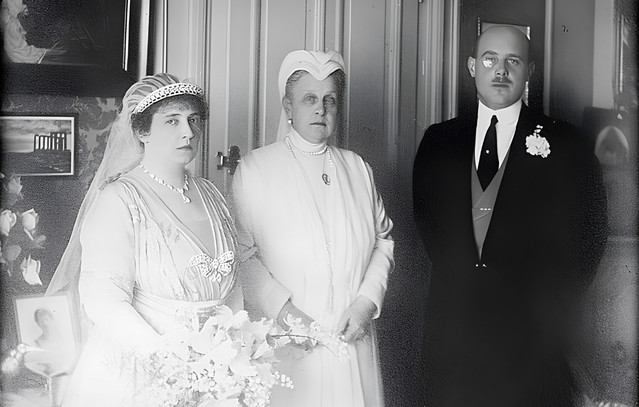
Prince Christopher of Greece married American heiress Nancy Stewart in Vevey, Switzerland, concluding a quiet six-year conflict with the Greek royal court.
The marriage on New Year's Day in 1920 united the youngest son of King George I and Queen Olga with an extraordinarily wealthy widow whose fortune would later save the exiled royal dynasty from financial ruin.
Prince Christopher, an avid lover of art, music, and comfortable living, had previously turned down three separate offers to take a throne in Portugal, Lithuania, and Albania. He preferred to avoid the stress and heavy burdens associated with reigning over a nation.
A chance meeting in Biarritz
The course of his life changed during the summer of 1914 in the French coastal resort of Biarritz, where he met Nancy Stewart. Stewart was an elegant American woman ten years older than Christopher, though some accounts placed the age gap at fifteen years.
She possessed a massive fortune that sources estimated at more than $40 million, an extraordinary sum for the early twentieth century. Stewart had inherited the vast estate from her second husband, William Leeds, a wealthy industrialist known as the tin king.
Her wealth allowed her to maintain a private salon inside the Cartier boutique on Rue de la Paix in Paris. American newspapers dubbed her The Dollar Princess due to her lavish collection of jewels, which included rare diamonds, a pearl necklace valued at $340,000 at the time, Cartier creations, and pieces linked to the famous jewelry of Grand Duchess Vladimir.
Royal opposition and a secret agreement
Although the couple fell in love immediately, the announcement of their engagement on the Italian island of Capri provoked intense opposition in Athens. Royal protocol strictly forbade a marriage to an American commoner who had been married twice before, having gone through a divorce and the death of her second husband.
King Constantine I, Christopher's older brother, and Queen Sophia vetoed the proposed match, arguing that the union would damage the prestige of the dynasty. The refusal triggered a silent, exhausting dispute between Christopher and the palace that persisted for six years.
Palace officials suggested that Christopher renounce his Greek citizenship and royal rights to marry Stewart. He refused to abandon his family while World War I raged across Europe, while European newspapers cast Stewart as a wealthy fortune hunter seeking to purchase a noble title.
The standoff ended when the couple wed in a small, private ceremony in Vevey. To ease remaining court objections, Stewart converted to Eastern Orthodoxy and took the name Anastasia, after which King Alexander officially granted her the title of Princess of Greece and Denmark.
The royal permission came with strict conditions imposed by King Constantine I. Princess Anastasia was required to renounce any claim that her future children would hold equal royal inheritance rights, and she signed a private agreement pledging to cover all of Christopher's personal expenses so he would not draw from public funds or the royal treasury.
Funding the royal family in exile
The political upheaval following the Asia Minor Catastrophe forced the Greek royal family into exile, leaving them with frozen bank accounts and no income. The woman once rejected by the court became the family's sole financial lifeline.
Princess Anastasia used her fortune to maintain the exiled house. She purchased and rented homes for Christopher's siblings, paid for their daily living expenses, and funded the education of the younger family members, though the royal family publicly denied certain rumors regarding her money and political influence at the time.
Tragic final years and legacy
Three years after the wedding, Princess Anastasia was diagnosed with advanced stomach cancer. Doctors secretly informed Christopher that her condition was terminal, and sources noted that he chose to conceal the severity of the illness to spare her from fear before caring for her personally until her death in London in August 1923.
Rather than being buried at the royal estate in Tatoi, Greece, her final wish was for her body to be returned to the United States and placed in her family mausoleum in the Bronx, New York. She left her remaining estate to her son and to Christopher.
Christopher remained unmarried until 1929, when he wed Princess Françoise of Orléans while retaining his role as a beloved uncle to the royal family. Their son, Prince Michael of Greece, later known as the author Michel de Grèce, mirrored his father's choice by renouncing his succession rights to marry sculptor Marina Karella.


