

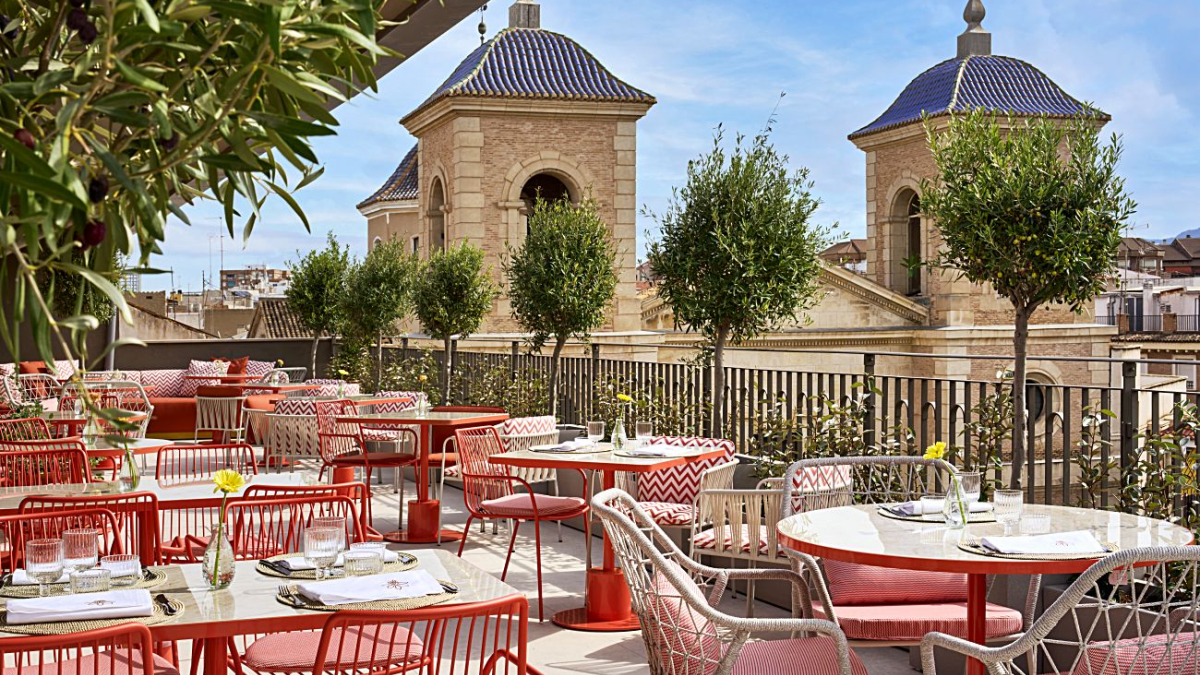
Murcia, Spain, has its first five-star hotel. Palacio San Juan, a Royal Hideaway Hotel, opened in September in what was once the home of the Count of Floridablanca. The property has 70 rooms, a rooftop with city views and a pool, and a food and drink offer overseen by Juanlu Fernández, the chef from Jerez de la Frontera who holds two Michelin stars at his restaurant LÚ Cocina y Alma.
The building belongs to Tomás Fuertes, president of Grupo Fuertes, the Murcian business holding company behind the food producer ElPozo Alimentación. Fuertes has handed day-to-day management to Barceló Hotel Group, the Mallorca-based hotel company that already runs four other properties for him. For this hotel, Barceló chose its most premium brand, Royal Hideaway, which it describes as reserved for properties in exceptional locations connected to the art and culture of their surroundings.
Sensory touches are part of that brand identity. At check-in, guests are offered a tasting of three scents, Narcisus, Sophisticated Oud and Bergamota Santalum, and whichever one they prefer is meant to resurface through small evocative details during their stay.
A jurist's residence
José Moñino y Redondo, known to history as the Count of Floridablanca, lived from 1728 to 1808. The Murcian jurist rose to become secretary of state under King Charles III and King Charles IV. His rapid rise in the Spanish court led him to commission a residence befitting his standing in his home city in the late 18th century. The architect Ramón Berenguer built a four-storey palatial house in the centre of Murcia, a short walk from the city's cathedral, where Moñino spent periods after leaving political life. The building passed through various uses over the following two centuries before reopening as the city's first five-star hotel.
Two years of work, 18 million euros
The renovation was led by Jesús Zafra of the firm Zorg Arquitectos. Zafra said the project involved a series of small interventions to reconcile the different floor heights of the two buildings that make up the hotel, giving coherence to a structure that had seemed chaotic and unworkable. Demolishing the previous hotel on the site was ruled out as unfeasible, so Zafra chose to transform it instead, reorganising the entrances and relocating the reception and restaurant areas. The work took 24 months and cost 18 million euros. Zafra summed up his aim as making sure his intervention was noticed as little as possible.
70 rooms from 275 euros
Little survives of the original palace beyond its neoclassical facade and the wooden doors at the entrance, but the elegant feel of a private residence carries through into the communal areas and the 70 rooms, some of which have private terraces. Rates start at 275 euros a night without breakfast. Wood, marble, natural light, high ceilings and natural textures dominate throughout, tied together by a terracotta tone that runs through the hotel. Murcia itself appears in details such as corridor bas-reliefs depicting scenes from the Santa María cathedral and the city's traditional market gardens, and railings that echo the shape of the nearby Arco de San Juan, the archway that gave its name to the hotel that occupied the building until 2020. The custom, handcrafted furniture was made by J. Martín, a company based in Jumilla.
A Michelin-starred menu
All of the hotel's food is overseen by Fernández. His influence runs through the menu at Ocra, the ground-floor restaurant whose name comes from spelling arco, the Spanish word for arch, backwards. Ocra pays tribute to local Murcian produce with starters of aubergine, peppers and tomatoes alongside croquettes, tartares, wagyu cecina, salted fish and white shrimp. Main courses include a red tuna chop and scallops with cod tripe, while the meat section features lamb ravioli in its own juices, a dish called Lechazo churro, chato murciano pork shoulder and roast coquelet. Off the menu, the restaurant also serves long-matured meats and its own aged fish, both prepared on site.
Ocra seats around fifty diners. In the coming weeks, a terrace is due to open in the Plaza de San Juan behind the hotel, and a separate bar aimed at snacking is being fitted out in a space beside the main entrance on Plaza Ceballos. Fernández said he had been surprised by the average bill at Ocra, which runs between 60 and 80 euros, higher than he expected. He said that in Murcia people like to eat well and are willing to spend money on it, speaking as he showed off the chamber where four red snappers were hanging as they matured.
Rooftop pool for guests only
Room service and breakfast, served buffet-style and a la carte in the fourth-floor restaurant Floridablanca, also carry Fernández's signature, as does the cocktail and drinks list at Royal Heaven, the rooftop bar overlooking the city, which is due to add tapas and shared plates later on. The rooftop is open daily from 7pm to midnight and is accessible to people who are not staying at the hotel. The small pool located there, however, is reserved for guests only.
What happens next
A terrace is due to open in the coming weeks in the Plaza de San Juan behind the hotel, and a separate snack bar is being fitted out near the main entrance on Plaza Ceballos.
Test yourself
Whose former residence does Palacio San Juan occupy?
How much did the hotel's renovation cost?
Who oversees the hotel's gastronomy?
Have your say
Would you consider staying at a historic palace hotel like Palacio San Juan?
Where it happened
Murcia, Spain


