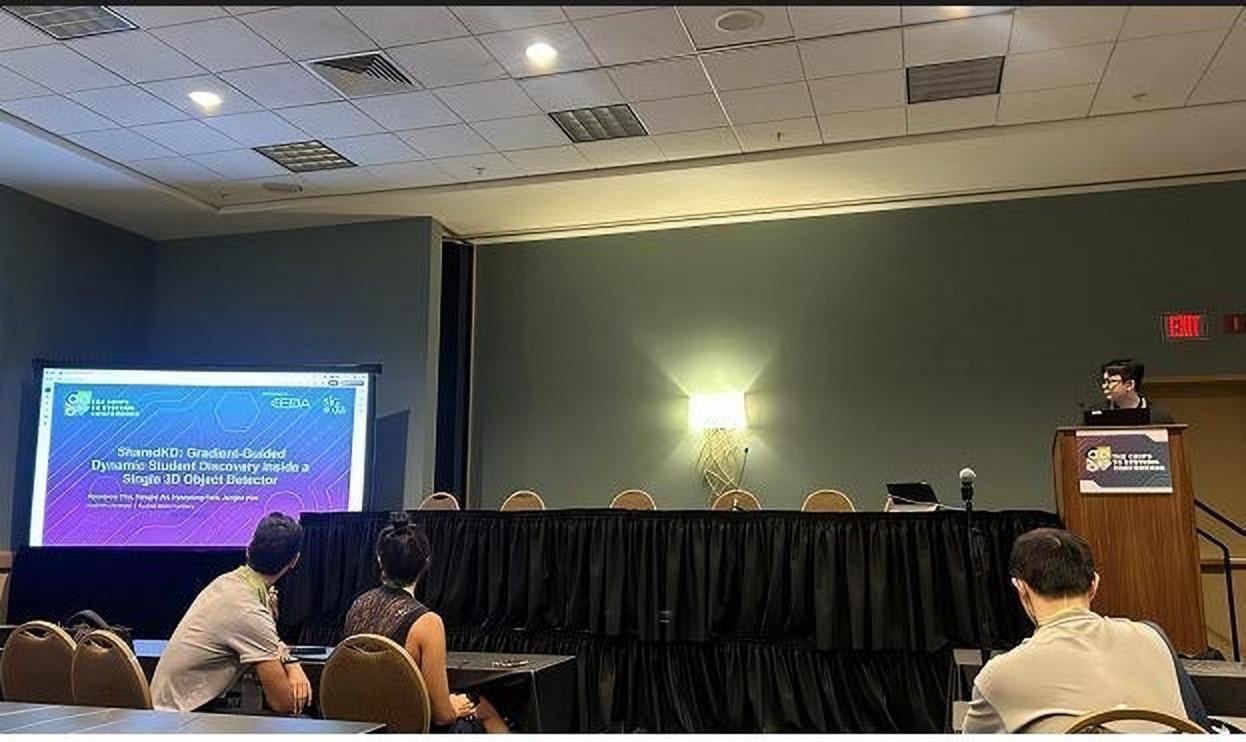
Researchers from Hyundai Motor and Kookmin University have developed a neural network compression technique called SharedKD that reduces the size of 3D detection models by 75 percent while increasing accuracy on autonomous driving benchmark tests.
The new method achieved a nuScenes Detection Score 2.55 percent higher than the previous record on the nuScenes dataset, despite discarding three quarters of the original model structure.
SharedKD combines two common approaches to neural network compression: pruning and knowledge distillation within a single 3D detector. The system allows a vision model to maintain spatial perception accuracy while operating on limited computing resources.
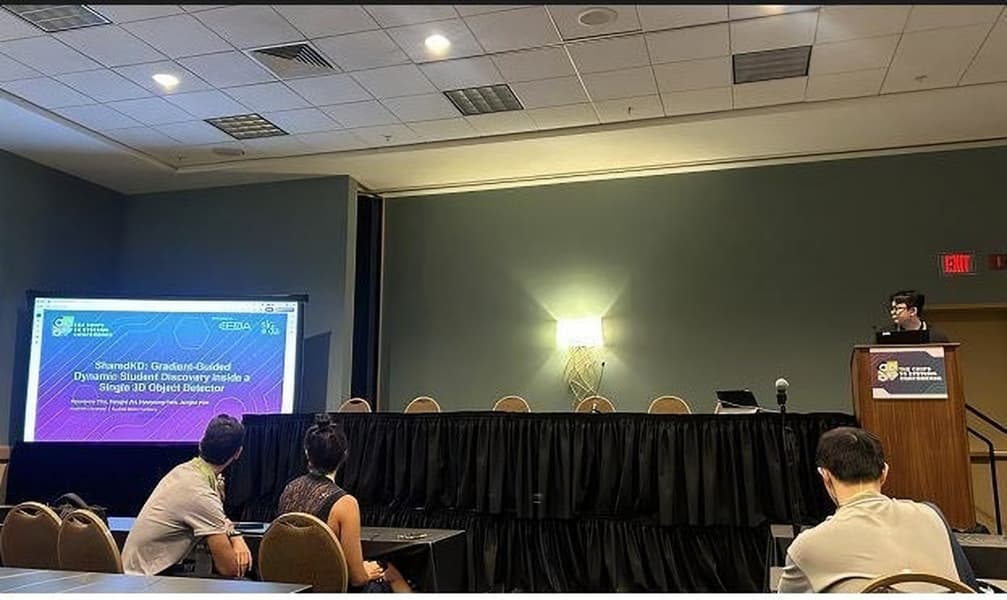
In traditional knowledge distillation, a large teacher model and a compact student model exist separately, with the teacher transferring information to the student. Under SharedKD, the full version of the network acts as its own dynamic teacher while its reduced subnetwork serves as the student. A gradient-guided selection mechanism allows both components to evolve simultaneously during training, eliminating the need to build and maintain a separate teacher network.
Testing on the nuScenes benchmark
The research team evaluated SharedKD using nuScenes, a widely used public dataset designed for developing autonomous driving perception systems through vehicle sensor data and environmental object annotations. The 2.55 percent performance gain applies specifically to the 75 percent pruning rate on the nuScenes evaluation suite.
The nuScenes Detection Score serves as a comprehensive benchmark metric that evaluates how accurately a 3D perception system recognizes and localizes objects in three-dimensional space. It combines several distinct quality characteristics into a single evaluation score for environmental detectors.
Hyundai Motor Company is South Korea's largest automaker, headquartered in Seoul, while Kookmin University is a private research university located in the same city. Autonomous vehicles rely heavily on 3D computer vision detectors to process camera, LiDAR, and radar sensor feeds to identify nearby vehicles, pedestrians, and road obstacles in real time. Neural network compression techniques such as pruning and knowledge distillation are essential for fitting complex artificial intelligence models onto lightweight automotive microprocessors.
Current limitations and hardware testing
According to Kookmin University, the SharedKD approach reduces overall computational load and execution times. However, the published research materials do not include specific numerical measurements for key operational parameters. The authors did not report data regarding performance on automotive accelerator chips, frame processing latency, system throughput, memory consumption, or power usage.
Because of these missing metrics, the researchers noted that the current results remain at an experimental research level. The benchmark test demonstrates the theoretical advantages of SharedKD, but it does not confirm whether the compression technique is ready for deployment in production vehicles.
Determining commercial readiness will require dedicated hardware testing on target automotive microprocessors. Future evaluations must assess performance under specific vehicle sensor configurations, strict real-time latency constraints, and specialized safety validation datasets used for autonomous driving certification.