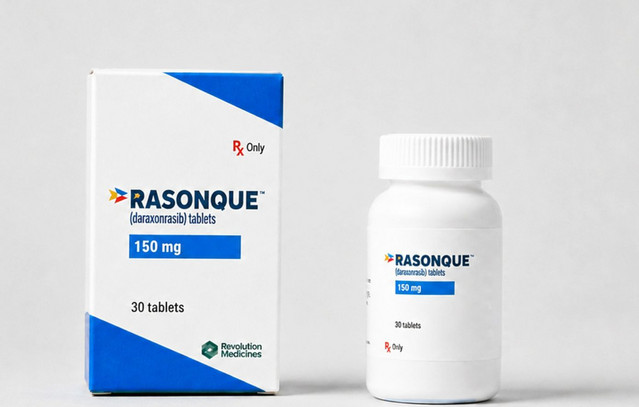
The US Food and Drug Administration approved Rasonque on August 26, 2026, providing a new oral treatment option for adult patients with metastatic pancreatic adenocarcinoma.
Developed by biotechnology company Revolution Medicines, Rasonque, known generically as daraxonrasib, is taken once daily by mouth. It is the first approved therapy that broadly targets the RAS protein family, a key molecular mechanism that fuels tumor growth in the vast majority of pancreatic adenocarcinomas.
Pancreatic adenocarcinoma is an aggressive form of cancer that begins in the digestive tissues of the pancreas. When the disease becomes metastatic, cancer cells spread from the primary pancreatic site to distant organs throughout the body, making surgical intervention impossible and significantly reducing survival rates.
The regulatory approval specifically applies to adult patients with metastatic pancreatic adenocarcinoma who have already received at least one prior systemic therapy. It also covers patients who are not considered suitable candidates for treatment with a combination of multiple systemic agents.
Systemic therapies involve medications that travel through the bloodstream to treat cancer cells across the entire body. Regulators noted that the clearance does not apply to all pancreatic cancer patients, nor does the treatment represent a cure, though it offers a targeted option for patients with advanced disease who previously had limited choices.
Trial results show significant survival increase
The decision by the FDA was based primarily on data from the Phase 3 RASolute 302 clinical trial. The study evaluated 500 patients with metastatic pancreatic cancer whose disease had progressed after receiving prior treatment. Participants in the study were assigned to receive either daraxonrasib or standard chemotherapy.
Patients receiving Rasonque achieved a median overall survival of 13.2 months, compared to 6.7 months for those treated with standard chemotherapy. Revolution Medicines reported that the drug reduced the risk of death by approximately 60 percent during the clinical trial.
The median progression-free survival reached 7.2 months with Rasonque, compared to 3.6 months in the chemotherapy group. A higher percentage of patients receiving daraxonrasib also experienced tumor shrinkage, leading medical experts to describe the results as one of the most significant developments in metastatic pancreatic cancer treatment in recent years.
Overcoming decades of targeted therapy challenges
Mutations within the RAS biological pathway, particularly in the KRAS gene, are detected in the vast majority of pancreatic adenocarcinomas. For decades, researchers considered these specific proteins extremely difficult to target effectively with pharmaceutical agents.
Unlike earlier drugs that focused on single genetic variants, daraxonrasib was engineered to block multiple active forms of RAS proteins. This broad therapeutic action is critical in pancreatic cancer, where more than 90 percent of tumors display RAS activation.
Expedited decision and international market status
The FDA granted approval approximately 6.5 months earlier than the original projected completion date for its evaluation. The agency used expedited review procedures due to the pressing medical need for effective therapies, after previously granting the drug Breakthrough Therapy and Orphan Drug designations.
Breakthrough Therapy status accelerates the assessment of drugs showing early promise for serious conditions, while Orphan Drug designation provides regulatory incentives for therapies treating rare diseases. Rasonque is now available by prescription in the United States.
The clearance applies strictly to the US market. The decision does not grant automatic approval in the European Union, where pharmaceutical products must undergo a separate evaluation process by European regulatory authorities.
As with other anticancer treatments, daraxonrasib is associated with side effects. The most common reported adverse events include rash, diarrhea, stomatitis, nausea, fatigue, vomiting, abdominal pain, decreased appetite, and edema. Stomatitis involves painful inflammation and sores inside the mouth.
While health officials emphasize that Rasonque does not resolve the overall challenge of pancreatic cancer, its approval marks a major advance for a disease where progress has remained slow for decades and options after initial treatment failure have been sparse.