

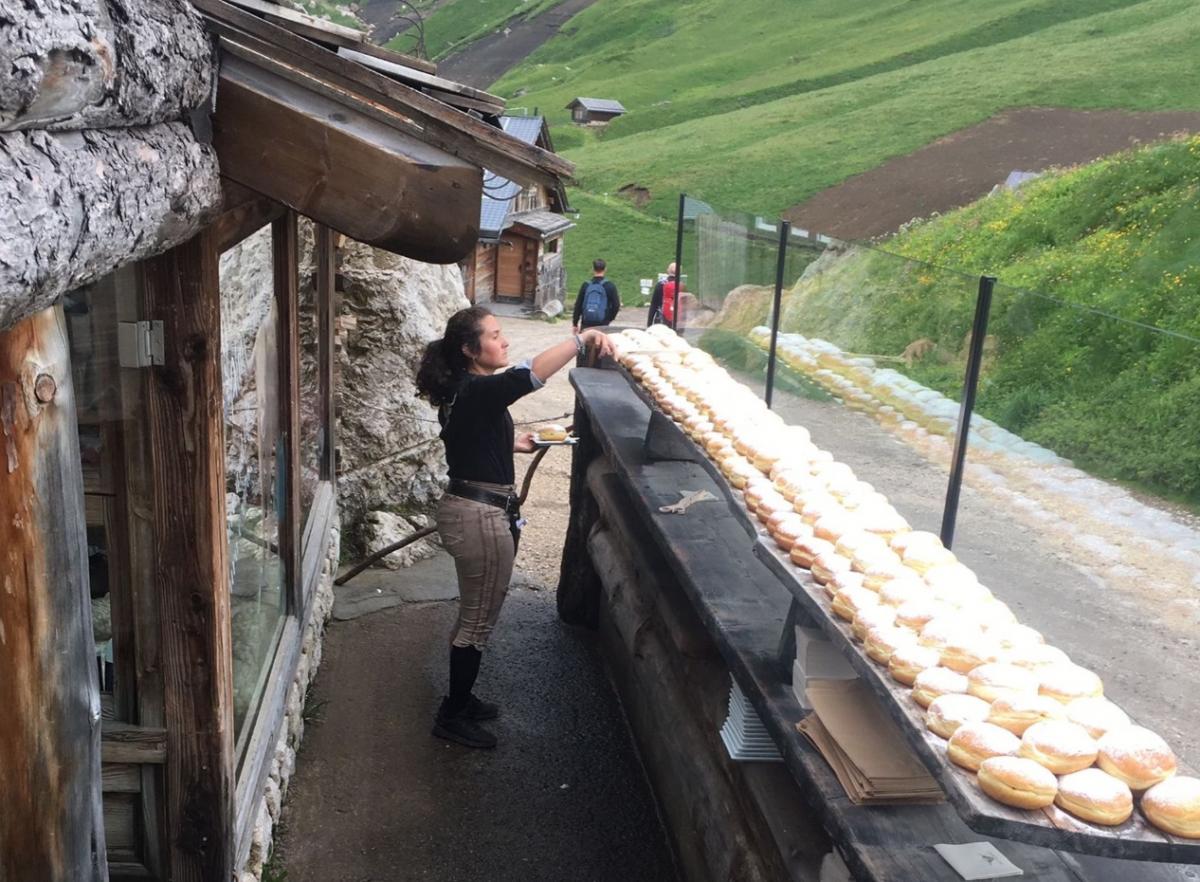
Hundreds of tourists have swarmed the Friedrich August refuge in the Italian Dolomites in search of creamy pastries rather than panoramic mountain views, sparking fresh debate over social media driven overtourism. The influx was reported by The Guardian after crowds filled the high-altitude site.
Visitors travelled to the refuge, which sits 2,300 metres above sea level between the Col Rodella and Sella passes in the Val di Fassa valley. Some tourists woke at dawn or spent the night sleeping in tents along the mountain path to ensure they could buy freshly baked krapfen, a traditional German doughnut-like pastry, before supplies ran out.
Food bloggers lured visitors by posting videos on social media in which they tasted the pastries, priced at up to 4 euros each, against the backdrop of the Dolomite Alps. Long queues quickly formed along the narrow trail leading to the mountain shelter. Rather than deterring visitors, images of the lines shared online attracted even more people to the area.
Visitors told Italian news outlet Rai News that they had travelled specifically for the pastries, with one visitor noting an Instagram post about krapfen accompanied by divine music had drawn them to the location. An employee at the refuge, who requested anonymity, said staff had been baking the pastries for 30 years without fuss. The employee blamed social media influencers for creating a chaotic situation and added that staff did not like the disruption.
Mountaineering groups raise overtourism concerns
Associations representing Italian mountain towns expressed concern over the influx, stating that the primary issue was not the pastries themselves but algorithms that direct large crowds into fragile alpine environments. Marco Bussone, president of the National Union of Mountain Communities, known as Uncem, said that the mountains are not a playground.
Francesco Abbruscato, president of the Venetian branch of the Italian Alpine Club, said image-driven tourism undermines the true spirit of the mountains. He stated that the main problem stems from people visiting alpine environments without knowing or respecting them. Abbruscato added that while overtourism was not observed in specific places or moments across the Dolomites five or six years ago, iconic locations are now crowded with dozens of people taking selfies who are there only for that purpose.
The Dolomites are a mountain range in northeastern Italy known for steep limestone peaks and high-altitude hiking paths. The Italian Alpine Club, founded in 1863, is the country's oldest mountaineering organization, while Uncem represents local alpine authorities working to balance tourism with environmental protection in mountain valleys like Val di Fassa.
Shift in European tourism habits
Alongside alpine tourism developments, recent research highlights broader changes in European holiday habits. A study conducted by French research firm IFOP revealed that the average proportion of European women regularly sunbathing topless on beaches fell by 10 percent between the mid-2000s and 2019.
The survey found that Spanish beaches recorded the highest annual percentage of topless sunbathing and experienced the smallest decline among all countries studied. Researchers noted, however, that an evident demographic shift occurred across European coastal destinations over the period.


