

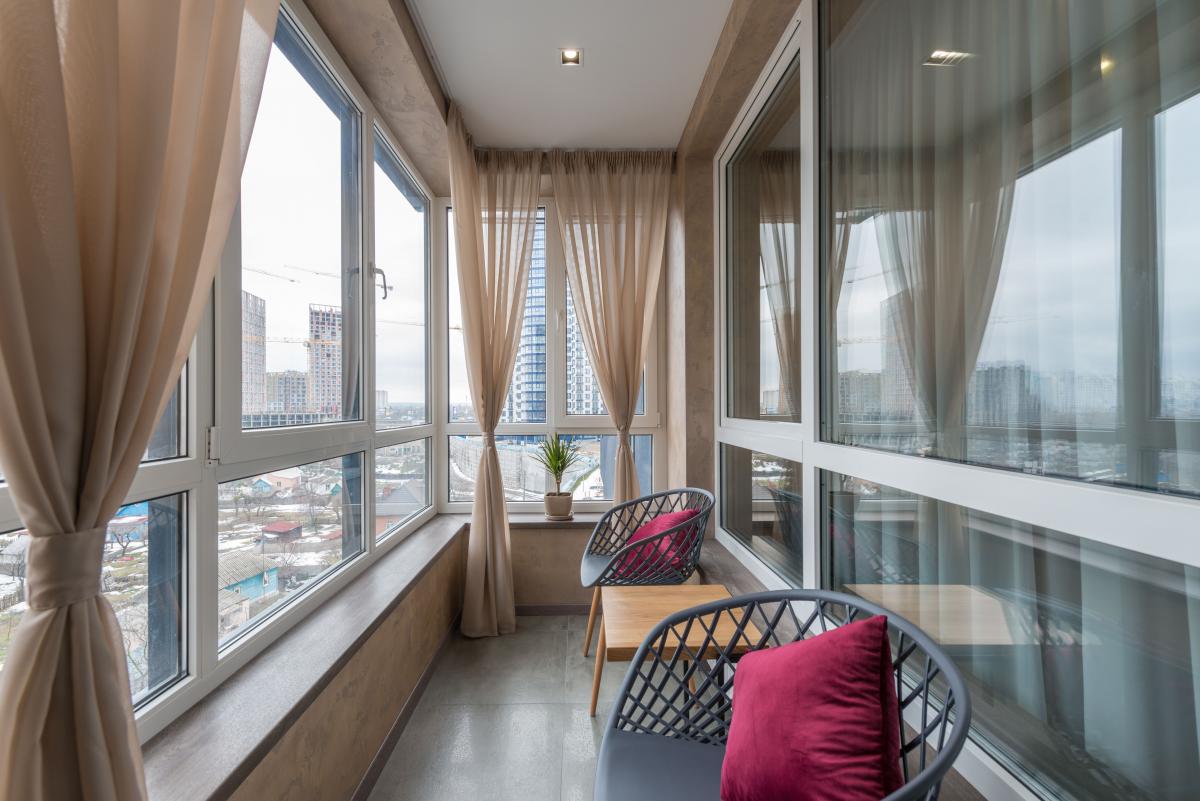
Ukrainian interior designers Tatiana Golovko and Tetyana Zhyvotchenko told news agency UNIAN that classic window curtains are returning to popularity as strict minimalism gives way to maximalism in home decor.
Golovko said long-standing trends favoring plain grey and beige window textiles have worn out their welcome, creating space for expressive fabrics that add character and emotional warmth to residential interiors.
She explained that emotional design has become a primary focus for homeowners seeking recovery during turbulent times, making bare windows suitable almost exclusively for commercial spaces such as restaurants, offices, and retail showrooms.
Maximalism and Window Clothing
Zhyvotchenko, founder of TZH-DESIGN studio, noted that traditional curtains themselves never became outdated, but rather the uninspired practice of hanging fabric merely to cover glass.
Heavy drapery folds, decorative pelmets, and theatrical opera-style curtains look out of place in rooms that require openness and light, according to Zhyvotchenko.
She described appropriate window textiles as tailored clothing for a room that establishes atmosphere, whether through floor-to-ceiling drapes, Roman shades, blinds, or uncovered glass. Pelmets, also known as lambrequins, are decorative framework or drapery hung above a window to conceal curtain rods and fixtures.
Modern interior design prioritizes individual lifestyle needs over rigid trend rules, Zhyvotchenko added. Factors such as night-shift working hours, light sensitivity, or sleep disruption dictate whether a space requires total light blockage or sheer coverings.
Practical Alternatives to Traditional Drapes
To achieve full darkness without traditional curtains, Zhyvotchenko recommended dense blackout roller blinds or lined drapery designed to seal both the window glass and edge gaps, turning bedrooms into quiet spaces for physical recovery.
Both experts highlighted Roman blinds as a versatile modern classic suitable for any window scale or room dimension. Roman blinds are fabric window coverings that fold into neat horizontal pleats when raised by a cord mechanism.
For homeowners seeking an open feeling where full-length drapes are impractical, Golovko suggested Roman shades, wooden blinds, or standard fabric roller shades.
Golovko said blinds, roller shades, and Roman curtains offer similar functional benefits by blocking sunlight, protecting privacy, and guarding against flying glass fragments during emergencies.
Explaining the price hierarchy, Golovko noted that roller shades represent the most budget-friendly option, followed by mid-tier Roman blinds, while natural wooden blinds carry the highest price tag and immediately elevate the status of an interior.
Window Decor Anti-Trends to Avoid
Outlining anti-trends for the 2026 and 2027 seasons, Golovko advised against installing traditional metal blinds even in commercial offices or medical centers.
She cautioned that metal blinds suffer from a short service life, break down frequently, and collect heavy dust accumulations over time.
Golovko also recommended avoiding dual-layer Day-Night roller shades on balconies. Although these systems allow users to alternate between transparent and opaque fabric stripes or block light entirely, Golovko said they generate visual clutter on balconies and cheapen the exterior appearance of building facades.
Human-Centric Design and Specialized Spaces
Golovko emphasized that professional textile decorators must center their choices on human-centric design by analyzing the daily routines of room occupants.
While one homeowner might require dense roller shades to block every ray of morning light, another household might benefit from motorized smart curtains programmed with a favorite setting to open automatically to a precise height in the evening.
In commercial environments, practical considerations take a different form. Golovko pointed out that specialized office drapery can reduce indoor air temperatures by 2 to 3 degrees Celsius while sound-absorbing acoustic fabrics help divide open spaces.
For bedrooms where classic floor-length drapes are not desired, Golovko recommended frame-mounted pleated roller systems. Pleated blinds feature accordion-folded fabric fitted directly onto window frames, minimizing space usage while offering a wide range of colors and textures.
For kitchen cooking areas and dishwashing zones, Golovko identified roller shades as the most effective solution. She added that water-resistant synthetic materials imitating wood enable wooden-style blinds to be installed safely in high-humidity areas like kitchens, bathrooms, and indoor pool enclosures.
Background of the Designers

Golovko holds a master's degree in design with a specialization in trend forecasting. Based in Kharkiv, she is the founder of the IT Deco interior agency, teaches custom courses at leading Ukrainian design academies, and curates professional exhibition tours abroad for interior decorators.

Zhyvotchenko graduated from V. N. Karazin Kharkiv National University with a degree in economic cybernetics. She transitioned to interior design after constructing her own home, completing specialized coursework in interior planning and 3ds Max visualization software.
Prior to Russia's full-scale invasion of Ukraine, Zhyvotchenko managed a design firm in Kharkiv. She currently works as an interior designer for the Kharkiv manufacturer Ermitagedecor, which produces decorative gypsum ceiling moldings, regularly attends international design expos in France and Germany, and launched her independent studio TZH-DESIGN on July 1, 2026.


