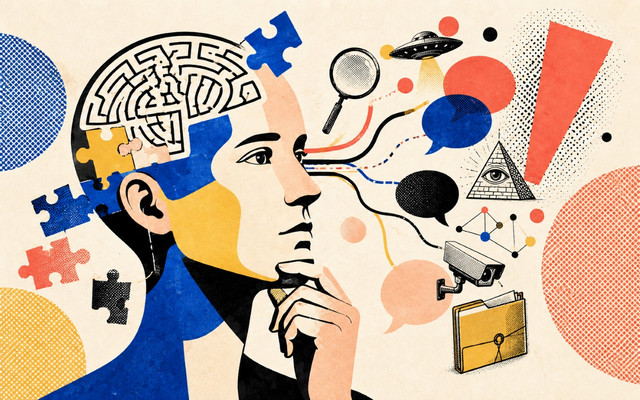
Research published in Psychology Today in 2026 shows that people who adopt extreme conspiracy theories are driven by excessive self confidence, fear and cognitive biases.
Scientists examining how information is processed found that individuals prone to fringe theories display overwhelming certainty in their views while wildly overestimating public support. Although conspiracy believers made up just 12 percent of study participants, they believed they were part of the majority in 93 percent of cases.
The report noted a central paradox in conspiracy thinking, where unproven claims rejected by most people become absolute truth for a minority. The more extreme an assertion appears, the greater the certainty shown by those who embrace it, with believers frequently describing themselves as critically thinking free people.
Overconfidence and cognitive distortions
The 2026 study analyzed the mental mechanisms that lead individuals to adopt and maintain ungrounded narratives. Researchers found that overconfidence was most strongly tied to the most fringe and radical theories, leaving believers convinced that others shared their views despite holding minority opinions.
Social psychologists explain that deeply rooted mental distortions move ordinary judgment away from factual data. One key driver is cognitive dissonance, a psychological term describing the discomfort caused by contradictory thoughts or behaviors. To resolve this uncomfortable internal conflict, individuals may adopt a conspiracy theory that provides a convenient explanation.
Once an unusual belief takes root, confirmation bias reinforces it by leading people to seek supporting evidence while ignoring contradictory facts. This pattern is common in political media consumption, but social media platforms now make it simple to locate material backing any fringe claim while discarding extensive counter evidence.
Social conformity and existential fear
Because conspiracy adherents remain a small minority, maintaining their views requires social reinforcement. Studies on social conformity reveal that connecting with just one agreeing person can solidify a belief. Social media networks frequently serve as gathering points for like minded individuals, prompting believers to report that many others share their ideas.
Psychologists also linked fringe narratives to existential fears surrounding mortality, personal security and democratic institutions. Unfounded perceptions often develop as direct extensions of individual anxiety over safety and survival.
Research into deception indicates that larger, more audacious lies can be easier for people to accept. Hearing an extreme claim can lead individuals to conclude it must be true because of its sheer severity. This mechanism draws people into unusual belief systems and is subsequently used to recruit others.
Challenging conspiracy beliefs
Psychology Today, an American publication founded in 1967 to cover human behavior and mental health, highlighted that dismantling conspiracy beliefs is notoriously difficult. Because believers possess high confidence and overestimate social consensus, standard arguments often fail to alter their mindset.
Researchers stated that the primary antidote involves presenting as much objective evidence as possible that directly contradicts the belief. Even if contradictory facts are initially dismissed, experts noted that encouraging individuals to engage in genuine critical thinking remains the essential first step toward shifting their perspective.