

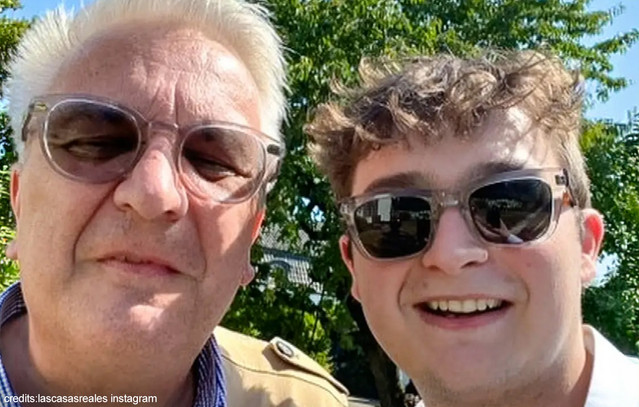
Clément Vandenkerckhove has officially received the title of Prince of Belgium after being formally recognised as the biological son of Prince Laurent, the younger brother of King Philippe. The 26-year-old former car salesman gained official entry into the Belgian royal family through a legal paternity process completed discreetly about six months ago.
The official recognition of paternity was formalised during a ceremony at a town hall, though details of the agreement only emerged much later. While the legal recognition grants him the right to use the royal title, it does not entitle him to any state financial support or public allowance.
Vandenkerckhove is the son of Prince Laurent and the Belgian singer Wendy Van Wanten, whose real name is Iris Vandenkerckhove. The prince and the singer were in a relationship during the 1990s, prior to Prince Laurent marrying Princess Claire in 2003.
Surname and royal title
Despite his new royal status, Vandenkerckhove has not yet decided whether he will abandon his mother's surname to adopt Saxe-Coburg, the historical family name of the Belgian royal house. Speaking to the Dutch-language Belgian newspaper Het Nieuwsblad, he said he might consider making the change in the future, but emphasised that he remains proud of the Vandenkerckhove name. He explained that giving up his maternal surname would feel like a betrayal of everything his mother had done for him throughout his life.
The acquisition of the title does not alter his position within the constitutional operation of the Belgian monarchy. Vandenkerckhove will have no place in the line of succession to the Belgian throne, nor will he participate in official public engagements or duties on behalf of the royal family. The line of succession continues to include Prince Laurent's three children from his marriage to Princess Claire, namely Princess Louise, Prince Nicolas, and Prince Aymeric.
Discovery and DNA testing
The relationship between Vandenkerckhove and his biological father developed gradually over several years. His mother first revealed the identity of his father to him when he was 16 years old. Four years later, at the age of 20, he made his first telephone call to Prince Laurent. The two men maintained regular contact, which eventually led to a face-to-face meeting.
Confirmation of their biological relationship was established through a DNA test that Prince Laurent himself proposed. Recalling the test during a Flemish television documentary broadcast by VTM, Vandenkerckhove remembered going to the hospital together with the prince, who offered to undergo the sample collection first to help him feel more comfortable. The subsequent laboratory results confirmed a 99.5 percent DNA match between the two men.
Their very first meeting had actually taken place much earlier, in 2013, at a shopping centre, at a time when Vandenkerckhove was still unaware that the man he encountered was his father. His personal story and gradual journey toward building a relationship with Prince Laurent were featured in detail in a Flemish television documentary broadcast last September.
State subsidies and royal precedent
While Vandenkerckhove now holds a prince's title, he remains excluded from public funding due to strict financial regulations governing the Belgian monarchy. Amendments made to Belgian law in 2013 significantly restricted the number of royal family members eligible to receive a state endowment. Currently, state financial support is limited to King Philippe, former monarch King Albert II, Prince Laurent, and Princess Astrid, leaving Vandenkerckhove without any claim to public funding.
The legal recognition of Vandenkerckhove closely mirrors an earlier high-profile paternity case within the Belgian royal family. Prince Laurent's father, former King Albert II, was involved in a long-running court battle with artist Delphine Boël. In 2020, following years of legal disputes and a court-ordered DNA test, King Albert II publicly acknowledged that he was her biological father. Boël subsequently gained the right to be styled Princess of Belgium and now uses the name Delphine de Saxe-Cobourg. That case attracted widespread national attention in Belgium and was closely linked to the period surrounding King Albert II's abdication from the throne in 2013.


