

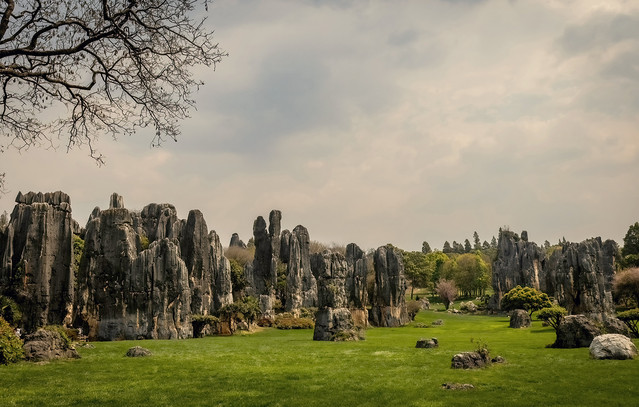
Towering, sharp limestone formations rising skyward in the Yi autonomous region of Yunnan Province, southwestern China, form Shilin, known globally as the Stone Forest. The UNESCO World Heritage site, which dates back more than 270 million years, draws travelers with a dramatic landscape that creates the illusion of a dense, petrified forest.
Beyond the geological explanation of rock erosion, local villagers recount a romantic and tragic myth explaining how the stone labyrinth was created. According to ancient tradition, the forest was born from the tears of Ashima, a young woman of the Yi ethnic group whose name signified being precious and shining like gold.
Ashima fell in love with a poor young shepherd named Ahei, but her beauty drew the attention of Azhi, the son of a wealthy and evil local landowner. When Ashima rejected Azhi's proposal of marriage, the landowner's son abducted her by force.
Determined to save his beloved, Ahei rushed to the estate and challenged the abductor to a traditional singing contest in accordance with tribal customs. The competition lasted for three days and three nights, with Ahei winning every trial and forcing the landlord to release Ashima.
The Legend of Ashima Rock
The outcome turned tragic as the couple made their journey back home. Enraged by his defeat in the singing contest, Azhi caused a sudden, catastrophic flood along the river, sweeping Ashima away in the rushing waters where she drowned.
Rather than perishing entirely, lore says Ashima transformed into a towering stone pillar inside the Little Stone Forest, known today as Ashima Rock. The formation resembles a young woman wearing a traditional Yi headscarf and carrying a bamboo basket on her back.
Locals maintain that shouting Ashima's name inside the stone forest produces an echo that serves as her living voice. The tale remains a cornerstone of regional folklore, giving emotional depth to the surrounding geological features.
Exploring the Shilin Karst Labyrinth
Visitors walking the narrow paths of Shilin find that the noise of the modern world fades away beneath rock columns that reach the height of multi-story buildings. Changing sunlight creates shifting shadows across a terrain filled with natural caves, hidden lakes, and dark labyrinths.
The park is divided into several distinct sections, including the Major Stone Forest, the Little Stone Forest, and the Naigu Stone Forest, which is characterized by darker dolomitic rock formations. The broader complex also encompasses subterranean caverns, waterfalls, and lakes formed over geological epochs.
Cultural Heritage of the Sani People
The region surrounding the stone formations has been inhabited for centuries by the Sani people, a branch of the Yi ethnic group with a rich cultural heritage. Sani communities continue to preserve their ancestral customs while residing around the periphery of the site.
Each year, local communities organize the famous Torch Festival, featuring traditional music, dances, and wrestling competitions. The annual event attracts crowds of travelers eager to experience the living culture alongside one of southwestern China's most famous natural landmarks.


