

Veterinary experts speaking to pet care publication Parade Pets have identified seven distinct behavioral signs that indicate a domestic cat is healthy, comfortable, and living a happy life.
Understanding feline emotional states can prove more challenging than interpreting the behavior of other household pets. Individual cats vary widely in sociability, with some animals seeking constant human contact while others maintain a more independent demeanor.
Veterinarian Chyrle Bonk explained that owners should not assume a cat is unhappy simply because it declines to sit on a person's lap. Bonk noted that certain cats prefer not to express affection through lap cuddling, communicating their emotional well-being primarily through routine behavior and subtle body language instead.
Vocal signals and tail posture
Vocalization provides one of the clearest indicators of feline contentment. While purring frequently signals that a cat feels safe and trusts its owner, veterinarian Aimee Warner noted that happy cats may also produce vocalizations resembling melodic trills or bird chirping.
Warner explained that vocal tendencies differ significantly among individual felines, meaning that communicative pets in a positive mood will sometimes engage in back and forth vocal exchanges with their owners.
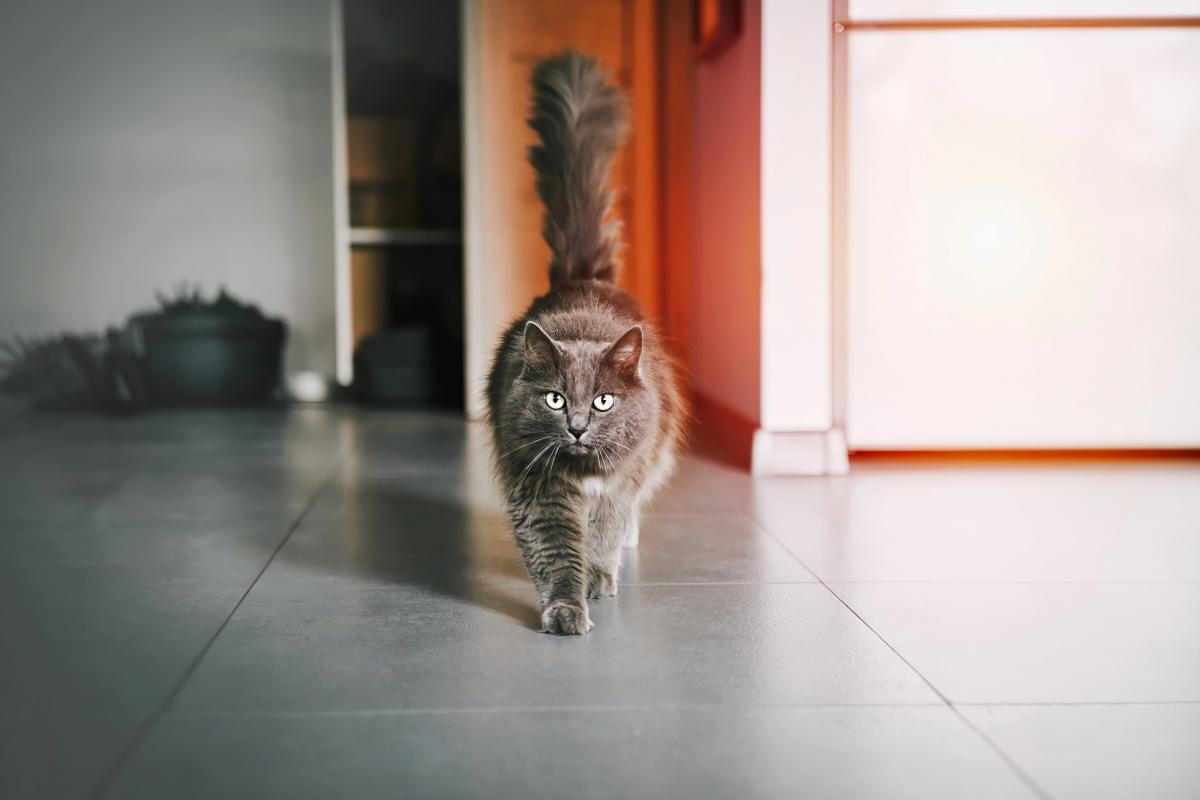
Tail positioning offers additional insight into a pet's emotional state. Bonk explained that a relaxed and happy cat routinely holds its tail curved at the tip in the shape of a question mark. While moving across a room, a content cat may also sway its tail gently from side to side.
Excitement can also alter tail movement. Bonk noted that a satisfied cat maintains a loose, un-tensioned tail posture, but may exhibit a slight trembling or quivering motion in its tail when particularly pleased to be near its owner.
Physical affection and scent marking
Physical contact such as facial rubbing serves as a key indicator of trust and social bonding. Felines feature specialized scent glands on their head and cheeks. Bonk explained that when a cat rubs its face against a handler's leg, arm, or body, it deposits its unique pheromones, effectively marking the person as its own.
Proximity preferences also reflect a cat's emotional state. Warner noted that cats enjoying human company will naturally follow their owners from room to room. However, Warner emphasized that a cat choosing to spend time alone is not necessarily unhappy, as affection levels naturally differ between pets.
Appetite and territorial scratching
Dietary habits correlate strongly with psychological well-being. Warner stated that a steady, healthy appetite generally demonstrates that a cat feels secure and relaxed in its environment. Because cats instinctively conceal physical weakness and illness, Warner advised that any sudden drop in food intake warrants a consultation with a veterinarian.
Scratching behavior also signals positive health and mood. Veterinarian Lisa Kahn explained that regular scratching is a normal feline activity that allows animals to stretch their muscles. Kahn added that scratching enables cats to leave visible claw marks and deposit scent marks from glands located in their paw pads, establishing and defending their territory.
Related insights into feline communication previously reported by Ukrainian news outlet UNIAN highlighted that specific physiological reasons govern why cats reveal their bellies without wanting them stroked, and noted that touching an owner with a paw usually represents a direct request for attention depending on the context.


