

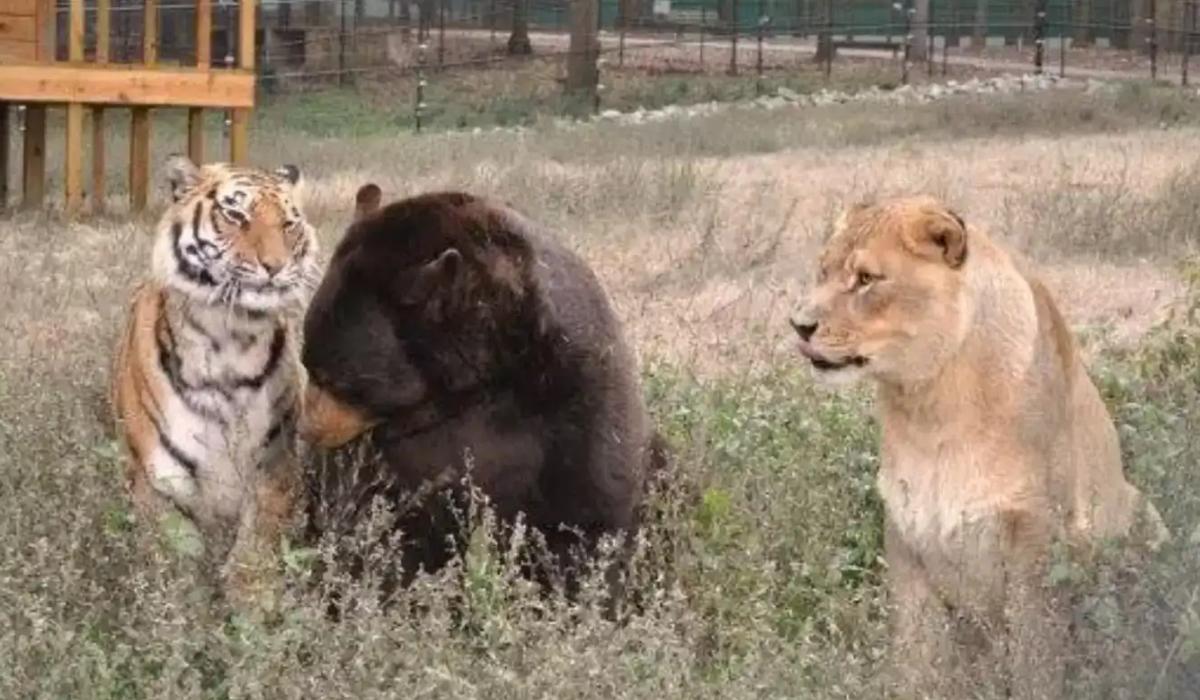
An American black bear named Baloo, an African lion named Leo and a Bengal tiger named Shere Khan have been buried together at Noah's Ark Animal Sanctuary in Georgia following the death of Baloo, completing a quarter-century story of interspecies friendship.
Baloo was humanely euthanized in the spring of 2025 after suffering a severe loss of mobility and physical strength, sanctuary caregivers announced. The elderly black bear had outlived his two companions by nearly seven years, remaining at the sanctuary until his final days.
The three animals first gained international attention after police rescued them as terrified cubs during a 2001 drug raid on a residential basement in Atlanta, Georgia. Officers discovered the malnourished cubs huddled together in dark conditions, serving as each other's sole source of comfort.
All three animals showed signs of severe abuse when rescued from the Atlanta home. Shere Khan the tiger was dangerously underweight, malnourished and infested with parasites. Leo the lion had been confined to a cage so small that he developed an open wound on his nose from constantly pressing against the metal bars.
Baloo the bear suffered the most severe injuries of the trio. A harness placed around his body when he was small was never loosened as he grew. The tight nylon material cut deep into his flesh, requiring surgical intervention after his rescue.
Rescue and Sanctuary Decision
Following their rescue, authorities transferred the animals to Noah's Ark Animal Sanctuary, a non-profit wildlife refuge located in Locust Grove, Georgia. Sanctuary staff initially planned to separate the three predators so each could live a quiet life in an individual enclosure.
However, efforts to separate the animals caused immediate distress. All three stopped eating, became highly anxious, and began growling and calling out to one another across the facility. Caregivers quickly abandoned the separation plan and allowed the bear, lion and tiger to share a single habitat.
The decision ran contrary to standard zoological practices. Tigers are solitary ambush hunters, bears lead mostly solitary lives, and lions are social animals that typically bond only with members of their own pride.
Wildlife experts cited by ZME Science explained that shared childhood trauma had effectively reprogrammed the animals' brain chemistry. The surges of cortisol caused by fear and abuse were softened by the physical presence of the other two animals, creating an unbreakable social bond.
Life inside the Shared Enclosure
For more than 15 years, visitors at the Georgia sanctuary watched the three apex predators live in harmony. Shere Khan frequently rubbed his head against Baloo's shoulder, while Leo napped as Baloo groomed the lion's mane. The trio shared meals, slept side by side, and routinely cared for one another.
The unusual bond eventually began to succumb to age and chronic health conditions. In August 2016, veterinarians diagnosed Leo with inoperable liver tumors. After a battle with the illness lasting several months, sanctuary caregivers made the difficult decision to euthanize the lion.
Following Leo's death, sanctuary staff monitored the surviving animals closely. Shere Khan and Baloo spent long periods sitting near the spot where Leo usually slept, displaying clear signs of depression.
In December 2018, Shere Khan died of old age and declining health right next to Baloo. The bear was left alone for the first time in his life, raising concerns among sanctuary caregivers that he might quickly decline.
Despite those fears, Baloo survived for nearly seven more years. He continued to greet sanctuary visitors while receiving veterinary pain management for age-related physical ailments before his health declined in the spring of 2025.
Sanctuary caregivers buried all three animals together, ensuring that the companions remained united at their final resting place.
Wild Horse Population Saved From Extinction
In additional wildlife conservation reporting published alongside the sanctuary update, researchers highlighted the recovery of Przewalski's horse, the only remaining wild horse species in the world. Small populations of the endangered animal continue to live in parts of Europe, including Ukraine.
The species managed to survive despite shrinking to a critical genetic bottleneck of just 31 captive animals, of which only 12 were capable of breeding. During the 1950s, small wild groups still inhabited Mongolia and China's Yellow Mountains, but the last confirmed wild sighting occurred in the Gobi Desert in 1969.
To prevent extinction, Prague Zoo launched a captive breeding recovery program. By 1990, the global captive population expanded to 961 horses across 33 countries on four continents, providing a sufficient foundation to reintroduce the species to the wild.


