

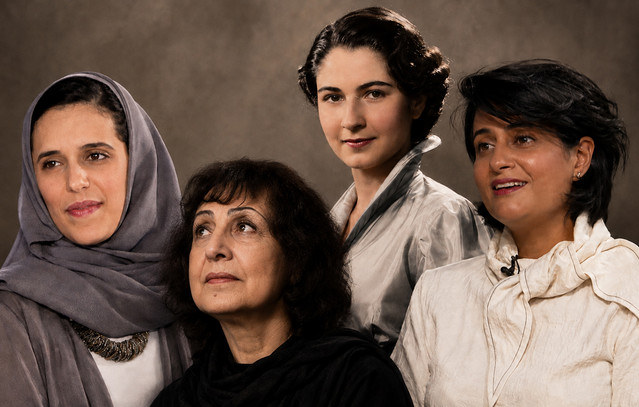
From Egypt to Oman, women born into the royal families of the Arab world have stepped beyond traditional duties to build significant careers in the visual arts, establishing galleries and exhibiting their work globally.
Queen Farida of Egypt
Queen Farida of Egypt, born Safinaz Zulficar in the Gianaclis district of Alexandria, was the daughter of Zainab Said, a lady in waiting and friend of Queen Nazli Sabri, and Youssef Zulficar, a judge and diplomat of Circassian descent with a passion for the piano. She married King Farouk in January 1938. Educated at the Collège Notre Dame de Sion, she adopted the name Farida to honour the wish of her late father in law, King Fuad, that his descendants bear names starting with the letter F.
She said in a 1977 interview with French journalist Jean Lacouture that although Farouk promised she would help with his duties, older politicians told the king a woman in the East should not mix in politics. During World War Two, she witnessed the 1942 Abdeen Palace incident, where British troops and tanks surrounded the residence and forced the king to form a coalition government with the Wafd party. She chaired the Women's Committee of the Egyptian Red Crescent to support war victims and became a patron of feminist organisations.
The couple divorced on November 17, 1948. While the lack of a male heir was often cited, the queen stated she wanted to end the marriage because she could no longer tolerate the debauched life Farouk had led since the early 1940s. Following the abolition of the monarchy in 1953, she lived in exile until 1974, initially in Lebanon and then in Europe.
Farida turned to painting to compensate for the absence of her three daughters, whom Farouk had taken to exile in Italy following the 1952 Revolution. Initially self taught, she worked in a studio provided by her uncle, Mahmoud Said, in his Alexandria palace, and at her home near the Giza pyramids. She left Egypt for Beirut in 1963, taking lessons from Lebanese Armenian painter Jean Guvder and selling portraits of the bourgeoisie to make a living. She moved to Switzerland in 1967 and held her first solo exhibition at the Galerie Hervé Odermatt in Paris in 1968, supported by gallerist Raymond Nacenta. Her technique involved using a blowtorch to treat melted metal mixed with colour.
In 1970, she studied art history at the École du Louvre, lithography at the Fernand Mourlot studio and engraving at Ateliers Rigal in Fontenay-aux-Roses. Her work later approached the Hurufiyya movement, forming Arabic letters such as Allah and galala from sails, tree trunks and architectural elements. She noted in a 1978 Paris exhibition catalogue that spiritual references in her paintings reflected her reflections on painting and her awareness of world turmoil. Despite a successful 1980 exhibition at the Le Méridien hotel in Cairo, she lived her final days in voluntary isolation on a meager pension in a small Maadi apartment.
Princess Hayfa of Saudi Arabia
Princess Hayfa bint Abdullah of Saudi Arabia, born in 1981, pursued her artistic education while remaining in Jeddah. She said before her solo exhibition at the Stellan Holm gallery in New York that her life was complicated as a mother of three, making domestic study her only option. She began classes with artist Mona Al-Kasabi in 2000, and her husband later hired Australian artist Naomi Greschke and Lebanese painter Malak Tabsh to train her. With the help of art teacher Melinda Placko, she enrolled in an online undergraduate program at the Art Academy University in San Francisco, where she is now pursuing a Master of Fine Arts.
She donated all net proceeds from her New York exhibition to the Child Mind Institute, an organisation supporting children with mental health problems. Speaking to Whitewall magazine, she said her work stems from imagination rather than realism, visualising ephemeral materials like ice cubes, perfume, smoke, fire and light transforming into portraits. She noted that as a woman raised in Arab culture she inevitably includes symbols of her life, just as an American artist includes Western objects, adding that true art should provoke a personal emotion that might differ from her intention.
Sheikha Lateefa of the United Arab Emirates
In the United Arab Emirates, Sheikha Lateefa bint Maktoum bin Rashid Al Maktoum founded Tashkeel, a contemporary art and design centre in Dubai. Her digital montages, installations and layered photography explore identity, cultural heritage and rapid social change, contrasting modern urbanisation with traditional Eastern landscapes. She has exhibited internationally since 2004, representing the UAE at the 2011 Venice Biennale, with major conceptual photographic works including Sustained Identity and Oral Tradition.
Sayyida Meyyan of Oman
Sayyida Meyyan bint Shihab Al Said, a member of the Omani royal family, specialises in photography and digital art. She married Sayyid Theyazin bin Haitham Al Said, the Crown Prince of Oman, at the Mazay Hall of Al Alam Palace on November 11, 2021. The couple, who are double first cousins, ended their marriage in early 2022.
Meyyan holds a bachelor's degree in interior design from the Virginia Commonwealth University School of the Arts in Qatar and a master's in design strategy from Brunel University London. She sold all the pieces at her 2021 debut solo exhibition, Fragments of Imagination, donating the proceeds to the Al Rahma Association for motherhood and childhood. Following her Reflections exhibition at London's Khaleeji Art Museum, she continues her work as a member of the Oman Photography Society, having won its Best Photography award in 2016. In 2021, she received the Apex Media Women of the Year award in the arts category. She chairs the Oman Design Association and has supported events including the Makan Studios opening, the Oman Across Ages museum event and the IDF Oman exhibition.
Princess Fahrelnissa Zeid of Jordan
Princess Fahrelnissa Zeid, who died in 1991, was a pioneer of Turkish Jordanian modern art. Born Fahrünissa Şakir to an artistic Ottoman family in Istanbul, she was among the first women to attend the city's Academy of Fine Arts for Women in 1919 before studying at the Académie Ranson in Paris. She married Iraqi diplomat Prince Zeid bin Hussein in 1933 and lived across Istanbul, Berlin, Baghdad, London and Paris.
Following political turmoil, she moved to Amman, Jordan, in the 1970s and founded an informal art school for local women. Known for large scale abstract canvases like My Hell (1951) and Towards a Sky (1953), she experimented with bone and resin collages later in life and cemented her legacy with retrospectives at institutions including London's Tate Modern.
Sheikha Hala of Bahrain
Sheikha Hala bint Mohammed Al Khalifa, born in 1977, began her artistic journey at age 10 when her mother hired a tutor. She graduated from Tufts University in Boston in 1999 and earned a master's degree from London's Slade School of Fine Art in 2002. The former Director General of Culture and Arts in Bahrain, she taught at the University of Bahrain and headed the education department at the Museum of Islamic Art in Doha from 2008. The diplomatic crisis with Qatar disrupted her work there, but the Fire Station Artist in Residence program she launched in 2015 continued. Her works are held in the Mathaf museum in Doha, the Jordan National Gallery of Fine Arts in Amman, the Bahrain National Museum and the Saudi Art Council.
Princess Wijdan of Jordan
Princess Wijdan Ali of Jordan, born Sharifa Wijdan bint Fawwaz in Baghdad on August 29, 1939, traces her lineage to the Prophet Muhammad. The daughter of architect Sharif Fawwaz Muhana and Sharifa Nafi'a bint Jamil Ali, she studied Middle Eastern history at Beirut University College, now the Lebanese American University. In 1962, she became the first woman to join the Jordanian Ministry of Foreign Affairs and the first female diplomat to represent the country at United Nations meetings and the General Assembly.
She took private art lessons from French teacher Alice Ladoux before marrying Prince Ali bin Naif in 1966, after which she resigned her diplomatic post. She studied with Jordanian artists Muhanna Al-Dura and Armando Bruno, earning a doctorate in Islamic art from the University of London in 1993. Her work revives Islamic calligraphy and explores dramatic historical events, such as the Karbala series depicting the 7th century martyrdom of Hussein. She has also written about the impact of colonialism on centuries old traditions in North Africa and the Middle East.
The founder of the Royal Society of Fine Arts and the Jordan National Gallery of Fine Arts, she also served as the founding dean of the College of Arts and Design at the University of Jordan. Her award winning works are held in the British Museum, the Ashmolean Museum, the National Museum of Women in the Arts and the National Art Gallery of Pakistan.


