

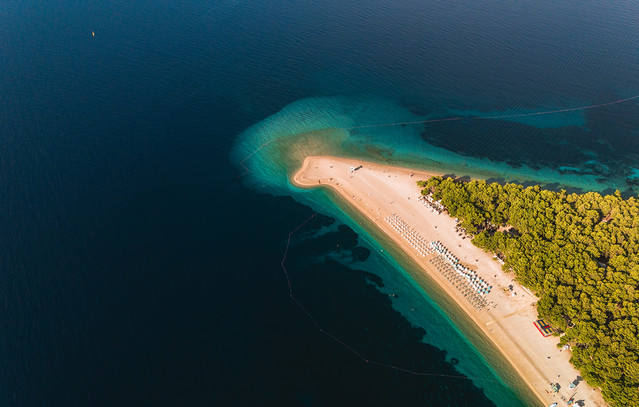
Zlatni Rat beach on the Croatian island of Brac continues to change its physical shape daily as sea currents and coastal winds shift its tip.
Known globally as the Golden Horn or Golden Cape, the narrow landform on Croatia's southern Dalmatian coast extends approximately 450 metres into the Adriatic Sea like a natural pier. The coastal formation regularly appears on global rankings of top international beaches.
Unlike conventional shorelines that remain static, Zlatni Rat operates as a living natural phenomenon. Tidal shifts, local wind patterns and marine currents continually move the narrow spit, causing its pointed tip to curve to the right, bend to the left or extend completely straight into the water.
Pebble shore and contrasting sea conditions
Despite a common belief that the beach is covered in sand, the spit consists entirely of fine, smooth and uniform white pebbles. This specific pebble composition prevents fine dust from clouding the sea, keeping the surrounding water unusually clear.
The clear water produces striking gradients of turquoise and deep blue hues, creating a vivid visual display when viewed from nearby heights or from the air. The physical layout of the spit also creates two distinct microclimates along its edges.
The eastern side of the spit is sheltered from winds, producing calm and shallow waters that cater to families and casual swimmers. In contrast, the western side catches open sea breezes, establishing it as one of the premier locations in the Adriatic region for windsurfing and kitesurfing.
Historic settlements and monuments near Bol
Visitors to the beach frequently tour the nearby town of Bol, situated about two kilometres along the coast. The town features traditional Dalmatian stone architecture, a compact harbour and narrow stone-paved lanes decorated with blooming pink and purple geraniums during the summer season.
The surrounding area holds significant historical sites dating to the late Middle Ages. On the eastern edge of Bol stands a Dominican monastery established in 1475. The complex includes a preserved garden and a museum that houses rare historical manuscripts and religious artefacts.
Further west of Bol, near the hillside village of Murvica, sits the historic Dragon Cave. Monks established the isolated cave hermitage during the 15th century as a secluded refuge from surrounding conflicts.
Inside the cave, early inhabitants carved elaborate stone reliefs directly into the rock face. The artwork uniquely combines Christian iconography with ancient Slavic mythological themes, featuring a large relief of a dragon that gives the site its name.


