

A new mathematical brainteaser is gaining traction on social media, challenging users to find the hidden pattern behind a series of unusual equations.
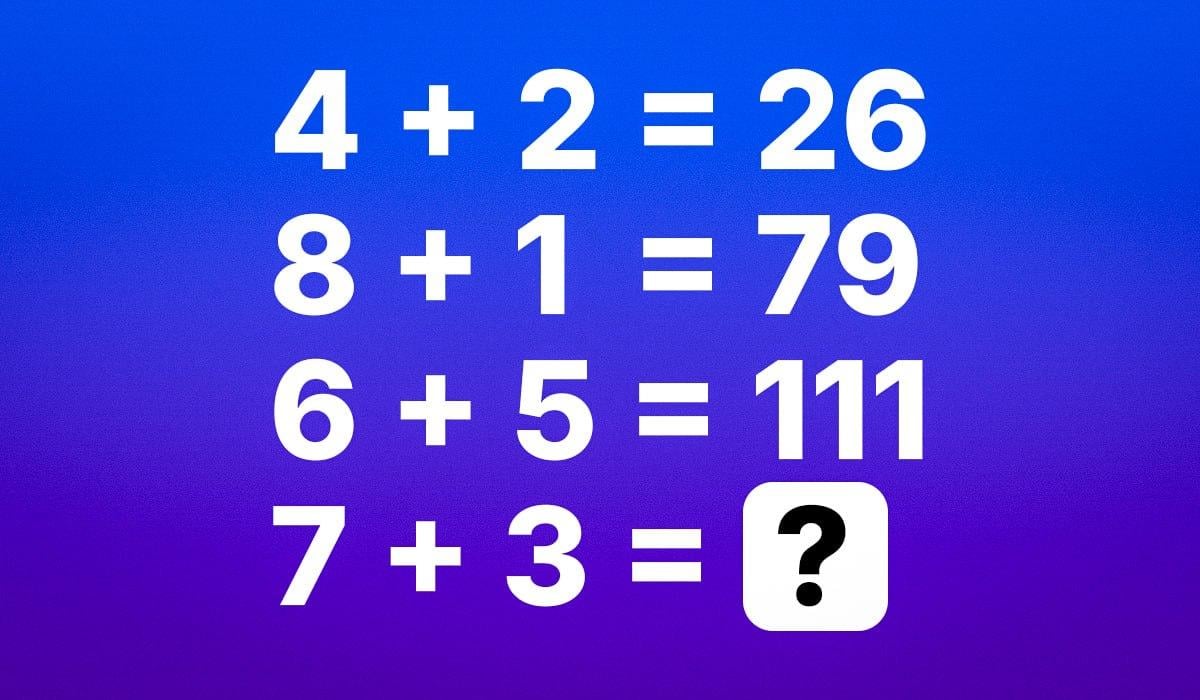
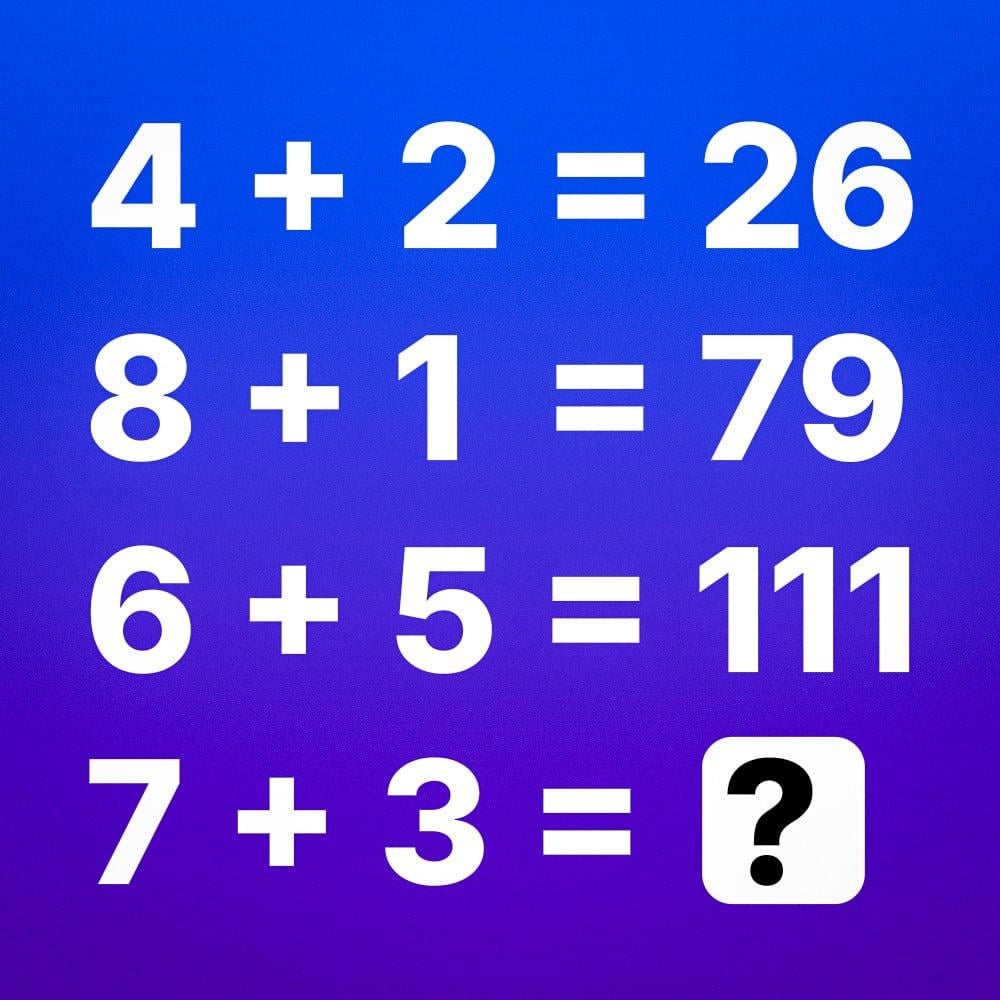
The puzzle presents four lines of sums that do not follow standard arithmetic rules. The first three equations are given as 4 + 2 = 26, 8 + 1 = 79, and 6 + 5 = 111. Users are then asked to determine the answer to the final equation, 7 + 3.
Attempting to solve each line as a standard addition problem will not produce the correct results. Instead, the first three lines must be analysed together to discover the underlying logic used to construct the puzzle.
The hidden pattern
Puzzles of this kind test observation skills and the ability to recognise unconventional patterns, rather than advanced mathematical knowledge. The solution is often hidden in basic arithmetic operations performed in an unexpected sequence.
To find the answer, users are advised to look closely at the numbers to the right of the equals sign. For the first equation, the result of 4 and 2 is 26. For 8 and 1, the answer is 79, and for 6 and 5, it is 111.
The hint suggests that each result is actually composed of two separate numbers joined together. To solve the brainteaser, users must perform two simple mathematical operations on each pair of numbers, and then place the resulting figures next to each other.
Puzzle solution
The secret to the puzzle is to first subtract the second number from the first, and then add the two numbers together. Both results are then written side by side.
Applying this rule to the first equation, subtracting 2 from 4 gives 2, and adding 4 and 2 gives 6, resulting in 26.
For the second line, 8 minus 1 is 7, and 8 plus 1 is 9, creating 79. In the third equation, 6 minus 5 is 1, and 6 plus 5 is 11, giving 111.
Using the same logic for the final problem, 7 minus 3 equals 4, and 7 plus 3 equals 10. Placing these two results together gives the final correct answer of 410.


