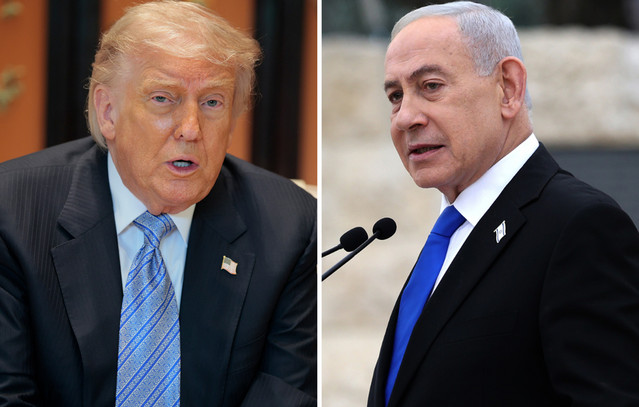
Donald Trump's plan for Gaza remains in force and talks with Israel are continuing, despite Benjamin Netanyahu's public rejection of key points, according to an official from the United States Board of Peace.
The official's comments came on Monday, August 10, a day after the Israeli prime minister said Israeli forces would not withdraw from Gaza until Hamas is "truly" disarmed. The Board of Peace official told Reuters the plan remains active and moving forward, insisting its implementation rests on sequential, verifiable steps on the ground.
Washington's position is that no next stage will be triggered until it is confirmed that commitments from the previous one have been met. Israel is not being asked to simply rely on promises or take irreversible steps without concrete actions on the ground first, the official said.
Netanyahu's rejection
Netanyahu said on Sunday that Israel does not accept the new 15-point plan as presented. The core disagreement concerns the sequencing of disarmament and withdrawal. The American plan calls for Hamas and other armed groups to hand over their weapons gradually, while Israeli forces withdraw in successive phases.
Netanyahu's government, by contrast, is demanding a substantial and complete disarmament of Hamas before any further withdrawal of the Israeli military. Israel does not accept the 15-point document, Netanyahu said, according to the Washington Post, insisting his country will not withdraw while Hamas remains armed. The public rejection marks an unusual rift between Netanyahu and Trump at a time when Washington is pressing to keep the Gaza de-escalation process on track.
What the 15-point plan calls for
Trump announced on July 30 that "historic" progress had been made in talks on disarming Hamas. The new 15-point roadmap aims to unblock the wider ceasefire agreement reached in 2025, which had not led to either the full disarmament of Hamas or a definitive Israeli withdrawal from Gaza.
At its core, the plan calls for the gradual handover and deactivation of weapons held by Hamas and other armed groups, a phased Israeli withdrawal, the handover of Gaza's administration to a Palestinian technocratic body, deployment of an International Stabilization Force, the creation and training of a new Palestinian police force, and the gradual reconstruction of the devastated Gaza Strip.
The Board of Peace
The Board of Peace was created as the main mechanism for implementing the American plan for postwar Gaza. The White House announced its formation in January 2026 as part of the second phase of Trump's broader plan to end the conflict and rebuild the territory.
Trump chairs the body himself, with Secretary of State Marco Rubio, Jared Kushner and former British prime minister Tony Blair among its members. The plan also provides for deployment of an International Stabilization Force, which would work alongside the new Palestinian police force and take on a security role during the transition period.
Deployment of that international force is still at an early stage. Uganda has already approved sending troops, while Reuters reports that so far only a limited number of countries have committed personnel.
Disagreement over what "disarmament" means
Hamas has accepted the new roadmap but avoids using the term "disarmament" the way Israel and the United States use it. According to Reuters, Hamas has said it could hand over its weapons for safekeeping under the control of a US-backed Palestinian administration, on condition that Israel halts military operations and begins withdrawing its forces in line with the agreement.
Israel considers that insufficient and is demanding the complete neutralization of Hamas's military apparatus and removal of its weapons.
Who moves first
In practice, the biggest difficulty no longer appears to be simply whether Hamas will hand over its weapons, but when that will happen relative to Israel's withdrawal. Netanyahu's government wants disarmament first and withdrawal after.
The American plan tries to link the two in parallel, verifiable phases, so that each Israeli withdrawal takes place only after a specific disarmament step has been confirmed. That is what the Board of Peace official sought to emphasize on Monday, noting that the roadmap sits between the Board and Hamas and that talks with the Israeli government are continuing.
The public dispute comes as Israel's military operations in Gaza have been significantly scaled back under American pressure, though they have not stopped entirely. Trump's plan has therefore not collapsed following Netanyahu's rejection, but it has entered its most difficult phase: turning an agreement in principle on disarmament and withdrawal into a concrete timeline acceptable to both Hamas and Israel. For now, that timeline remains the biggest sticking point.