"The Backrooms," directed by 20-year-old Kane Parsons, has become the highest-grossing film in the history of independent studio A24, with worldwide box office earnings closing in on $400 million by early August. The horror movie opened in Russian cinemas in June before arriving on digital platforms in July.
The film's opening weekend brought in $81.5 million in North America and $118 million worldwide, the best debut in the studio's history. By its tenth day in theatres, it had already overtaken "Marty the Magnificent" to become A24's highest-grossing release of all time.
Parsons also set a personal record. At 20, he became the youngest director whose film has topped the US box office. The previous mark had belonged to Josh Trank, who directed "Chronicle" in his twenties and held the record for nearly a decade and a half. Before Trank, the record had stood for almost 40 years, since Steven Spielberg's "Jaws."
From a 4chan Post to a Global Hit
The film's origins are unusual even by modern Hollywood standards. In spring 2019, an anonymous user on 4chan posted a photograph of an empty room with yellow walls and a flickering fluorescent light. Another anonymous poster added a short text: step wrong in the wrong place and you fall through reality into an endless suite of identical rooms, where there is nothing but the hum of lights and the smell of damp carpet.
That is a creepypasta, the internet's version of a campfire ghost story, an urban legend written down and posted online rather than told aloud in the dark. Users kept adding to it, inventing new creatures, rules and levels, building a sprawling body of lore out of a few paragraphs.
The legend spread to Reddit, then generated videos and amateur Roblox games. In early 2022, Kane Parsons released the first episode of his web series based on the concept, which drew tens of millions of views on YouTube. Several studios pursued the rights, and in February 2023 A24 announced a feature film, made on a $10 million budget.
A Furniture Store as a Portal
Parsons has spoken openly about his influences, saying his visual language owes far less to other films than to video games, particularly Portal and Half-Life. The resemblance shows: the sterile Aperture Science labs of Portal and the yellow corridors of the Backrooms both run on the same idea, a space designed by people but no longer inhabited by them.
In the film itself, the portal is literal. The lead character, Clark, is a failed architect and the owner of a furniture store on the verge of bankruptcy. Off-screen troubles, drinking and a collapsing marriage, force him to sleep in the showroom on a display bed. While investigating why the electricity keeps failing at night, he finds a passage in a basement wall.
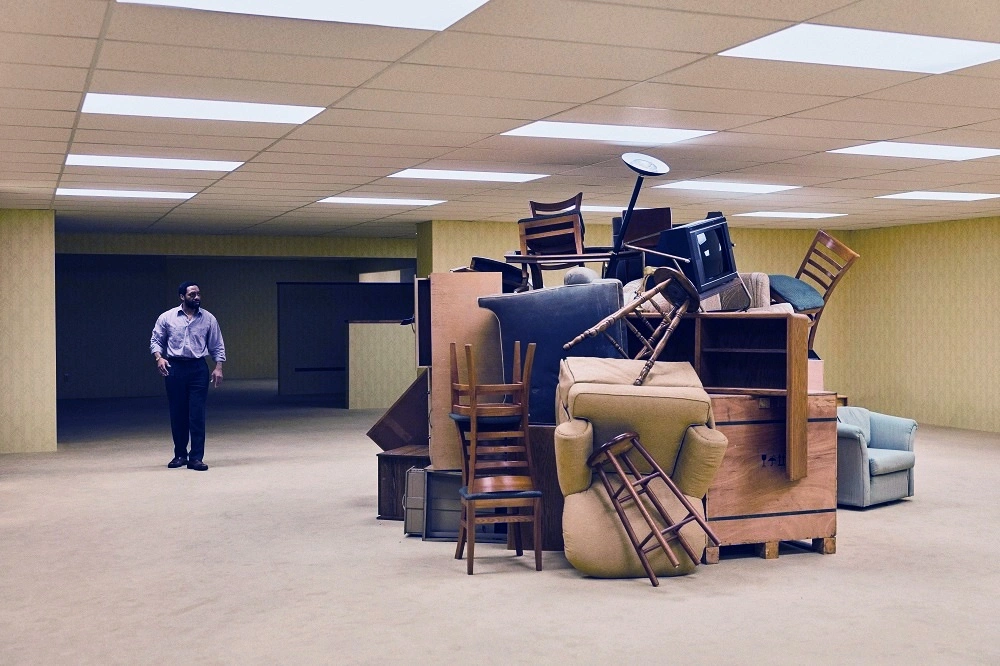
Behind the wall is a liminal space of office corridors with yellow wallpaper, furnished in a way that looks almost, but not quite, normal, producing the same uncanny effect as the original online images. Two of Clark's employees follow him through the wall, then his therapist, Mary Kline. Meanwhile, an unnamed organisation is separately watching the location, and the two threads drive the rest of the plot.
The story leans heavily on suggestion rather than explanation, leaving space for interpretation that fans have filled for years, first around the creepypasta, then the web series, and now the feature film.
Visuals and Sound
The production design team earns credit for the sets, which read as genuinely unsettling rather than simply an office awaiting renovation, despite the deceptively simple premise. The cinematography shifts between static wide shots, first-person chase sequences and quieter cutaways to the real world, alternately letting viewers take in the space and disorienting them alongside the characters.
The score avoids memorable themes by design. Instead, humming lights, dull thuds, static and mechanical noise sustain the tension throughout. In several scenes, sound effectively replaces a jump scare: rather than a frightening face flying at the camera, viewers are hit with a sharp, physically uncomfortable noise, the kind that leaves you flinching at the light in your own hallway afterward.
Chiwetel Ejiofor and Renate Reinsve deliver lively performances within a script that gives them little room to manoeuvre. In places, their scenes together play like improvisation, which works to the film's benefit.
A Solid Horror Film, Not a Great One
Much of the film's success can be traced to that careful execution. There are no obvious missteps or failed staging anywhere in it, and the combination of an unusual source material with strong craft appears to explain the financial results.
Set the box office aside, though, and the film looks less exceptional. It is a good horror movie with a handful of strong ideas about inner fear and how people cope with it, but the writers largely leave the deeper work to the audience, offering striking images without always connecting them.
Other films have gone further with similar material. "The Babadook" turned unprocessed grief into a monster twelve years ago without a single endless corridor, and A24's own "Hereditary" explored inherited trauma without leaning on nostalgia for YouTube videos. Rossiyskaya Gazeta rated "The Backrooms" 3.5 out of 5.
What Comes Next
There is no official sequel announcement yet, though Parsons regularly hints at a franchise, and unconfirmed rumours of varying credibility continue to circulate online.
The film is worth seeing not just for horror fans but for viewers drawn to new formats and unconventional storytelling. Even for those the yellow corridors don't frighten, the story of how they travelled from an anonymous 4chan post to a Hollywood hit is notable on its own.
The one concern is the prospect of turning it into a franchise. The Backrooms concept works because of what it leaves unexplained, and emptiness only functions as long as nothing fills it. Once the corridors come with explanations, numbered levels and a catalogue of creatures, the result risks becoming an ordinary monster attraction like dozens of others in theatres. Collective internet folklore has no single author and no ending, which is precisely why it endures. A film franchise may not be able to reproduce that.