


The Tapo L530E smart bulb turns itself on at different times each night, doing something a classic plug-in timer never managed: looking like a real person is home. A mechanical timer switches on at nine sharp and off at eleven sharp, and that clockwork regularity is exactly what signals an empty house. The Tapo L530E takes a different approach, and a two-pack currently costs less than buying the bulbs separately from any store.
Away mode does what a mechanical timer cannot
Away mode is the feature that gives the bulb its trick. Instead of switching on and off at a fixed hour, it varies the schedule within a set range, so from outside it looks as though someone is moving around the living room, turning a light on and switching it off later. That is different from the predictable pattern of a plug-in timer, which anyone watching a doorway for three nights running would quickly learn.
Regular schedules are just as easy to set, and there is a detail that anyone away for summer will appreciate: the times can be tied to sunset rather than a fixed hour. That way the bulbs switch on when evening actually falls, rather than too early in August, when it gets dark much later than in winter.
Because everything runs through the Tapo app, it makes no difference whether the user is at the beach or a thousand kilometers away: the phone can check whether the bulbs are on, change the schedule or turn them off. They also respond to Amazon Alexa and Google Assistant if a speaker is already set up at home.
Plug it in, no hub or bridge needed
The Tapo L530E is one of the most common smart bulbs people choose for their first connected light point, largely because of how little it needs to get started. This is what sets it apart from a system like Philips Hue: the Tapo L530E needs no hub at all. A bridge-based system can turn on over Bluetooth without the hub box, but controlling it from outside the house or chaining automations requires connecting it to the router. The Tapo L530E works over direct 2.4GHz WiFi instead: screw it in, open the Tapo app, connect it to the home network, and it is ready to schedule.
There is a tradeoff to running over WiFi, though. Each bulb takes up a slot on the 2.4GHz network, so filling an entire house with twenty of them is where a dedicated hub system performs better. For two or three light points it makes no difference, but anyone already running a Zigbee ecosystem will find mixing apps less convenient.
Color for evenings, plain white for work
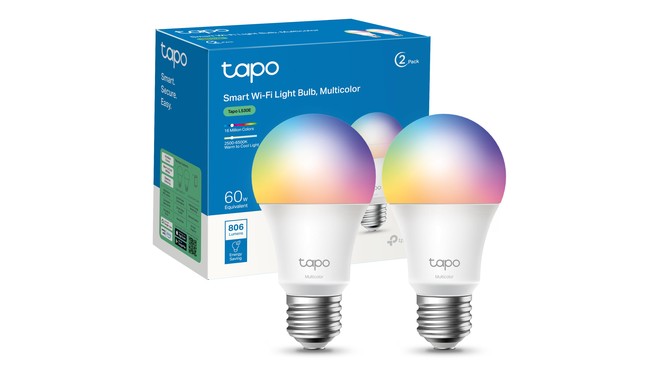
Color is the bulb's everyday feature: 16 million shades and dimming that in practice give two lights in one. Warm amber for dinner or a film, and flat cool white for cooking or reading without straining the eyes. It puts out about 800 lumens, roughly the light of an ordinary living room bulb, neither dim nor overly bright.
Scenes can be saved and triggered by voice or from the phone: one for dinner, a dimmer one for a film, another at full power for washing up late at night. It is the kind of feature that sounds like a gimmick until a week of using it makes going back to the wall switch feel like a step backward.
The bulb draws 8.3 watts to produce the light of a 60-watt incandescent bulb, so it barely shows up on the electricity bill, even though its energy label sits at a modest F. The app also tracks consumption for each bulb, more of a curiosity than a necessity, but available for anyone who wants to check.
Starting with two bulbs and an app, without boxes or new cables to run to the router, is the simplest way to keep a home looking lived-in while its owner is looking at the sea.


