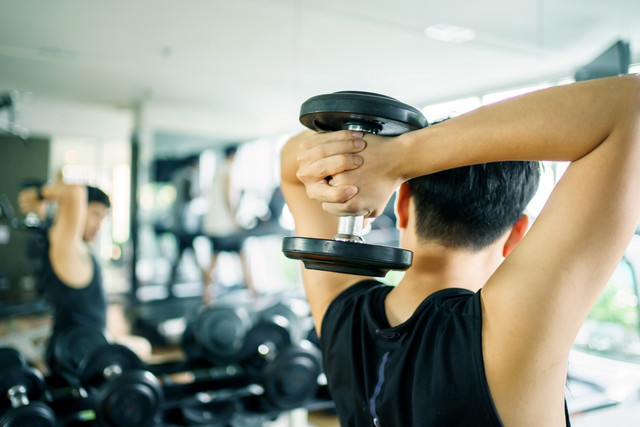
The overhead weighted march builds deep core strength and protects balance as people age, physical therapists writing for fitness website Fit and Well reported.
Gradual decline in balance can make routine daily movements challenging and heighten the risk of fall-related injuries. Physical therapists noted that combining single-leg balance with overhead weight bearing offers an effective strategy to preserve stability and functional mobility in older adults.
The movement targets deep core muscles responsible for supporting the pelvis and spinal column, keeping the posture upright during motion. Maintaining a weight overhead requires constant core activation to stabilize the trunk while marching in place on one foot at a time. The position simultaneously builds muscular endurance throughout the shoulder and arm supporting the dumbbell or kettlebell.
Anatomy of core stability and age-related balance
The deep core consists of internal stabilizing muscles, including the transverse abdominis and pelvic floor, which form a protective cylinder around the spine. Unlike outer abdominal muscles used in traditional crunches, deep core muscles function continuously to control posture and transfer forces between the upper and lower body. As people age, subtle reductions in muscle mass and proprioception, which is the nervous system's spatial awareness, can compromise stability during walking.
Fit and Well highlighted that single-leg exercises force the body to adjust to shifts in center of gravity. Exercises that train balance on one leg mirror real-world movements, such as stepping onto curbs or navigating uneven ground, which are essential for maintaining independence in later years.
Step-by-step exercise technique and routine parameters
To perform the overhead weighted march, individuals should stand with feet hip-width apart while holding a dumbbell or kettlebell at shoulder level. After engaging the core muscles, the exerciser presses the weight directly overhead until the arm is fully extended. A moderately heavy load is recommended for standard execution.
From the standing overhead position, the movement begins by lifting one knee to hip height and holding the balance briefly. The raised knee is then lowered back to the floor before repeating the movement with the opposite leg. Practitioners complete all repetitions holding the weight in one hand before switching the weight to the other arm.
Experts recommend starting with three sets of 10 repetitions per side, scheduled three to four times per week. As physical strength and movement control improve over time, individuals can gradually increase the frequency of the workouts.
Modifications and progressive training options
For individuals who lack steady balance, therapists suggest placing the free hand on a stable surface such as a counter or sturdy wall for extra support. As confidence and trunk control increase, support can be reduced to fingertip contact until the march can be completed entirely unsupported.
Beginners can also perform an unweighted regression by marching in place using only body weight while keeping arms at their sides. This modified version still strengthens the deep core and improves stability. Practitioners can next progress to marching with one or both arms extended overhead without weights.
Once the bodyweight overhead position is mastered, exercisers can introduce light weights starting at 1 to 1.5 kilograms. Training intensity can then be expanded by gradually increasing the weight, the number of repetitions, and the overall duration of the marching sets.