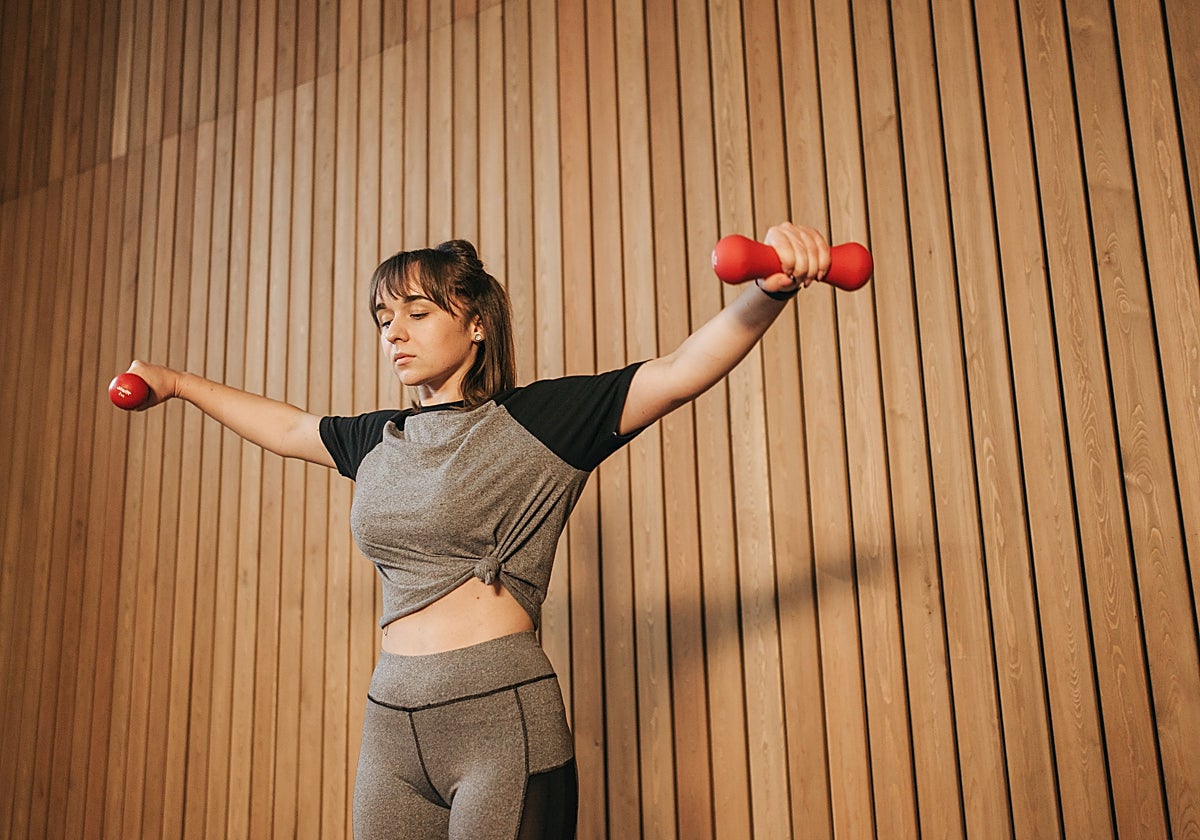
Women looking to build firmer shoulders may get better results from lighter dumbbells than heavier ones, according to Patricia Vera, a wellness coach and specialist in female training at Malagaentrena, a training studio in Spain.
Vera said the exercise known as the lateral raise targets the medial deltoid, the side portion of the shoulder muscle whose main job is to move the arm away from the body. While the biceps and triceps get most of the attention when women want to improve their arms, she said the shoulder itself is just as important for the look and function of the whole upper body.
Exercises such as the shoulder press, push-ups and chest work mostly engage the front of the deltoid, Vera said, leaving the lateral portion under-stimulated. She said that from around age 45, muscle mass naturally begins to decline without regular strength training, sometimes alongside the hormonal changes of perimenopause, and the shoulder can lose some of its rounded, firm shape as a result. Training the medial deltoid, she said, helps restore that shape and improves the proportion between shoulders, arms and waist.
Vera drew a distinction between appearance and posture. A strong medial deltoid helps the shoulder function properly, she said, but it is not mainly responsible for keeping someone upright; that also requires training the upper back, the muscles that stabilise the shoulder blades, and spinal mobility. In her experience, she said, women who start training their shoulders and back fully often see a bigger visual change than they expected.

Why the exercise is harder than it looks
Lateral raises isolate the arm-separating function of the shoulder more directly than the press, Vera said, because the press relies heavily on the front deltoid and triceps. Asked why so few people perform the move correctly, she said it is because lateral raises look far easier than they actually are: watching someone lift two dumbbells out to the sides looks like nothing more than raising and lowering the arms.
The three mistakes she sees most often are shrugging the shoulders up towards the ears, swinging the torso to help lift the dumbbells, and letting the arms drop without controlling the descent. Behind all three, she said, is usually the same cause: using more weight than the person can actually control.
Vera gave the example of a woman who starts with 5-kilogram dumbbells, believing the heavier weight will build firm shoulders faster. The first few repetitions go well, she said, but fatigue soon sets in, causing the torso to sway and the shoulders to creep upward. The weight still moves, Vera said, but the medial deltoid stops getting the stimulus it needs. Her advice is simple: reduce the load. Switching to 2 or 3-kilogram dumbbells, she said, often makes it easier to control the movement and start making real progress.
How to perform the lateral raise
Vera recommends standing with feet hip-width apart, knees slightly bent and the abdomen engaged, holding a dumbbell in each hand with the elbows slightly bent. From there, the arms are raised out to the sides, slightly in front of the body, up to shoulder height or to the point just before any discomfort. The dumbbells should then be lowered slowly rather than allowed to drop on their own. Her practical tip is to imagine gently separating the arms from the body, rather than throwing the weight upward.
Other details matter too, Vera said, including keeping the wrists aligned and letting the shoulder blades move naturally with the motion. She advises against the popular pouring-a-jug technique, in which the thumb points downward, saying it serves no real purpose and can feel uncomfortable for some shoulders. She prefers a neutral hand position or one angled slightly forward. It is also normal for the trapezius muscle to join in, she said; the goal is to avoid exaggerated compensation, not to isolate the deltoid completely.
Choosing the right weight and variation
For beginners starting from scratch, Vera suggests 1 or 2-kilogram dumbbells, though she stressed that the weight should not be chosen based on age. What matters, she said, is being able to complete 10 to 15 repetitions with good technique, feeling the effort towards the end without swinging. She recommends taking one to two seconds to raise the weight and two to three seconds to lower it, doing two to three sets, once or twice a week.
Vera also noted that the rotator cuff is protected by gradually building strength, not simply by lifting light weights, which is why she pairs lateral raises with rowing movements, external rotations and other back exercises.
Dumbbells remain the most accessible option and her favourite for learning the movement, Vera said. Elastic resistance bands are practical for training at home, and she is fond of the single-arm cable pulley once someone has mastered the technique, although she said it does not by itself guarantee better results. If pain, a sharp twinge or persistent discomfort appears, she said, it is time to review the exercise and consult a professional. Above all, Vera said, women should not train out of fear or avoid weights altogether, but should learn to use them properly.
Test yourself
Which shoulder muscle do lateral raises mainly target, according to Patricia Vera?
What does Vera say is the main reason people perform lateral raises poorly?
How many repetitions does Vera recommend to build good technique?
Have your say
Do you include shoulder-specific exercises like lateral raises in your workout routine?