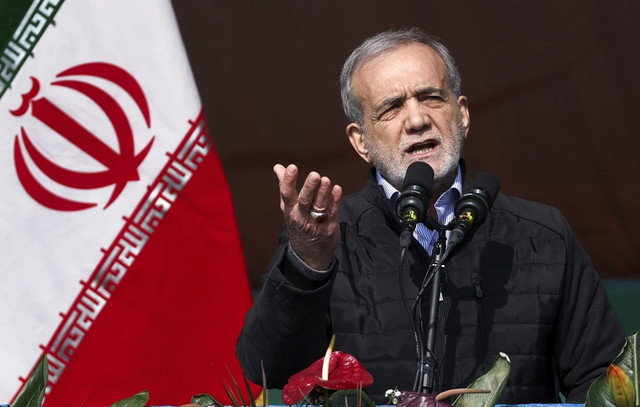
Iranian President Masoud Pezeshkian has stated that American sanctions have reduced Iran's foreign trade by up to 35 percent during a Friday night television broadcast.
Speaking on Iranian state television, Pezeshkian delivered a dual message aimed at domestic viewers and neighbouring countries, offering cooperation with Saudi Arabia and the United Arab Emirates to help ease Tehran's economic isolation.
According to Reuters, Pezeshkian acknowledged that US sanctions and trade blockades caused both exports and imports to fall significantly, with imports experiencing the sharpest decline of between 25 percent and 35 percent.
Pezeshkian's trade admission represents a rare public assessment by the Iranian president regarding the magnitude of economic pressure on the nation. Iran, a Middle Eastern country situated along the Persian Gulf, has faced long-standing international financial restrictions over its nuclear program and regional foreign policy. In practical terms, fewer imported goods mean Iranian businesses encounter major difficulties obtaining foreign raw materials and products, creating severe strain on an economy already facing high inflation and restricted access to global banking systems.
Sanctions and Shipping Disruptions
The Trump administration has recently intensified efforts to isolate Tehran economically by imposing new sanctions and targeting financial networks that Washington says allow Iran to bypass restrictions.
Commercial pressures have been compounded by disruptions to maritime shipping in the Strait of Hormuz, a narrow waterway between Oman and Iran that acts as one of the world's most critical channels for global energy trade. Transportation restrictions in the area have affected both Iran and the wider Gulf economies.
Despite the commercial pressure, Pezeshkian claimed Tehran managed to maintain a significant export volume by selling approximately 90 million barrels of oil during the implementation period of a temporary agreement.
Regional Diplomatic Outreach
Accompanying his economic figures, the Iranian president made a clear diplomatic opening by stating that Iran is ready to cooperate and reach an understanding with neighbouring countries, explicitly naming Saudi Arabia and the United Arab Emirates.
Saudi Arabia, governed from Riyadh, and the United Arab Emirates, based in Abu Dhabi, are two of the most influential political and economic powers in the Gulf region. Both countries maintain close ties with the United States while recently advocating for diplomatic solutions and de-escalation, as the prolonged shipping crisis in the Strait of Hormuz imposes heavy economic costs on all regional economies.
Security Proposals and Future Talks
Pezeshkian's remarks follow a proposal he made one day earlier calling on Muslim nations to strengthen cooperation and establish a joint security and non-aggression framework. He also stressed that the territory of any Muslim nation must never be used to launch attacks against another.
Tehran has repeatedly stated that it seeks to resolve regional disagreements through dialogue rather than military confrontation. During a meeting with the Prime Minister and Minister of Foreign Affairs of Qatar, Pezeshkian asserted that Iran does not seek war and insisted that all outstanding issues should be resolved through talks.