

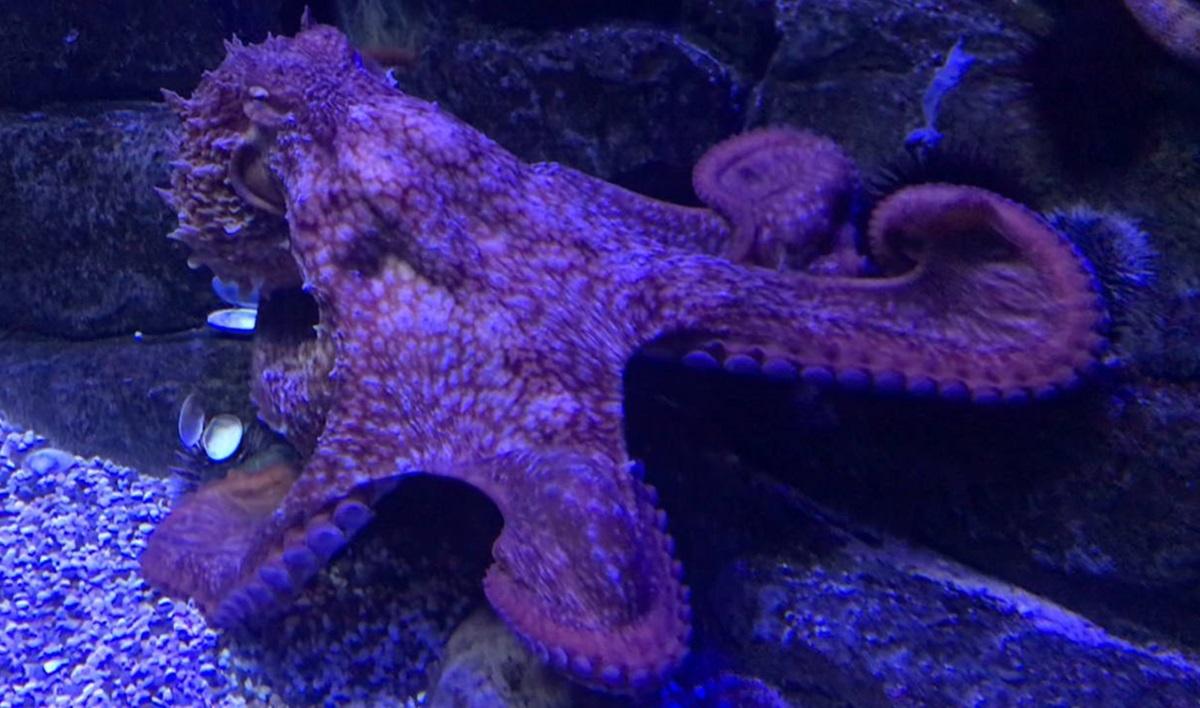
The giant octopus uses nine individual brains and stealth camouflage to hunt small sharks in the ocean, BBC Wildlife Magazine has reported.
Reaching an average length of about 4 metres, these highly intelligent marine animals are the largest of all octopus species. Unconfirmed accounts suggest the largest recorded specimen reached nearly 10 metres in length, roughly equivalent to the length of a school bus.
The creature features a reddish-brown colouration and a soft, boneless body anchored by eight tentacles. Each tentacle moves independently from the rest of the body and is covered with thousands of suckers packed with chemical receptors, allowing the octopus to taste whatever it touches.
Nine brains and high intelligence
Despite their immense size, giant octopuses are masters of camouflage capable of changing their skin colour and texture in a fraction of a second. This instant transformation is made possible by specialized pigment cells called chromatophores.
Their complex nervous system relies on nine brains, consisting of a central brain paired with a smaller secondary brain in each of the eight tentacles. This multi-brain structure allows each arm to execute independent tasks at the same time.
Researchers consider the giant octopus to be the most intelligent of all invertebrates, a broad animal group that lacks a backbone. Studies demonstrate that giant octopuses can open jars, solve intricate puzzles and mazes, squeeze their soft bodies through tiny openings, and recognize individual human faces. They have even learned to snatch caught fish directly from fishermen.
Hunting tactics and venomous bites
The standard diet of a giant octopus includes fish, shrimp, molluscs, crabs, lobsters, and scallops. On occasion, they also prey upon other octopuses and small sharks. When hunting at night, the creature relies on camouflage and stealth to stalk its targets without being detected.
Once close enough to its victim, the octopus uses jet propulsion to accelerate rapidly and strike before the prey can escape. It holds the victim firmly with the strong suckers on its tentacles before delivering a bite. The animal's saliva contains a paralytic venom that immobilizes the prey, which the octopus often carries back to its lair to eat in safety.
Although giant octopuses are venomous and bite prey to inject toxins using a beak, they pose almost no threat to humans. They are significantly less dangerous than the tiny blue-ringed octopus, which is recognized as the most venomous octopus species in the ocean.
Giant octopuses are generally non-aggressive toward people unless provoked, and their venom is typically not fatal to humans if medical treatment is provided promptly. Nevertheless, experts advise maintaining a safe distance and seeking immediate medical attention if bitten.
Dumbo octopus and giant cephalopods
In an earlier report, BBC Wildlife Magazine highlighted the Dumbo octopus, a deep-sea cephalopod belonging to the genus Grimpoteuthis that lives in cold, dark ocean waters worldwide. The animal earned its name from ear-like fins that resemble the ears of an elephant.
While average Dumbo octopuses measure between 20 and 30 centimetres in length, the largest recorded specimen reached 1.8 metres long and weighed 5.9 kilograms. By comparison, the record holder among all cephalopods is the colossal squid, which can reach 13 metres in length and weigh up to 495 kilograms.
To swim gracefully through deep waters, the Dumbo octopus flaps its strong fins. The webbing between its short tentacles forms a bell-shaped umbrella that opens and closes to propel the animal forward.


