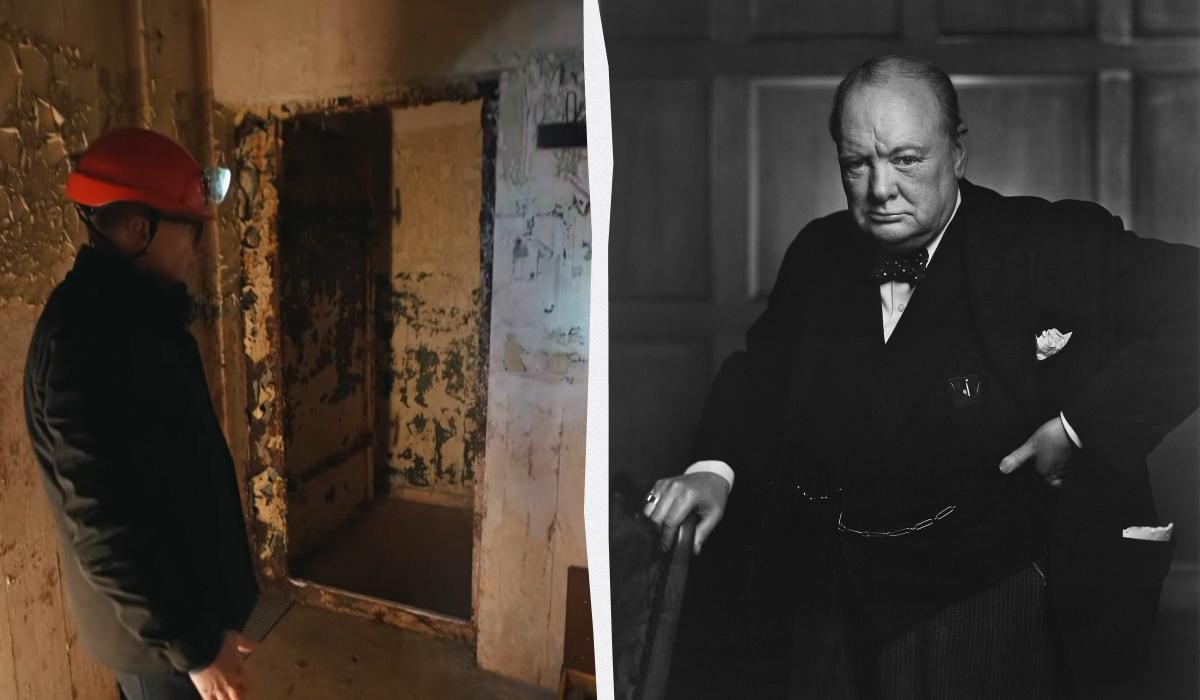
A secret Second World War command bunker built on the orders of Winston Churchill opens to visitors in Britain from Friday. The underground post, at Fan Bay near Dover, was where British forces coordinated artillery strikes against German ships crossing the English Channel.
The command point, protected by concrete structures, housed the first land-based computerised artillery guidance system, according to John Barker, who led the archaeological excavation on behalf of the National Trust. He said it functioned as the brain of an artillery battery that defended Dover and attacked German vessels in the Channel.
Barker became the first person to enter the bunker after it was rediscovered in 2017. The site had been secretly sealed in 1957, then classified until 1981 because of its military significance.
Barker compared the moment to the discovery of Tutankhamun's tomb for an archaeologist studying military conflict. He said his team had spent a huge amount of effort researching the people who served there, then suddenly found themselves standing in their actual workplace, calling the experience incredibly exciting.
How Churchill ordered the secret command post
The creation of the command post and the artillery it controlled is directly tied to Churchill. Shortly after his famous speech on the need to fight the enemy on the beaches, he visited the Kent coast and grew concerned that enemy ships were passing through the Dover Strait unchallenged.
At the time, Dover sat on the front line of Britain's defences and was regularly shelled by German guns stationed in occupied France.
In a memo from July 1940, Churchill wrote that Britain had to fight for control of the Straits using artillery, destroy enemy batteries and strengthen its own.
He ordered the use of the most advanced technology available and demanded weekly progress reports on the new Dover defence system. The gun emplacements were ready within 100 days, and the bunker with its control point was finished a further 64 days later. Barker said locals came to call the guns Churchill's favourites.
Signs of wartime haste
Barker said traces of the rush to build the site are still visible today, including rough holes cut into the walls and floor to run cables. Accounts from the period describe equipment being installed before the drawings for its layout were even finished.
The control point held an electromechanical computer measuring 1.8 metres, known as a gun-laying or fire control table. It calculated the position moving ships would be in at the moment a shell struck, then transmitted firing commands to the gun crews.
Barker compared the bunker's rediscovery to the rescue of Bletchley Park in the 1990s, the British code-breaking centre in Buckinghamshire that worked on German ciphers during the war. He said nobody knew about it at the time, but it is now part of the national consciousness, and the Fan Bay command post is a new chapter in that hidden history.
Barker noted that popular images of artillery fire control tend to come from war films, showing women of the Women's Royal Naval Service moving markers across a map. At Fan Bay, he said, there was no map, only a genuine advanced electromechanical computer that he described as unique.
The computer itself was deliberately destroyed in 1957 so it could not fall into enemy hands.
Searching for the bunker's crew
Up to ten people could work inside the control point at once. Barker said he hopes to track down relatives of those who served there to better understand how the machine actually operated.
He said everything currently known about it is based on an instruction manual and faint marks left on the floor, and that he would very much like to hear from anyone whose relatives served at Fan Bay, since so few records have survived.
So far only a handful of the people who worked with the computer have been identified. One was Wallace Eaton, an actor who later played Senator Ludicrus Sextus in the comedy television series Up Pompeii! alongside Frankie Howerd.
Records also mention a man named W. P. Bryant, who held the rank of junior bombardier and worked as an operator at the control point. Barker said he had been a tailor, and suggested he likely had a knack for working with numbers.
Preserved exactly as it was found
From Friday, the bunker can be visited as part of tours organised by the National Trust. Access is through a hatch set in the middle of a field, and the site has been kept exactly as archaeologists found it.
Among the items left inside are old newspapers on the floor, shoes and official notices. Chalk writing on one wall of the service tunnel still reads: Heroes of Fan Hole, Dodds and Pettit. Barker suggested the two men may have helped lay the cables into the bunker.
He joked that they had probably declared themselves heroes for being responsible for running thick cables through particularly awkward tunnels.
Barker said there is something special about standing in a place that has barely changed since the people who worked there left it. Rather than recreating the past, he said, the team carefully preserved the control point exactly as it was found, leaving every trace of its history visible. He called it a rare chance to discover a completely different side of the white cliffs of Dover.