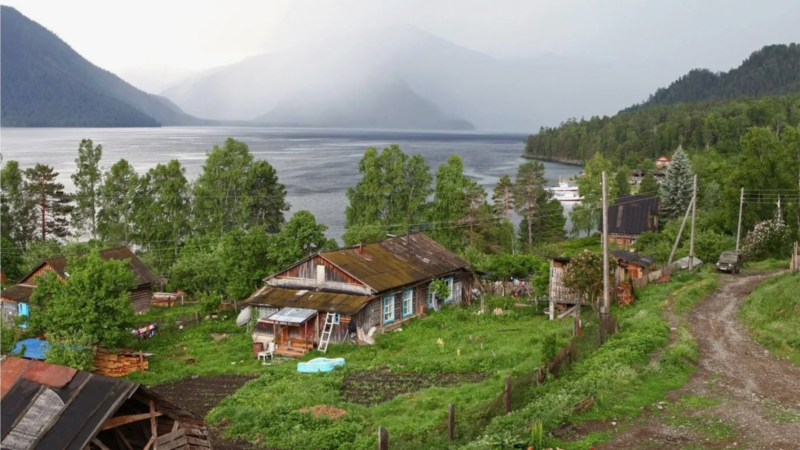
Three remote villages in Russia's Altai Republic are receiving electricity for only four hours each day, as a diesel fuel shortage cripples autonomous power stations and the region counts fresh deaths from the war in Ukraine.
The villages of Bijka, Yaylu and Kurmach-Baygol in the Turochasky district have faced rolling power cuts since late June. A resident of Bijka who gave only the name Roman, changed for his safety, said power was initially cut overnight and at midday but had since been reduced to just four hours each morning.
In Kurmach-Baygol, blackouts also knock out mobile internet and telephone connectivity. A former schoolteacher named Valentina said the village had gained internet access at the school and local administration only about 15 years ago, and mobile internet in homes only about five years ago. Without electricity, she said, residents were back in isolation, fetching water from wells and sitting by candlelight as they had done 20 years earlier.
The scale of these communities is visible in school enrollment figures. In 2024, eleven children started first grade in Bijka, four in Kurmach-Baygol and two in Yaylu.
Fuel rationing across the region
The power crisis is tied to a broader shortage. From July 1, following Ukrainian strikes on Russian oil refineries, the Republic of Altai introduced daily retail fuel limits. In some districts, individuals may buy no more than 30 litres of petrol and 50 litres of diesel per day. In the Turochasky district and other municipalities, the daily cap is 50 litres of petrol and 100 litres of diesel.
A local resident named Igor said that in these taiga settlements, roads wash out constantly and without a vehicle or a boat a person is helpless. He added that fuel was more expensive than money, and that the only thing arriving without delays was coffins.
Indigenous men dying in Ukraine
The Turochasky district is home to the Chelkans and Kumandins, Turkic-speaking peoples recognised as numerically small indigenous minorities. This summer, the area buried three local men who died in the war: two from indigenous communities and one father of three, born in Ukraine.
Danila Saltayev, a Kumandin, left for the war on October 17, 2024, less than a month after turning 18. His mother announced his death on the Russian social network Odnoklassniki on November 20. Roman said Saltayev had just finished school and had no prior military service before signing a contract. Under Russian law, men may sign a first military service contract from age 18 without previous conscript service. Commenters on local social media pages questioned how an 18-year-old could have been sent to the front, with some saying he had received no moral or combat preparation and calling his deployment a crime.
Oleg Ostafiychuk, 34, was buried in Kurmach-Baygol in October 2024. He had grown up in the district, was raising three children and left for the war in spring 2024. He was killed on June 8. Valentina said Ostafiychuk had been born in the village of Panivtsi in Ukraine, and that learning he had died there felt strange. He left behind an elderly mother, brothers, a wife and three children.
Valeriy Pustogachev, a 21-year-old Chelkan from the village of Kebezen, was buried in January 2023 after being killed on January 5 of that year. A local resident named Ivan said Pustogachev had signed up from prison, with roughly six months remaining on his sentence, not for early release but for the money to support his mother and brothers. Mediazona, a Russian outlet that tracks war deaths, classifies Pustogachev as a prisoner recruited for combat. Igor said the young man had no education and no work was available locally beyond a sawmill and a bakery.
Konstantin Pustogachev, 38, also from Kebezen, volunteered in late August 2023 and planned to return within six months, drawing on his experience in the airborne forces. He was killed in October 2023 and left two children. Local authorities had described Kebezen in 2024 as the village in the Turochasky district that sent the most men to the war, with the district newspaper reporting that whole families went together.
Risk to communities numbering in the thousands
According to a geographical analysis by Mediazona and BBC Russia completed as of February 24, 2026, the Republic of Altai ranked fourth among comparable Russian regions for confirmed war deaths per capita, at 316 per 100,000 residents, behind only Tyva, Buryatia and Zabaykalsky Krai. The Mediazona database lists at least 36 confirmed dead linked to just five settlements in the Turochasky district alone.
The International Work Group for Indigenous Affairs reported in 2026 that Russia's indigenous peoples continue to be mobilised at a disproportionate rate, including through coercion. The organisation cited UN Special Rapporteur on Human Rights in Russia Mariana Katsarova, who concluded that war losses could push some numerically small peoples to the brink of extinction.
According to Russia's 2020-21 census, the country counted 1,314 Chelkans, 2,408 Kumandins, 3,675 Tubalars and 2,916 Telengits in total. Researchers link their particular vulnerability to poverty, remote locations, lack of employment and restricted access to traditional livelihoods including hunting, fishing and reindeer herding. No official statistics are kept on the participation of these peoples in the war.