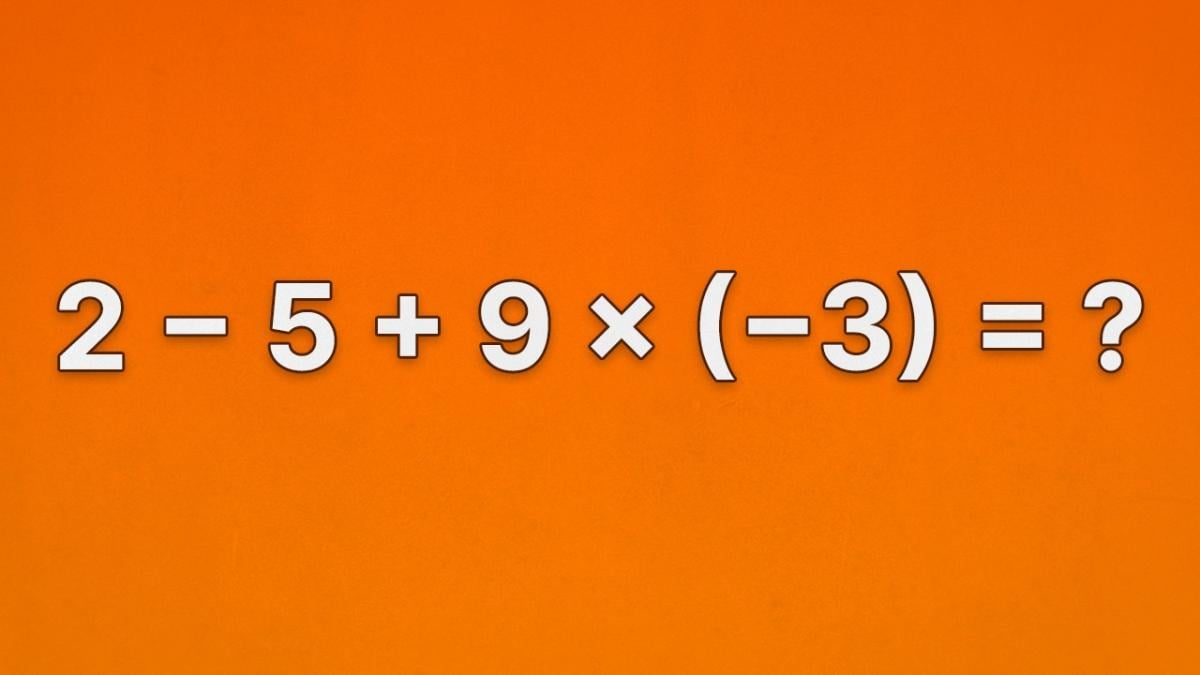
A math puzzle asking solvers to work out 2 − 5 + 9 × (−3) is circulating online, and the negative number at the end is what makes it harder than it first looks. The equation was set by the Polish outlet eDziecko, which challenged readers to find the correct number that belongs after the equals sign.
The expression contains just four numbers and three operations: subtraction, addition and multiplication. The catch is that solving it in the order it is written produces the wrong answer.
Why order of operations matters
Multiplication must be carried out before addition or subtraction, regardless of where it appears in the expression, because multiplication has a higher priority. In this case, that means calculating 9 × (−3) first.
Since the product of a positive number and a negative number is always negative, 9 × (−3) equals −27. The expression then simplifies to 2 − 5 + (−27).
From there, only addition and subtraction remain, and these are carried out from left to right because they share the same priority. First, 2 − 5 equals −3. Adding that to −27 means combining two negative numbers, which involves adding their values together and keeping the minus sign. That gives −3 + (−27) = −30.
The correct answer to the puzzle is −30.
The common mistake
According to the puzzle's explanation, many solvers get it wrong by starting with 2 − 5, then adding 9, and only afterward multiplying the running total by −3. That approach breaks the standard order of arithmetic operations, since the multiplication in the original expression applies only to the numbers 9 and −3, not to the result of the earlier subtraction and addition. That is why 9 × (−3) must be resolved into −27 first, before any other step is taken.
More puzzles to try
The article pointed to other brain teasers for readers who want a further challenge. One involves an expression containing six identical digits, four arithmetic operations and no brackets, which looks simple until the solver has to figure out the correct sequence for the calculations.
Another is a matchstick puzzle in which twelve is subtracted from eighteen, yet the result is unexpectedly positive and even larger than either original number, defying ordinary arithmetic. The puzzle can reportedly be corrected with a single move of one matchstick.
Test yourself
What is the correct answer to 2 − 5 + 9 × (−3)?
Which operation must be solved first in this puzzle?
Which outlet proposed this math puzzle?
Have your say
Did you get the correct answer to this math puzzle?