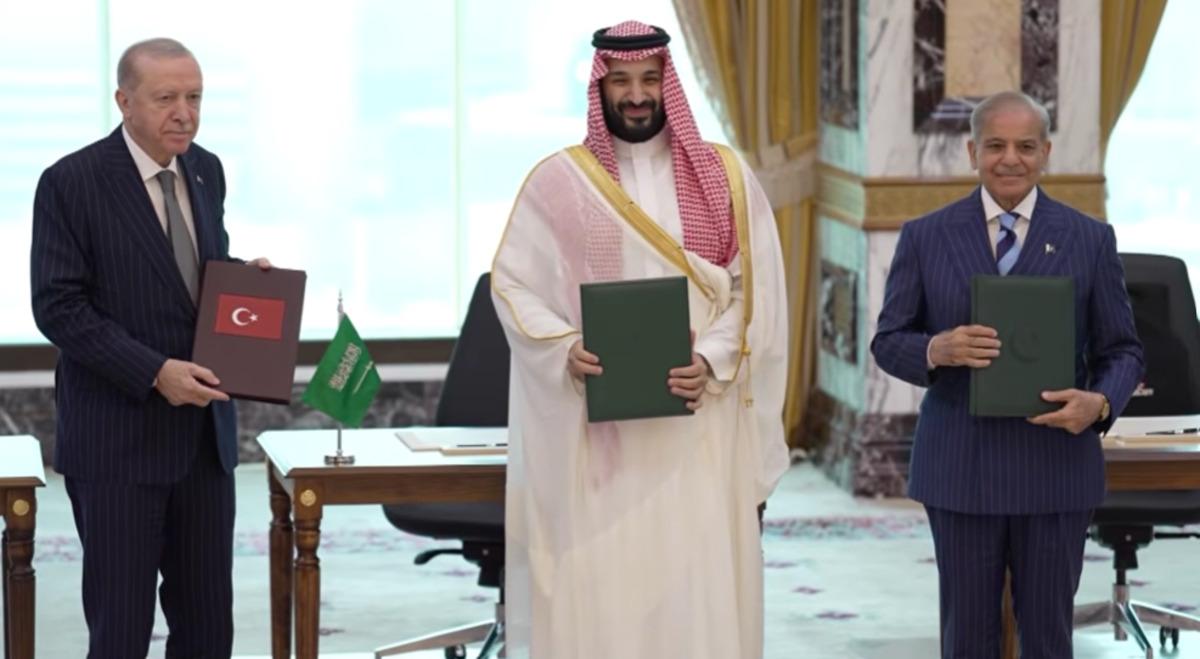
Saudi Arabia, Pakistan and Turkey signed a joint mutual defense agreement in Mecca to strengthen collective deterrence against acts of regional aggression, Reuters reported. Under the agreement, an armed attack on any of the three Sunni Muslim allies of the United States will be treated as an attack on all three nations.
The pact follows missile strikes by Iran and its allies against oil exporting states in the Persian Gulf and attempts to block their energy shipments. Those strikes began after the United States and Israel launched attacks on Iran on February 28, 2026, marking a major escalation after years of regional unrest.
The joint statement did not provide specific details about the obligations assumed by each country, leaving it unclear how far the agreement binds them to concrete military action. Turkish Vice President Cevdet Yilmaz said the deal is not aimed at any specific country. A Turkish official added that the agreement is purely defensive and does not cancel existing treaties with other nations.
Scope of the Defense Pact
The three countries share concerns over the increasingly aggressive military posture of both Israel and revolutionary Shia Iran. At the same time, their long-time ally, the United States, is attempting to contain regional turmoil that has caused a global energy crisis.
Turkey commands the second largest armed forces in NATO. Saudi Arabia holds Islam's holiest sites and ranks among the world's top oil exporters, while Pakistan is the only Muslim country possessing nuclear weapons.
Saudi Arabian Deputy Minister for Public Diplomacy Raed Krimly posted on social media that the agreement is not an effort to establish a military alliance or a sectarian bloc. Krimly added that the agreement is not linked to nuclear ambitions or an arms race.
Although Pakistan signed a mutual defense treaty with Saudi Arabia last year, it did not respond with military action to Iranian attacks on the kingdom. Pakistan also rejected suggestions that its nuclear deterrent could extend to allies, stating during last year's treaty talks that nuclear weapons were not on the agenda. Both Pakistan and Turkey expressed support for a Saudi-announced maritime defense coalition to protect regional shipping and energy routes.
Broader Conflict Developments
In related developments previously reported by UNIAN, Russia provided Iran with upgraded Shahed attack drones and targeting intelligence. Tehran used the equipment and data to attack American military forces and strategic targets in the Middle East.
Findings published on August 2 by the Institute for the Study of War indicated that the transfer of modified drones, developed from combat experience in Ukraine, signals a deeper strategic alignment that has raised concerns in the Pentagon and NATO.
Citing estimates from diplomats and international security experts, The New York Times reported that the armed conflict between the United States and Iran increasingly appears to be a strategic defeat for Washington. None of President Donald Trump's key goals have been met, while Iran retains control, keeps weakened nuclear and missile programs, and maintains influence over the Strait of Hormuz.