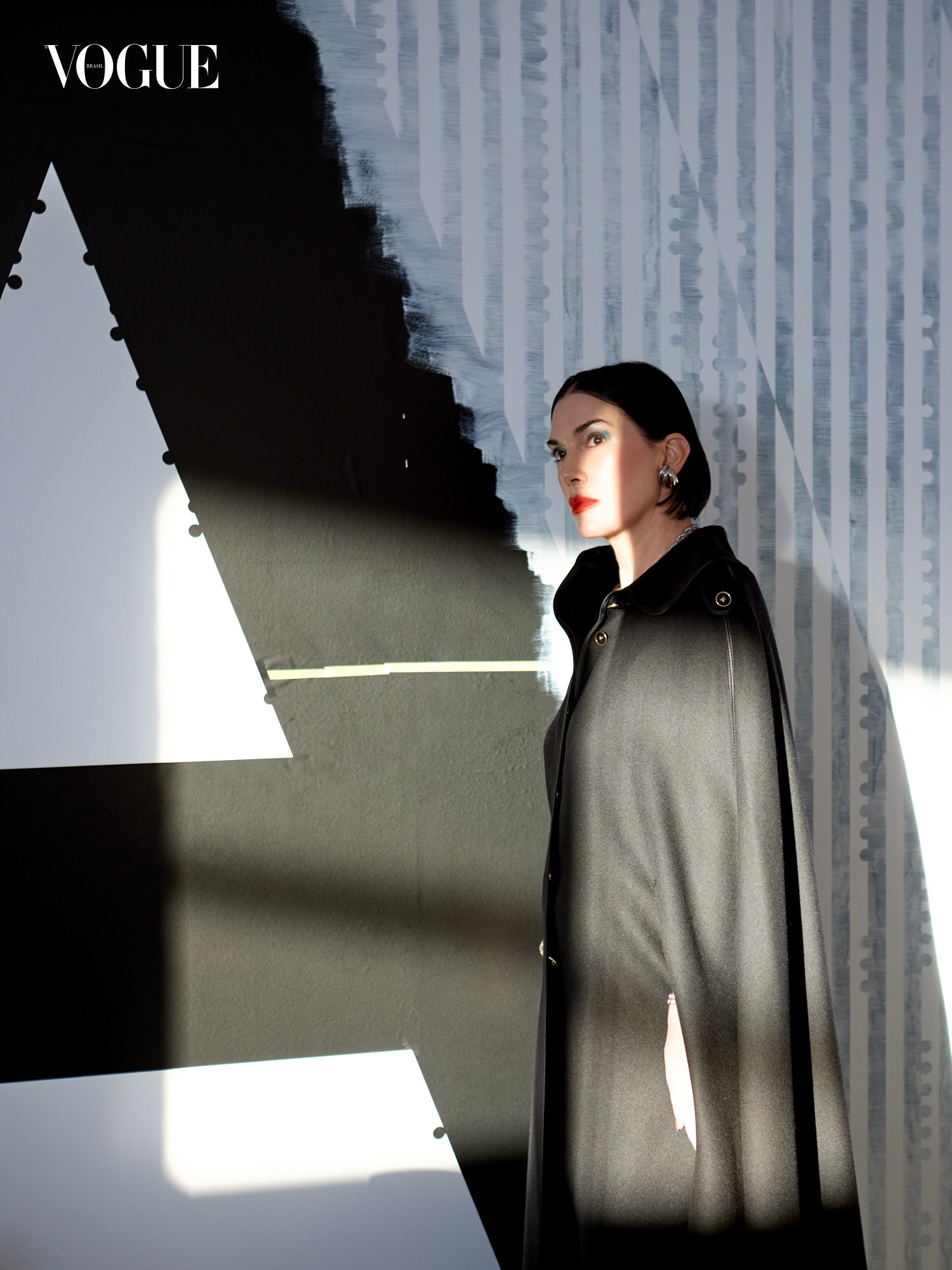
British-American artist Sarah Morris opens a solo exhibition titled "Lady Snowblood" on November 12 at Galeria Fortes D'Aloia & Gabriel in Sao Paulo, presenting new paintings built around some of Brazil's best-known conglomerates, including Unilever, Klabin, Banco Safra and Ambev.
Morris has spent three decades turning power and capitalism into geometry. Since her 1998 series Midtown, drawn from the glass facades of Manhattan, she has painted grids, curves and fields of color using household enamel paint. She told Vogue Brasil, speaking by video call from her studio in New York, that she has no interest in figurative painting and tries to make the things she wants to see but does not.
A love affair that began on a Rio New Year's Eve
Morris's connection to Brazil began personally. She had a Brazilian boyfriend in the 1990s, and although the relationship ended, the friendships stayed, leading to an invitation to a Rio de Janeiro Reveillon, or New Year's Eve celebration, in 1995. She went to Carnival rehearsals that year and fell completely in love with the country, drawn also to the beauty, intelligence and attitude she found in a culture that had flourished despite the military dictatorship.
That connection deepened over the years. She took part in the 25th Sao Paulo Biennial in 2002, made the 2012 film Rio with scenes shot in architect Oscar Niemeyer's office, and held her first solo show in Brazil in 2015, with canvases drawn from the work of Niemeyer, Bratke, Burle Marx and Lina Bo Bardi. She speaks of Bo Bardi almost as family, saying she feels it in her use of red and in the way she displayed paintings on glass easels like an army, a fleet.
An unfinished Welles project and a shift to data flows
Morris originally planned two films in addition to Rio, including one set in Sao Paulo, inspired by It's All True, the project Orson Welles left unfinished in Brazil. She said she thought she could finish it for him, but the Sao Paulo film was never shot. It remains in her head, and she said she would love to make it one day.
In the meantime, the focus of her work has shifted. She said the building was always a pretext, even when she was reinterpreting facades, and that her real subject is the flow of capital and data, which increasingly does without passports. She argued that there is no longer a "local" the way there was 50 years ago, with firm borders, noting that even back then Bo Bardi herself was Italian. She includes herself in that web of complicity, questioning whether an Apple computer is really American, or Chinese, or Irish because of the taxes it pays in Ireland, and concluding that no one stands outside the system.
Logos stripped of meaning
The shift in how the world works is something Morris has watched unfold. Filming the 2008 Beijing Olympics, she looked out of a window one morning and saw a military tank. She recalled that nobody knew which way China would go, and that there had been a hope that if Chinese citizens drank Coca-Cola, the country would end up like the West, something she called obvious nonsense.
In the paintings on show at the Fortes D'Aloia & Gabriel warehouse, logos, diagrams and organizational charts are taken apart and dissected until they lose their original function. Asked if the works are corporate portraits, Morris agreed they are portraits of a specific moment, but said she does not think of the corporations themselves as people. Instead, she sees amorphous, shadowy forms that keep changing shape, which could just as easily read as a landscape.
The uncredited designer behind a Sao Paulo icon
One painting breaks from the list of companies. It is dedicated to Mirthes Bernardes, a city hall draughtswoman who in 1966 won a competition launched by mayor Faria Lima with a stylized black-and-white map of the state of Sao Paulo, chosen by popular vote and later turned into an iconic symbol of the city.
According to research by the University of Sao Paulo's architecture school, FAU-USP, Bernardes never received public recognition or compensation for the design and died in 2020 at the age of 86. Morris said she learned the story only recently, noting that she must have walked over that map many times without knowing, and that the project was so successful it erased its own author.
When corporations collect their own critique
Morris pointed to an irony in the fact that corporations themselves collect her work. Reinsurer Swiss Re holds her 2014 print series Bye Bye Brazil in London, which includes a piece titled "Banco Safra." She described it as a strange closing of the circuit, almost a knot, and said it is hard to know whether such companies grasp the critique or simply see it with vanity, admiring it as their own portrait done well. For Morris, that ambivalence is exactly where great painting operates.
A studio named after a conspiracy thriller
Morris named her studio Parallax after Alan J. Pakula's 1974 thriller "The Parallax View," in which a corporation recruits assassins who do not fully know who they are working for. She said an artist likewise cannot know what forces a painting will end up serving, whether it becomes a stamp or propaganda, since you never really know your own use value.
She has kept painting regardless, a craft that seemed out of fashion when she started in the 1990s, when almost no one painted and her friends were making sculpture, film or conceptual art. Asked if it is still romantic to be a painter, she said very much so, recalling that her mother saw determination in her from childhood in the confident way she held her chin. She said that determination is necessary not out of egomania but because so much pushes an artist to stop, since not every critic or collector will love the work.
Marching on through changing times
Looking back helps, Morris said, because the history of ideas becomes a map that is not meant to be repeated. She said it makes no difference whether the world is living through COVID or fascism, an artist simply has to keep marching, again invoking Bo Bardi's army of easels at MASP, the Sao Paulo museum of art where Morris herself exhibited in 2020 and 2025.
She described a kind of militancy in being an artist, saying you have to keep beating the drum even when people do not want you to, which she called somewhat romantic because it leaves you alone, answerable in the end only to yourself for your own work. She added a caveat, saying that at some point an artist has to let go, since other people decide what the work is about and how they want to use it. The really good artists, she said, know exactly how much control they want and when to give it up.