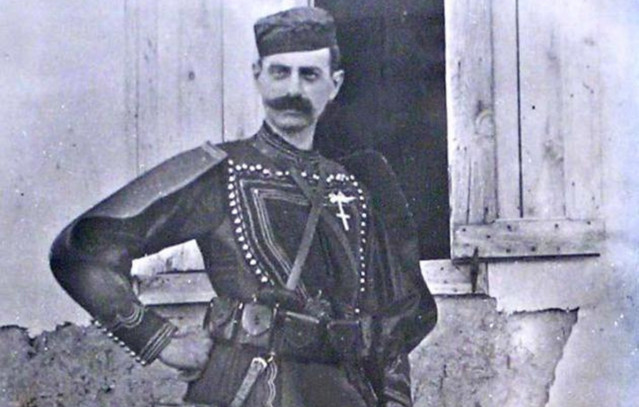
Greek army officer Pavlos Melas secretly crossed the Greco-Turkish border on August 28, 1904, to begin his final mission in Ottoman-ruled Macedonia.
Melas traveled with a unit of roughly 35 men under the assumed name Mikis Zezas. His objective was to coordinate Greek armed groups and resist Bulgarian comitadjis forces operating across the region.
At the start of the 20th century, Macedonia was subject to intense national rivalries among neighboring states and local factions. The Internal Macedonian Revolutionary Organization, known as IMRO, had been established in 1893, and armed Bulgarian comitadjis units emerged several years later.
Greek networks operated in parallel to safeguard local communities connected to the Ecumenical Patriarchate of Constantinople. The territory saw violent confrontations involving forced pressure, political assassinations, and harsh reprisals, while Ottoman imperial troops conducted ongoing operations throughout the area.
Melas had undertaken two exploratory trips to Macedonia earlier in 1904 to assess conditions and establish contacts with local figures. The August expedition marked a shift as he entered the territory as commander of an armed force heading toward the regions of Kastoria and Florina.
Before crossing the frontier from Makrovouni on August 28, Melas wrote a letter to his wife Natalia. Following Holy Communion shortly prior to entry, he stated in his letter that he felt strong, brave, and better, a document later published in Natalia Mela's biographical account of his life.
His campaign lasted under two months. Melas was killed on October 13, 1904, in the village of Statista near Kastoria during a battle with an Ottoman military detachment.
The death of Melas aroused widespread public emotion across Greece. His fallen status prompted an increased commitment of military officers and armed units to the conflict in Macedonia. Today, the village where he died bears the name Melas in his honor.
Key historical events on August 28
Military engagements on August 28 also include the 1826 Battle of Polyaravos during the Greek War of Independence. Fighter forces from the Mani peninsula repulsed troops led by Egyptian commander Ibrahim Pasha, preserving Mani as an independent enclave until the conclusion of the revolution.
Commercial history was made on August 28, 1898, when North Carolina pharmacist Caleb Bradham renamed his soft drink formulation from Brad's Drink to Pepsi-Cola. The rebranding laid the foundation for one of the most recognizable consumer beverage brands in global business.
Diplomatic relations in Southeastern Europe shifted on August 28, 1987, when the Greek government decided to formally lift its state of war with Albania. The decision followed an official proposal by Foreign Minister Karolos Papoulias, paving the way for normalized bilateral ties between the neighboring nations.
In international conflicts, a mortar shell struck the Markale marketplace in Sarajevo on August 28, 1995, causing dozens of civilian deaths and injuries. The bloody incident accelerated political and military decisions that resulted in NATO air strikes against Bosnian Serb military positions.
Royal and sporting milestones also occurred on this date. Prince Charles and Princess Diana finalized their official divorce on August 28, 1996, ending 15 years of marriage. Three years later, on August 28, 1999, Greek athlete Mirella Maniani won the gold medal in the javelin throw with a mark of 67.09 meters at the World Athletics Championships in Seville.
Notable births and deaths on August 28
August 28 marks the birth of several cultural figures. German writer Johann Wolfgang von Goethe was born on August 28, 1749. A foundational figure of European Romanticism, his literary output includes Faust, The Sorrows of Young Werther, and Wilhelm Meister, alongside contributions as a philosopher, scientist, and statesman. American illustrator and writer Jack Kirby was born on August 28, 1917, co-creating major Marvel and DC Comics characters such as Captain America, the Fantastic Four, the Hulk, Thor, the X-Men, and the New Gods.
Filmmaker David Fincher was born on August 28, 1962, earning acclaim for directing psychological cinema including Fight Club, Seven, The Social Network, Zodiac, and Gone Girl. Greek singer Melina Aslanidou was born on August 28, 1974, rising to prominence with the group Chainedes before establishing a solo career with popular songs such as Ola einai dromos, Diko mou stigma, and Ti sou 'kana kai pinis.
Notable deaths on August 28 include Greek dramatist, screenwriter, and film director Alekos Sakellarios in 1991, whose cinematic comedy classics included The Auntie from Chicago, Elias of the 16th, and There is Also Honor. Greek Left politician Leonidas Kyrkos died on August 28, 2011, after a political career that included service in the Democratic Army, imprisonment for his beliefs, election as a member of parliament and European parliamentarian, and leadership of the EAR party and Synaspismos. Fashion designer Michalis Aslanis passed away on August 28, 2013, after shaping Greek prêt-à-porter and haute couture fashion.