

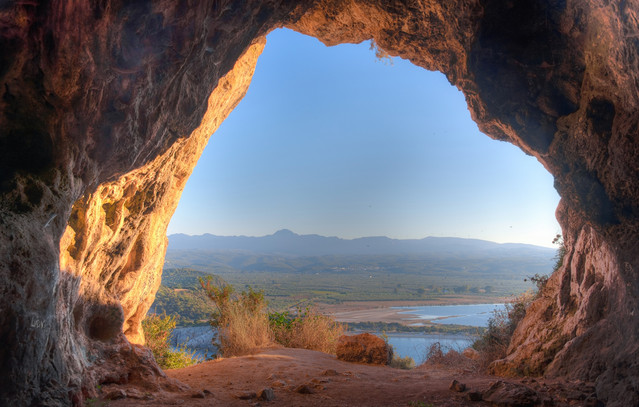
Nestor's Cave, perched above the turquoise waters of Voidokilia beach in Messenia, southern Greece, has become one of the country's most cinematic landmarks after serving as a filming location for Christopher Nolan's adaptation of the Odyssey. In the film, the cave was transformed into the eerie lair of the Cyclops Polyphemus, the setting for one of the movie's most gripping scenes.
The cave has long been associated with Homer's epic. In the poem, it is identified with the palace of the wise King Nestor of Pylos, who is said to have used the vast, sheltered cavern as a stable for his famous herds, giving the site its name. Greek mythology also places another story here: the hiding spot where the god Hermes concealed cattle he stole from Apollo.
The myth of Hermes and Apollo's cattle
According to the myth, Hermes escaped from his cradle on the very day he was born and stole 50 sacred cattle belonging to Apollo in Pieria. To cover his tracks and confuse his pursuers, he forced the animals to walk backwards while fitting his own feet with improvised sandals made from branches. He drove the herd across the Peloponnese before finding the perfect hideout deep inside Nestor's Cave.
There, Hermes hid the animals and sacrificed two of them to the gods, using their intestines to create something entirely new by stretching them across a tortoise shell, inventing the first lyre in history. When Apollo eventually tracked down the thief, he was so enchanted by the instrument's sweet sound that he agreed to give the entire herd to Hermes in exchange for the lyre, sealing their reconciliation at this same evocative site.
How to reach Nestor's Cave
Getting to the cave is a small adventure that rewards every visitor who makes the climb. The most popular route begins at the far end of Voidokilia beach, from where a marked path climbs through the sand dunes toward Palaiokastro. The hike takes roughly 15 to 20 minutes but requires care, since the incline is fairly steep and the ground is covered in loose stones. As visitors approach, the cave's massive triangular entrance appears carved imposingly into the rock face.


