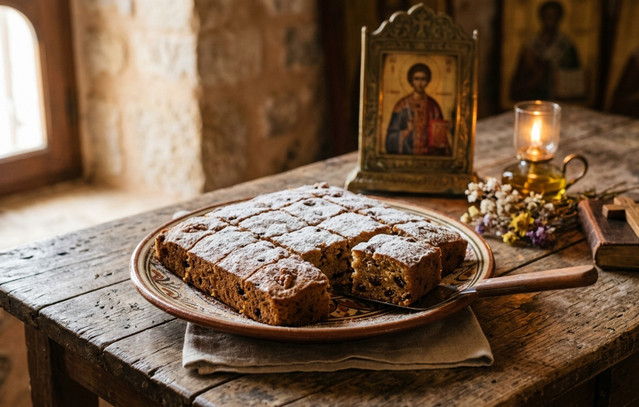
Across Greece, households mark the feast of Saint Fanourios on August 27 by baking fanouropita, a spiced fasting cake carried to church to be blessed before it is shared among worshippers, neighbours and relatives. The tradition goes back generations and is rooted in a votive offering, or tama, rather than a simple dessert.
On the feast day, kitchens fill with the smell of cinnamon, orange and clove as the cakes are prepared. Once blessed at the local church, the fanouropita is cut and distributed, sometimes even to people the baker does not personally know, as a central part of the custom.
Why Greeks Bake Fanouropita for Saint Fanourios
Saint Fanourios is known throughout Greece for his association with lost objects. Someone who has lost something, is searching for a solution, or wants something hidden to be revealed may pledge to bake a fanouropita as a tama.
The custom is tied to popular belief that the saint can help uncover what has been lost. The tradition holds particular significance on the island of Rhodes, where the earliest known veneration of the saint is linked. According to tradition, an icon of the saint was found in the ruins of an old church outside the city walls.
Fanouropita is therefore not regarded as a "magic sweet." It is a vow and an offering: a person asks for help and promises an act of gratitude in return, which becomes a shared occasion once the cake is distributed to others.
The Tradition of the Saint's Mother
One of the most distinctive elements of the custom concerns the saint's mother. In many parts of Greece, the baking of fanouropita is accompanied by the prayer "God forgive the mother of Saint Fanourios." According to a widespread folk tradition, the saint's mother was harsh and did not help the poor. After her death, the saint reportedly wished to help her and asked people to pray for her forgiveness.
There are no reliable sources describing the saint's mother or his family. The story is understood to be a tradition that formed and was preserved through popular religious devotion.
In some regions, the tradition extends beyond the mother to other women in the saint's family circle. The details vary from place to place, reflecting how strongly the story was passed down orally from one generation to the next.
Why the Ingredients Number 7 or 9
If one rule of the custom has endured above all others, it is the use of an odd number of ingredients. Most modern versions of the recipe use 7, 9 or even 11 ingredients, while some traditions simply call for any odd number.
The prevailing interpretations link the number 7 to the days of Creation and the Mysteries of the Church, while 9 is associated with the orders of angels. There is, however, no single church rule that mandates a specific number of ingredients. Fanouropita is primarily a custom of popular religious devotion, and recipes differ significantly from region to region, which is why there is no single "authentic" version of the cake.
The Monastery Recipe
The basic version using the 9 traditional ingredients calls for one glass of olive oil (or sunflower oil), one glass of natural orange juice, one glass of sugar, one teaspoon of baking soda, one teaspoon of cinnamon, half a teaspoon of clove, 500 grams of self-raising flour, half a glass of raisins and half a glass of coarsely chopped walnuts.
The oil and sugar are mixed until combined. The baking soda is then dissolved in the orange juice over the bowl and added to the mixture, followed by the spices, the flour, and finally the raisins and walnuts.
The mixture is baked in a preheated oven at 180 degrees Celsius for about 45 to 50 minutes, until a knife inserted into the centre of the pan comes out clean.
Once baked, the cake is taken to church, where it is read over and blessed before being cut and shared with worshippers, neighbours, relatives and others, continuing the custom that lies at the heart of the offering.