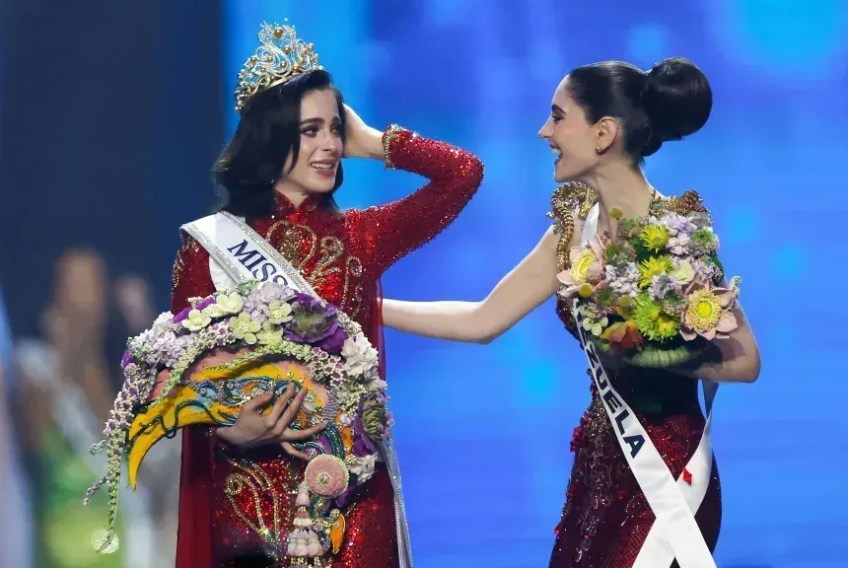
The 75th Miss Universe pageant plunged into fresh turmoil this week, with the final gala beginning Tuesday in Puerto Rico amid visa denials, contestant withdrawals and a judging process organizers have kept secret, according to CNN Brasil and diariolibre.com.
The telecast gala began at the Coliseo de Puerto Rico José Miguel Agrelot, where organizers built a stage production combining Caribbean culture with LED screens and 3D graphics to mark the pageant's 75th anniversary, diariolibre.com reported. Hosts Mario López and Jacqueline Bracamonte led the show, the outlet said. The 116 candidates, who had already appeared at Sunday's preliminary event, performed a choreographed routine before judges revealed the Top 30.
Dominican Republic's representative, Melissa Núñez, was among them; viewers there could follow the gala on Color Visión and Telemundo, according to diariolibre.com.
But according to CNN Brasil, the run-up to the final had already been marred by franchise disputes, a protest withdrawal, the absence of the pageant's co-owners, denied visas and a poorly organized unofficial beach runway event where contestants struggled to walk in heels on sand.
Southeast Asia boycott
Half of Southeast Asia has no representative this year because of a contractual dispute between organizers and businessman Nawat Itsaragrisil, who runs qualifying pageants in Indonesia, Laos, Malaysia, Singapore, Vietnam and his native Thailand, CNN Brasil reported. Itsaragrisil was the same person who triggered last year's walkout, when he criticized eventual winner Fatima Bosch of Mexico in front of other contestants; he later apologized but denied calling her empty-headed.
The feud appears to be fueled by the Miss Universe Organization's ownership structure, which splits control between a seemingly warring Miss Universe East and Miss Universe West, and by a qualification system that licenses national pageants to a select group of local promoters in more than 100 countries, the outlet said.
Contestants from Nepal and five African countries, including first-time entrants South Sudan and the Republic of Congo, were forced to withdraw because of problems obtaining U.S. visas, CNN Brasil reported. Miss France's organizers withdrew their contestant in May in protest at last year's turbulence, much of which centered on former judge Omar Harfouch's allegation that Bosch's win had been arranged in advance and that finalists were picked by an unofficial jury in a secret vote. The Miss Universe Organization has consistently denied the allegations and formed a selection committee that named a new Miss France, who travelled to Puerto Rico for the final.
Judges kept secret
Organizers have done nothing in the past year to rebuild trust in the judging process, CNN Brasil reported. Scoring criteria have always been broad and subjective, with no meaningful information published about how points are assigned or weighted, and independent auditors such as Ernst & Young, who once oversaw voting and delivered results in sealed envelopes onstage, are now completely absent.
Doubts about this year's process have deepened because organizers had not revealed the identity of any final judge as of publication, in contrast to last year, when some judges, including Harfouch, were announced weeks or months ahead of time, the outlet said. Itsaragrisil told CNN by text message that he wished contestants knew who would judge them, how judges were selected, how scores were verified and how conflicts of interest were handled, adding that he hoped his six Southeast Asian representatives who withdrew could compete next year.
Comments under a video posted by beauty pageant analyst Luis Portelles, who urged organizers to reveal this year's jury before the closed-door interview stage, ranged from fresh allegations of a rigged result to calls for a boycott, CNN Brasil reported. One commenter asked whether the contest still mattered.
Lawsuit and ownership turmoil
Former Miss Jamaica Gabrielle Henry has filed a lawsuit against the Miss Universe Organization accusing it of negligence over a head injury she says she suffered after falling from the stage during a preliminary event at the 2025 contest, according to CNN Brasil. The case is ongoing, and the organization did not respond to the outlet's request for comment.
Behind the scenes, the pageant's co-owners face their own legal problems. Anne Jakrajutatip, founder of JKN Global Group, which owns Miss Universe East, was convicted in absentia last year and sentenced to two years in prison over a 30 million baht ($885,000) corporate bond fraud, according to Thai media cited by CNN Brasil. The businesswoman and transgender rights activist did not appear at a Bangkok court in December and is now considered a fugitive.
The Miss Universe Organization, which Jakrajutatip bought for $20 million in 2022, announced in October that she had been replaced as chief executive, CNN Brasil reported. With JKN Global recently placed into bankruptcy reorganization by a Thai court, the company's stake in the pageant is also in question. Itsaragrisil claims he now effectively runs Miss Universe East, though his role is disputed by his Western bloc counterparts.
On the other side of the pageant is Raúl Rocha Cantú, whose Legacy Holding Group owns Miss Universe West. The Mexican businessman was at the center of last year's controversy, accused by Harfouch of manipulating the vote in Bosch's favor because of alleged business ties to her father, an allegation he strongly denied. Rocha Cantú later admitted on a livestream that the fragile passport status of frontrunner Miss Ivory Coast had counted against her, since she would have needed multiple visas to fulfill her international duties as Miss Universe.
Shrinking TV audience
The disarray comes as the pageant's commercial standing keeps shrinking in much of the West, CNN Brasil reported. Once a primetime fixture on network television, the English-language broadcast is now shown only on streaming platforms in the United States. Miss World airs on the Fawesome streaming service, while Miss USA and Miss America are carried on the specialist platforms Queen Beauty Network and PageantVision.
That decline makes the era when Donald Trump owned Miss Universe, from 1996 to the early 2000s before co-owning it with NBC until 2015, look like a golden age, according to Hilary Levey Friedman, a sociologist and author of the book "Here She Is: The Complicated Reign of the Beauty Pageant in America." Friedman told CNN that many of the pageant's problems began after Trump sold Miss Universe and Miss USA, adding that controversies over his ownership, including allegations that he entered dressing rooms while contestants were undressing or changing, only surfaced after he sold the pageants and ran for president; a spokesperson for his 2016 campaign denied the accusations at the time. She added that there used to be far more stability over who owned and ran the contest, and that there has been much more turnover in recent years.
Outdated beauty standards
The commercial struggles reflect wider social change, CNN Brasil reported. In the United States and elsewhere, pageants are increasingly viewed as anachronisms that objectify women and promote a narrow beauty standard. Recent attempts to modernize have done little to change that: the decision to let mothers and married women compete from 2023 only drew attention to the fact they had been barred, and a rule barring women over 28 was repealed only in 2024.
Miss Universe has allowed transgender women to compete since 2013, after beauty queen Jenna Talackova was controversially disqualified from Miss Universe Canada the year before. But Friedman said progress on who can enter has not been matched by who wins: the same body types tend to win, with more diversity in race, ethnicity, sexuality and some gender identities but not in body shape, producing what she called very real psychological problems for contestants. She said competitors can come away thinking they were not thin enough, tall enough or attractive enough, which is especially hard because some of those traits cannot be changed.
The pageant also still stages a swimsuit parade dating to the early 1950s, when it functioned more as a marketing vehicle for a swimwear maker, with contestants judged in bikinis except for some allowed to wear modest burqinis for religious reasons. Rival pageants Miss World and Miss America have replaced their swimsuit rounds with alternatives such as casual athletic wear, though Friedman said the focus there still tends to fall on how a body looks rather than what it does. She added that pageants' influence over beauty standards is likely diminished by their declining relevance compared with their 1950s and '60s heyday, now that women and girls face countless other sources of unrealistic body ideals, from reality television to social media.
Human cost
The spectacle still carries real weight for many contestants and fans, CNN Brasil reported. Saturday's national costume parade saw entrants dressed as a troll (Norway) and a golden frog (Costa Rica), though it was not free of controversy either: Miss Israel was audibly booed after revealing the word "peace," written in three languages, on the cape of her costume.
Watch parties were being held worldwide on Tuesday, including in parts of Africa, Asia and Latin America where pageants remain increasingly popular, CNN Brasil reported. This year's debutantes include Saint Martin and Uganda, while Jordan and Tunisia are competing for the first time since 1960 and 1971, respectively. In the United States, the Spanish-language broadcast of the 2025 final drew 2.6 million viewers on Telemundo, up from 2.1 million the year before, even as the English broadcast's audience keeps shrinking.
Miss Singapore Vion Tan, one of the contestants forced to withdraw, wrote on Instagram that being pulled from the competition affected her more than she could express in words, CNN Brasil reported. She said the journey had never been just about a crown or a competition but about the chance to carry Singapore's name onto an international stage and share her country's culture, stories and the spirit of a small nation with big dreams.
What happens next
Nawat Itsaragrisil said he hopes the six Southeast Asian representatives who withdrew this year will be able to compete next year, and Gabrielle Henry's lawsuit against the Miss Universe Organization remains ongoing.
Test yourself
Why do half of Southeast Asia's countries lack a representative at Miss Universe 2026?
What is Anne Jakrajutatip accused of in the Thai conviction cited by CNN Brasil?
How many candidates took part in Tuesday's gala in Puerto Rico, according to diariolibre.com?
Have your say
Do pageants like Miss Universe still matter to you?
Where it happened
San Juan, Puerto Rico