Swedish actress Ingrid Bergman was born in Stockholm on August 29, 1915, and died in London on August 29, 1982, on her 67th birthday.
Bergman died of cancer while still maintaining an extraordinary level of professional activity, having just completed one of her final major acting projects.
Her life spanned one of the most celebrated careers in cinema history. Over four decades, she won three Academy Awards and worked under renowned film directors including George Cukor, Alfred Hitchcock, Roberto Rossellini, and Ingmar Bergman.
Although she established herself as a major Hollywood star, Bergman famously left the commercial stability of the American studio system to explore freer European cinema. That transition allowed her to move beyond classic studio glamour and undertake increasingly complex dramatic roles across Europe.
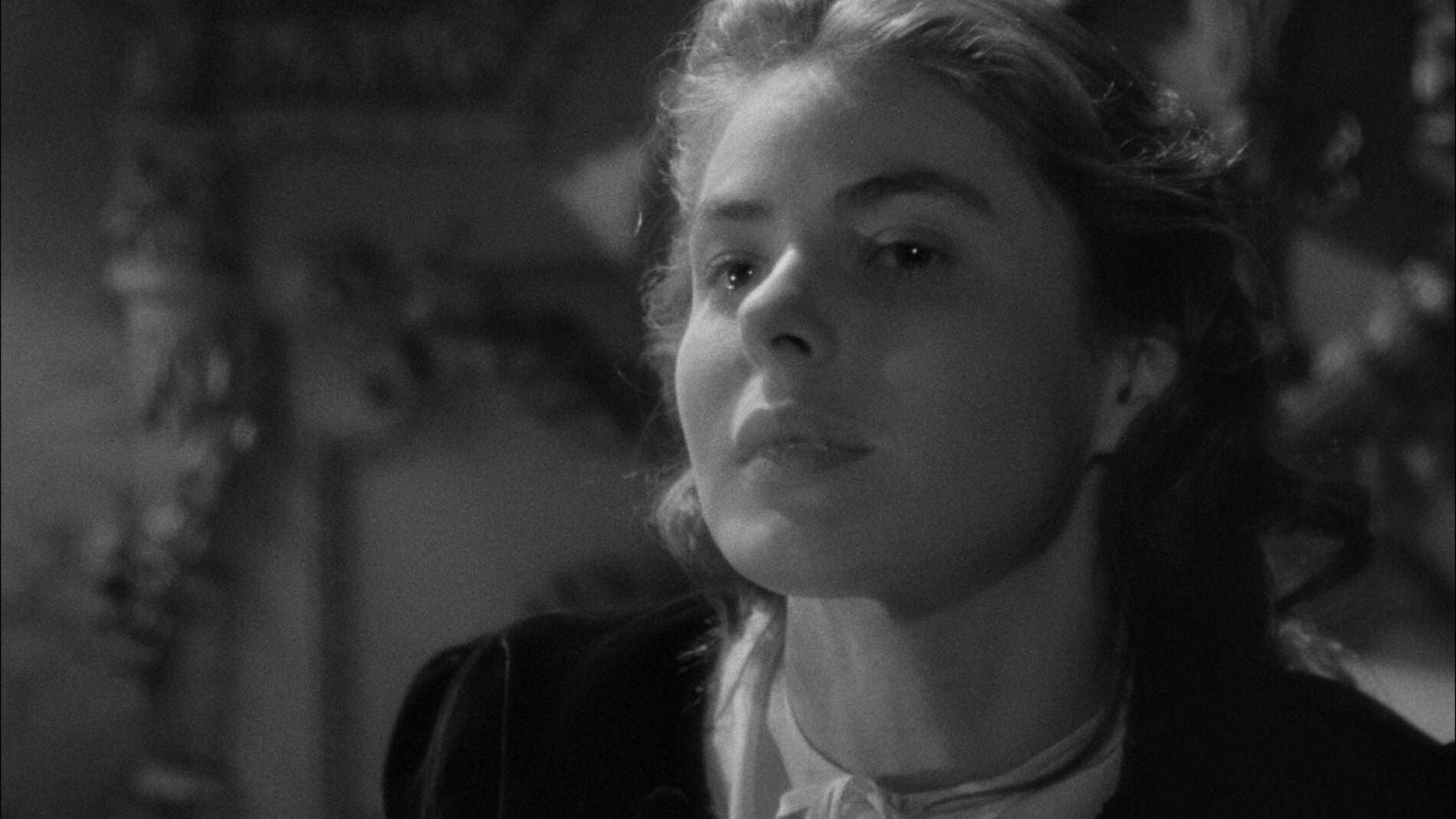
Ilsa Lund in Casablanca
Bergman achieved enduring mythic status in 1942 with her portrayal of Ilsa Lund in Casablanca, directed by Michael Curtiz. Set during World War II in a city that served as a haven for refugees, the film centers on Lund as she unexpectedly reappears in the life of her former lover, Rick Blaine, played by Humphrey Bogart.
Bergman rendered Lund as simultaneously romantic, vulnerable, and determined. Rather than relying solely on dialogue, her expressive gaze conveyed the heartbreak of a love condemned by circumstance, embodying the luminous and elegant screen image that Hollywood built into stardom.
Alicia Huberman in Notorious
Four years after Casablanca, Bergman demonstrated that she could take romantic vulnerability into much darker emotional territory in the 1946 espionage thriller Notorious. Directed by Alfred Hitchcock, the film stars Bergman as Alicia Huberman, a woman haunted by her family past who is recruited for a dangerous undercover assignment.
Trapped between patriotic duty, emotional manipulation, and her love for a government agent played by Cary Grant, Huberman represented one of Bergman's most complex roles. Rather than playing a flawless heroine, Bergman portrayed a flawed woman who drinks, makes errors, experiences fear, and suffers exploitation by those controlling her.
Charlotte Andergast in Autumn Sonata
Thirty-two years after Notorious, Bergman appeared with virtually no trace of her former Hollywood star persona in the 1978 drama Autumn Sonata. Directed by Swedish auteur Ingmar Bergman, who shared no family relation with the actress, the film cast her as Charlotte Andergast, a world-famous pianist reuniting with her estranged daughter.
The role marked Bergman's final major feature film performance and earned her a final Academy Award nomination. Performing opposite Norwegian co-star Liv Ullmann, Bergman stripped away all theatrical artifice, turning a tense family conversation into a devastating emotional confrontation.
Across these landmark performances, Bergman demonstrated three distinct artistic phases: the romantic heroine of Casablanca, the vulnerable spy of Hitchcock, and the mother unable to acknowledge her past mistakes. Though her life began and ended on the same calendar day, her influence on international cinema remains active.