

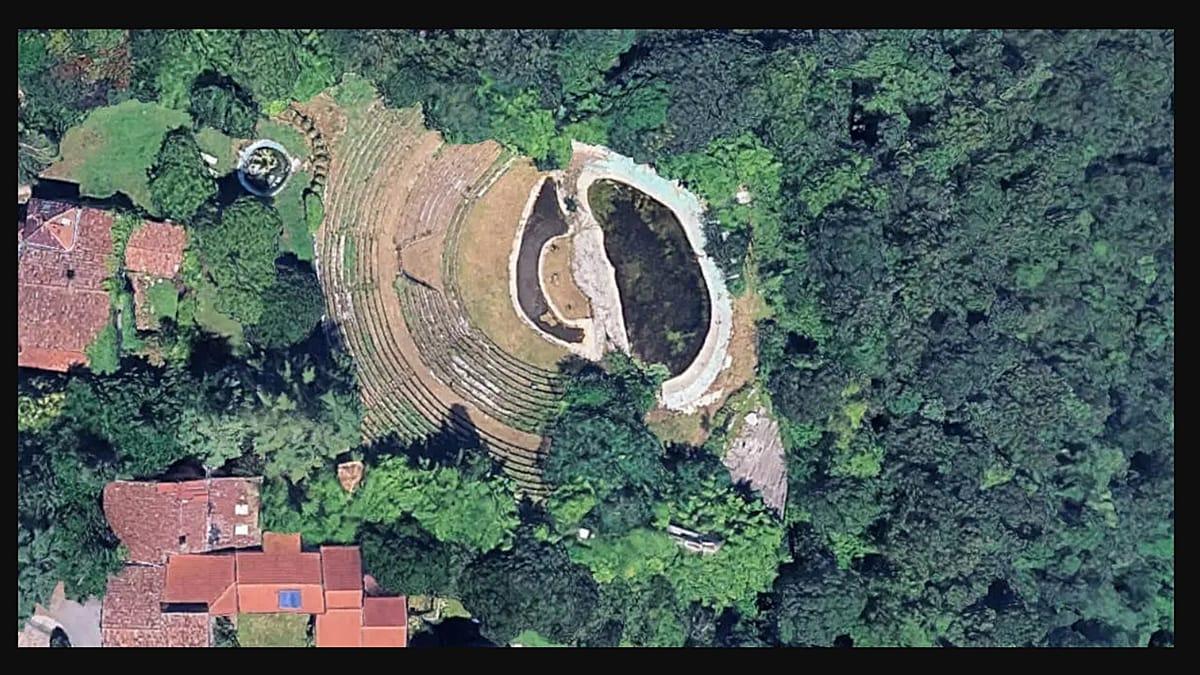
Italian citizen Franco Malosso, also known as Franco Alessandro Molosso Maltarel fon Rozenfrants, has lost his final court appeal over a fake Roman theater he built and advertised to tourists as an ancient landmark from 393 AD. Popular Mechanics reported that Malosso lost his legal challenge following a first trial, an appeal, and a second attempt to overturn his conviction for art forgery and illegal construction.
His sentence of two years and four months in prison remains in force. The court also ordered Malosso to pay fines and restore the site, though he has not yet dismantled the structure. The theater has been under a judicial injunction since 2016 but still stands today.
Investigation and Discovery Claims
The exact date Malosso built the Maritime Amphitheater of Porto degli Angeli Berico remains unknown. Malosso claimed he discovered the site, known as the Berico amphitheater, near the town of Arcugnano in the province of Vicenza in 2005 after a landslide. However, satellite imagery comparisons proved Malosso leveled the hillside to construct the structure, and no evidence exists that a landslide uncovered historical remains.
The attraction operated for several years, offering guided tours that showcased alleged Neolithic, Roman, and Greek artifacts ranging from statues to the theater itself. Reviews indicated that some tourists enjoyed the visits, but visitors were cheated after paying entry tickets costing up to 40 euros. By 2016, Italian authorities intervened, and the Vicenza prosecutor's office opened an investigation into the site.
False Historical Claims and Materials
Investigations revealed that Malosso told tourists the site was built in 393 AD and that Julius Caesar visited it with Cleopatra, a historical impossibility due to timeline discrepancies. He also claimed that Juliet Capulet, a fictional character from William Shakespeare's play Romeo and Juliet, once lived in an ancient church on the property, confusing Vicenza with Verona.
The physical structure was constructed using concrete columns, fiberglass, papier-mache, statues created in the 2000s, and modern building blocks. Workers layered the components with putty and artificially aged them to look old, adding a man-made pond. The site's designation was also inaccurate, as amphitheaters such as the Colosseum are elliptical, whereas semicircular structures like the Berico build are classified simply as theaters.
Many visitors believed they were touring one of the world's oldest and largest amphitheaters, although some recognized the deception. In other tourism news, Italy extended the operating hours of its most famous tourist attractions in August, allowing visitors to tour during cooler evening hours during a heatwave.


