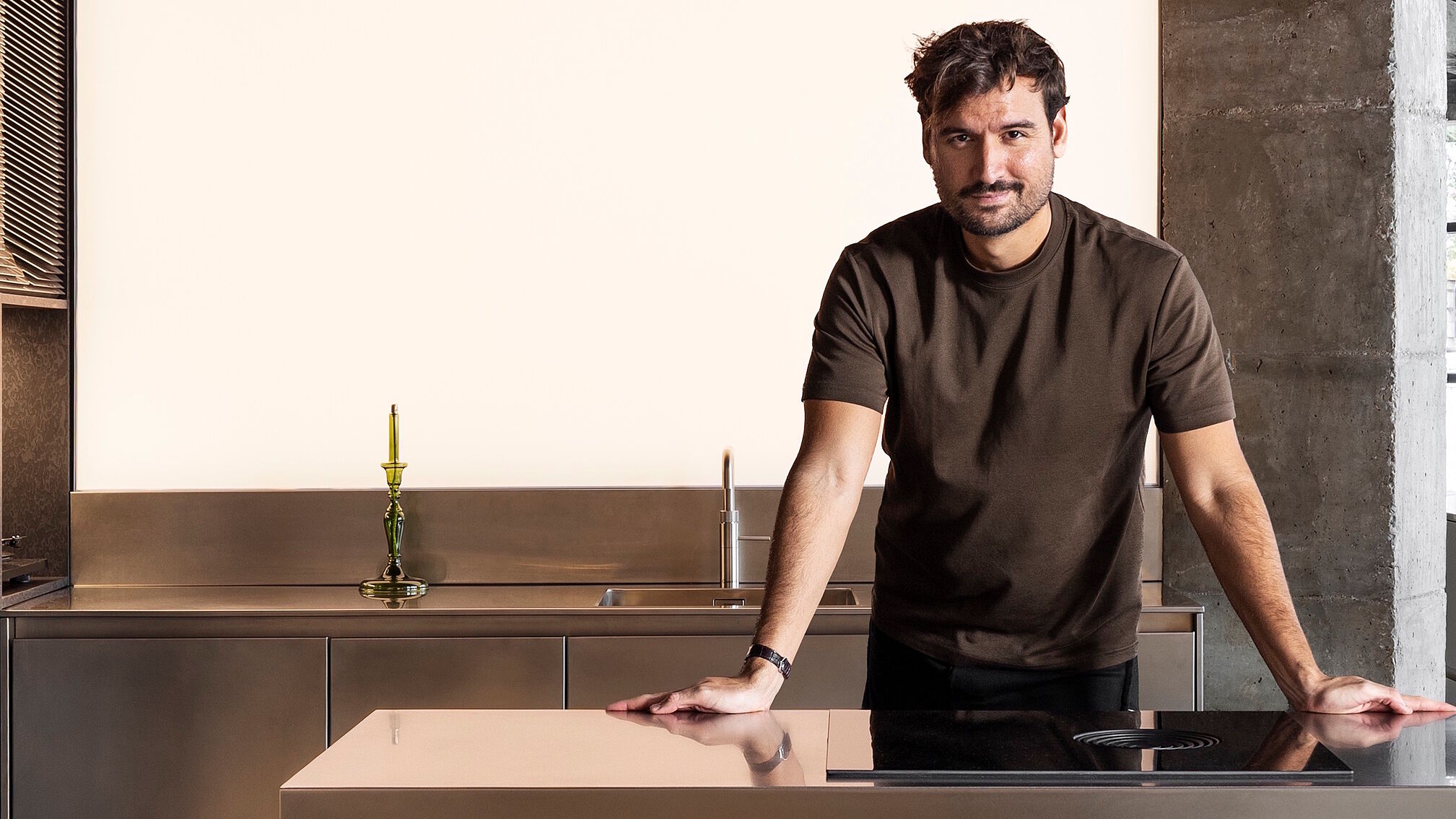
Architect and designer Marcos Trueba has unveiled Domesticidad escenificada, a kitchen design project developed with the Italian brand Moretti that challenges the traditional codes governing kitchen design. Trueba said the starting point was to question the conventional image of a kitchen and think of it instead as a space with its own identity, almost like an independent room within the home, yet fully connected to the life happening around it.
His approach brings together several trends he believes will define contemporary kitchens: fluid spaces, open to the rest of the home, designed to be lived in well beyond the stove. Trueba said design is not simply about solving practical needs but about proposing new ways of inhabiting spaces.
A futuristic vision rooted in the 1990s
For the project, Trueba drew on the collective fascination with the future that marked the 1990s and early 2000s. He said he wanted to recover the vision of the future people held then, when homes were imagined filled with metallic surfaces, integrated technology and almost cinematic atmospheres.
He was careful not to recreate a literal futuristic look, aiming instead for a balance between innovation and warmth. Trueba said the goal was not a futuristic kitchen in the literal sense, but an atmosphere where that technological aesthetic could coexist with a much warmer, more human domesticity.
Steel and petrified wood in dialogue
The project pairs steel with black petrified root wood from the Italian manufacturer ALPI, two materials Trueba said belong to almost opposite worlds. Steel carries an industrial, precise quality tied to technology and the futuristic imagery he wanted to revive, normally associated with professional kitchens but used here in a more architectural, sculptural way.
The ALPI wood introduces a different dimension entirely, he said, with an organic texture and visual richness that contrast with the cold, continuous surface of the metal. Trueba said he is drawn to the tension between contradictory materials, with steel suggesting the future and the wood returning the space to a more domestic, sensory scale.
Looking ahead, he said durability matters more to him than novelty. He is interested in materials that age well, keep their identity over time and gain character through use, naming steel, wood, stone and certain technical materials as likely to remain relevant if used coherently.
Light and music as design elements
Lighting plays a central role in the project. Trueba pointed to a large luminous wall that shifts its intensity and colour temperature according to the rhythms of the day, transforming the atmosphere of the space. He said wellbeing is closely tied to sensory experience, and that architecture influences mood far more than people realise through light, proportions, materials and the way people move through a space.
Music also features prominently, framed around the ritual of vinyl records. Trueba said choosing a record, taking it from its sleeve, placing it on the turntable and listening requires an attention that has been eroded by the immediacy of digital platforms. He called introducing that analogue gesture into a space full of technological and futuristic references one of the contradictions he enjoys exploring.
The kitchen replacing the living room
Trueba said the boundaries between rooms in a home are becoming increasingly blurred. While the living room has traditionally been the home's space for show and the kitchen linked to domestic labour, he said that division is disappearing, noting that in many homes guests end up gathered in the kitchen even when a large living room sits next door.
He said the project aims to push that idea further, creating a kitchen people can spend time in without needing to cook, simply because it is a pleasant place to be.
Technology hidden but present
Technology runs through the design but stays largely out of sight, tucked behind wood panels, with features such as integrated extraction built into the hob to keep the space free of unnecessary elements. Trueba said he does not believe technology must always be concealed, but that its presence should respond to a design intention, with some elements having a beauty of their own and others working better when they disappear visually.
Trueba's vision of the 2050 kitchen
Asked to imagine the kitchen of 2050, Trueba said he struggles to picture it as radically different in form, since the most important changes tend to happen in how people live rather than in extraordinary objects. He expects cooking, extraction, storage and lighting systems to become increasingly built into the architecture itself.
He said the essentials will likely remain similar: a surface to gather around, pleasant materials, good light and a comfortable space. Trueba described the 2050 kitchen as a more flexible place, able to adapt to different forms of cohabitation and incorporate technology almost imperceptibly, while still allowing something as simple as sitting with someone, playing music, opening a bottle of wine and talking for hours.
Test yourself
What is the name of Marcos Trueba's kitchen project with Moretti?
Which two contrasting materials does the project combine?
According to Trueba, what does the luminous wall in the kitchen do?
Have your say
Do you think the kitchen has replaced the living room as the main social space at home?