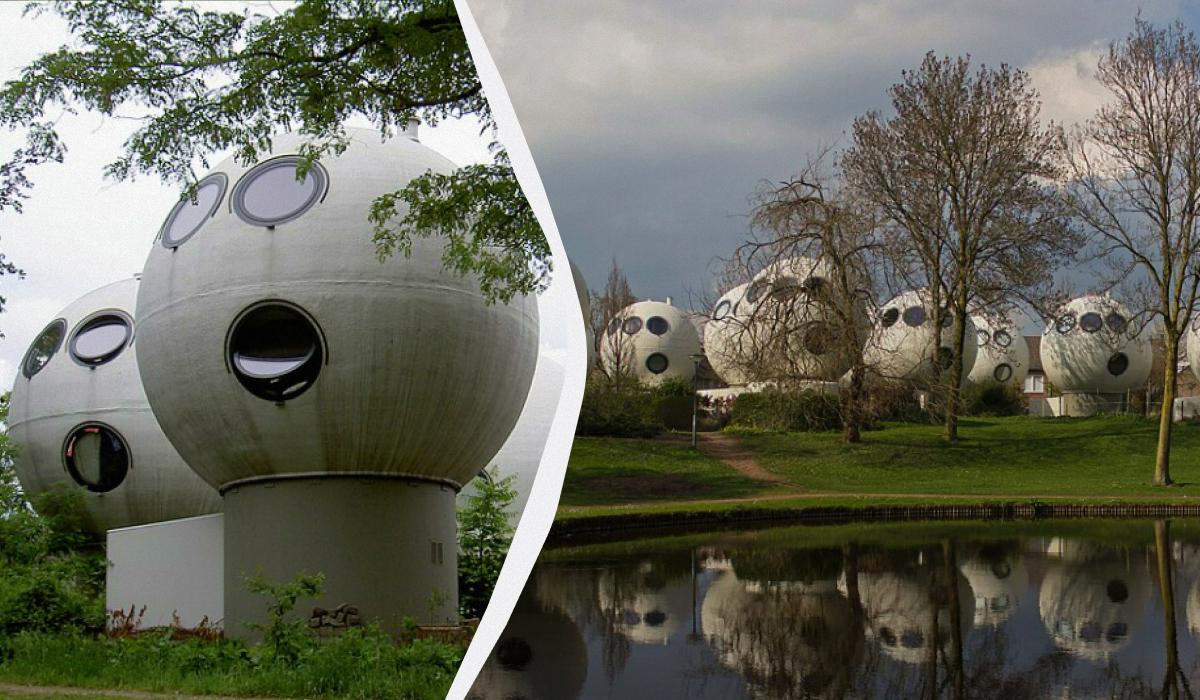
In the Dutch city of 's-Hertogenbosch, 50 round white houses that look like giant golf balls have been lived in for more than 40 years. Built in 1984, the spherical homes sit on concrete bases and are fitted with round windows, and they remain among the most recognisable architectural curiosities in the Netherlands, according to Xataka.
The houses are called Bolwoningen, which translates literally as "ball houses." They were designed by the artist and architect Dries Kreijkamp, who convinced local authorities that a spherical shape could be a cheap and efficient alternative to conventional housing.
A housing shortage sparks experimentation
In the 1960s, the Netherlands was experiencing rapid population and economic growth, which deepened a housing shortage. The country needed to build large numbers of affordable homes quickly, but authorities did not want cities to turn into endless rows of identical housing blocks.
From 1968, the government began subsidising experimental architectural projects. That movement also produced the unusual cube houses built in Rotterdam. It was in this climate that Kreijkamp put forward his own idea, arguing that the future of housing did not have to depend on straight walls and rectangular rooms.
The architect who believed people should live in spheres
Kreijkamp was born in 1937. He worked as a sculptor, industrial designer and architect, and from the 1960s he became fascinated with spherical forms. He drew inspiration from Inuit igloos, African mud huts and his own experience making glass spheres.
Kreijkamp considered rounded shapes more natural for people to live in. He explained his thinking by saying that people live on a sphere and are born from a sphere, so there was no reason they should not live in one too.
He first built a prototype house out of polystyrene foam, then persuaded the city council to commission 50 of the structures. The project was repeatedly delayed, and its feasibility was questioned. It was only completed in 1984 thanks to the persistence of Ton Lensen, a municipal councillor responsible for housing.
A giant golf ball that could be assembled in a day
Each Bolwoning is a sphere 5.5 metres in diameter, mounted on a cylindrical concrete base that houses utility connections and storage space. The spheres were manufactured industrially using steel moulds, built up from layers of fibreglass, glass wool insulation and an outer protective coating.
Each house weighed only 1,250 kilograms. Because the components were prefabricated, the design meant a single house could be assembled in just one day. The round windows were positioned to make the most of natural light, and the insulation and spherical shape were also intended to cut heating costs.
Life inside a sphere had its own quirks
Although each house covered a total area of about 55 square metres, only around 25 square metres were actually usable as living space. The interior was split across several levels linked by a spiral staircase. The bedroom sat on the lowest level, the bathroom in the middle, and a small living room and kitchen at the top, which also received the most natural light.
The curved walls made furnishing difficult: fitting cabinets, hanging pictures and using corners was far harder than in a conventional room. Kreijkamp considered the houses best suited to single people or couples without children, while acknowledging the layout could be awkward for anyone used to traditional living spaces.
Why the experiment was never repeated
Kreijkamp imagined a future in which his spherical houses could be linked together, made mobile, or even adapted to float on water. Those ambitions eventually ran into economic reality.
Despite promises of fast assembly, good insulation and low maintenance costs, manufacturing the spheres proved too complex and expensive to scale up. Funding and interest in building more of them dried up, leaving the original 50 Bolwoningen as a largely unique experiment.
Still a draw for tourists today
What began as an experimental answer to a housing problem has become one of the Netherlands' most recognisable architectural curiosities. All 50 houses stand together next to a canal, linked by footpaths and surrounded by greenery.
Tourists continue to travel to 's-Hertogenbosch to photograph the spheres, which stand out sharply against the city's otherwise conventional streets.
Test yourself
In which Dutch city were the Bolwoningen built?
How many spherical houses were built in the project?
What is the diameter of each sphere?
Have your say
Would you want to live in a spherical house like the Bolwoningen?
Where it happened
's-Hertogenbosch, Netherlands